

Introduction
Artificial Intelligence is transforming the way people search for information and interact with technology. Modern AI chatbots can answer questions, generate content, and assist users with different tasks. However, traditional Large Language Models (LLMs) sometimes provide outdated, incorrect, or incomplete information.
To overcome these limitations, Retrieval-Augmented Generation (RAG) is an effective approach. It combines information retrieval with generative AI to produce more accurate, relevant, and context-aware responses.
What is Retrieval-Augmented Generation (RAG)?
Retrieval-Augmented Generation (RAG) is an AI architecture that connects a Large Language Model with an external knowledge source. Instead of depending only on information learned during training, the system retrieves relevant information from documents or databases before generating an answer.
For example, imagine a student asking a chatbot about a particular university subject. A traditional chatbot may provide a general answer. A RAG-based chatbot can search uploaded study materials, retrieve the most relevant information, and generate an answer based on those materials.
This makes RAG useful for building intelligent question-answering systems.
How Does a RAG System Work?
A RAG system generally follows these five important steps:
1. Document Collection
The first step is collecting information from different sources, such as PDF files, Word documents, text files, and other knowledge resources.
2. Text Extraction and Chunking
The collected documents are converted into text. Large documents are divided into smaller sections called chunks. Chunking makes it easier to retrieve specific information.
3. Embedding Generation
Each text chunk is converted into a numerical representation called an embedding. These embeddings help the system understand the semantic meaning of the text.
4. Information Retrieval
When a user asks a question, the system converts the query into an embedding and searches for similar information in a vector database. The most relevant chunks are retrieved.
5. Response Generation
Finally, the retrieved information is provided to the Large Language Model along with the user’s question. The model generates a relevant response using the retrieved context.
Architecture and Components of RAG
A typical RAG architecture contains the following components:
- Knowledge Base: Stores documents and information.
- Document Processor: Extracts text and divides documents into chunks.
- Embedding Model: Converts text into numerical vectors.
- Vector Database: Stores and searches vector embeddings.
- Retriever: Finds relevant information based on the user’s query.
- Large Language Model: Generates natural language responses.
- User Interface: Allows users to interact with the chatbot.
These components work together to provide accurate and context-aware answers.
Technologies Used in RAG Development
Several technologies can be used to develop a RAG application:
- Python: Used for backend development and AI integration.
- LangChain: Helps connect language models, retrievers, and document sources.
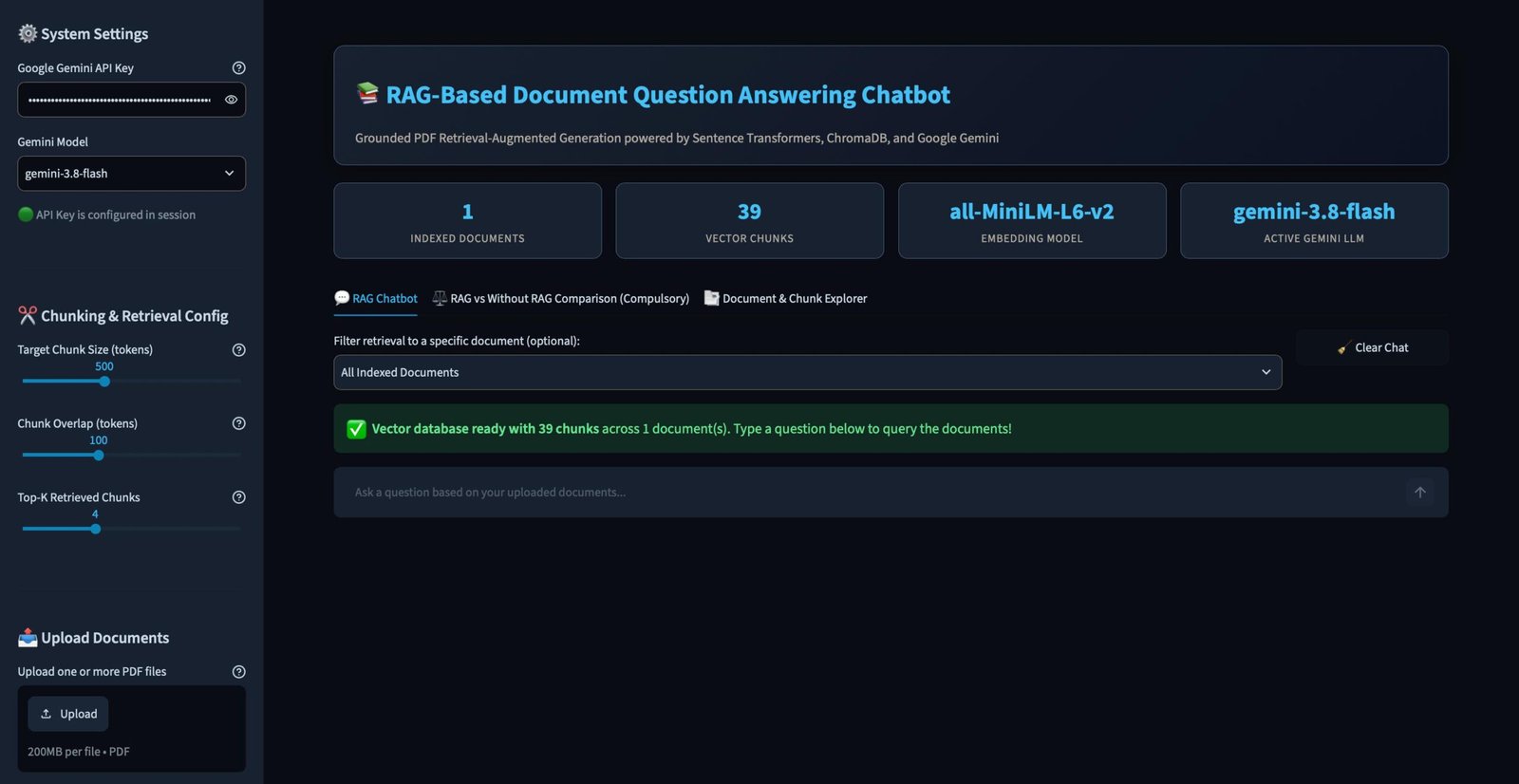
- FAISS / ChromaDB: Used for vector storage and similarity search.
- OpenAI / Google Gemini: Provides Large Language Model capabilities.
- Streamlit / Flask: Used to build user interfaces and backend applications.
- Sentence Transformers: Used to generate text embeddings.
The selection of technologies depends on the requirements and complexity of the application.
Real-World Applications of RAG
RAG technology is useful across many industries.
Education: Students can ask questions based on study materials and receive relevant explanations.
Healthcare: Healthcare information systems can retrieve relevant information from approved medical documents.
Customer Support: Businesses can build chatbots that answer customer questions using company documentation.
Banking: Financial institutions can retrieve information from internal documents and policy resources.
Enterprise Knowledge Management: Employees can search large collections of company documents using natural language questions.
Benefits of Retrieval-Augmented Generation
RAG provides several advantages:
- Improved Accuracy: Responses are generated using relevant retrieved information.
- Updated Information: External knowledge sources can be updated without retraining the entire language model.
- Reduced Hallucinations: Providing relevant context can reduce incorrect or unsupported answers.
- Cost Efficiency: Updating documents is often easier than retraining a large language model.
- Domain-Specific Responses: RAG can work with specialized knowledge bases.
However, RAG systems still depend on the quality of documents, retrieval accuracy, and language model performance. Incorrect or irrelevant retrieved information can affect the final response.
Conclusion
Retrieval-Augmented Generation is an important development in modern Artificial Intelligence. By combining information retrieval with Large Language Models, RAG makes it possible to build intelligent applications that provide more relevant and context-aware responses.
As Generative AI continues to grow, RAG will play an important role in education, business, healthcare, customer support, and enterprise applications. Learning how to develop RAG-based applications is a valuable step toward building practical AI solutions.
Author: Lohith Mallimpalli
Field: Computer Science Engineering | Artificial Intelligence and Machine Learning

Leave a Reply
You must be logged in to post a comment.