
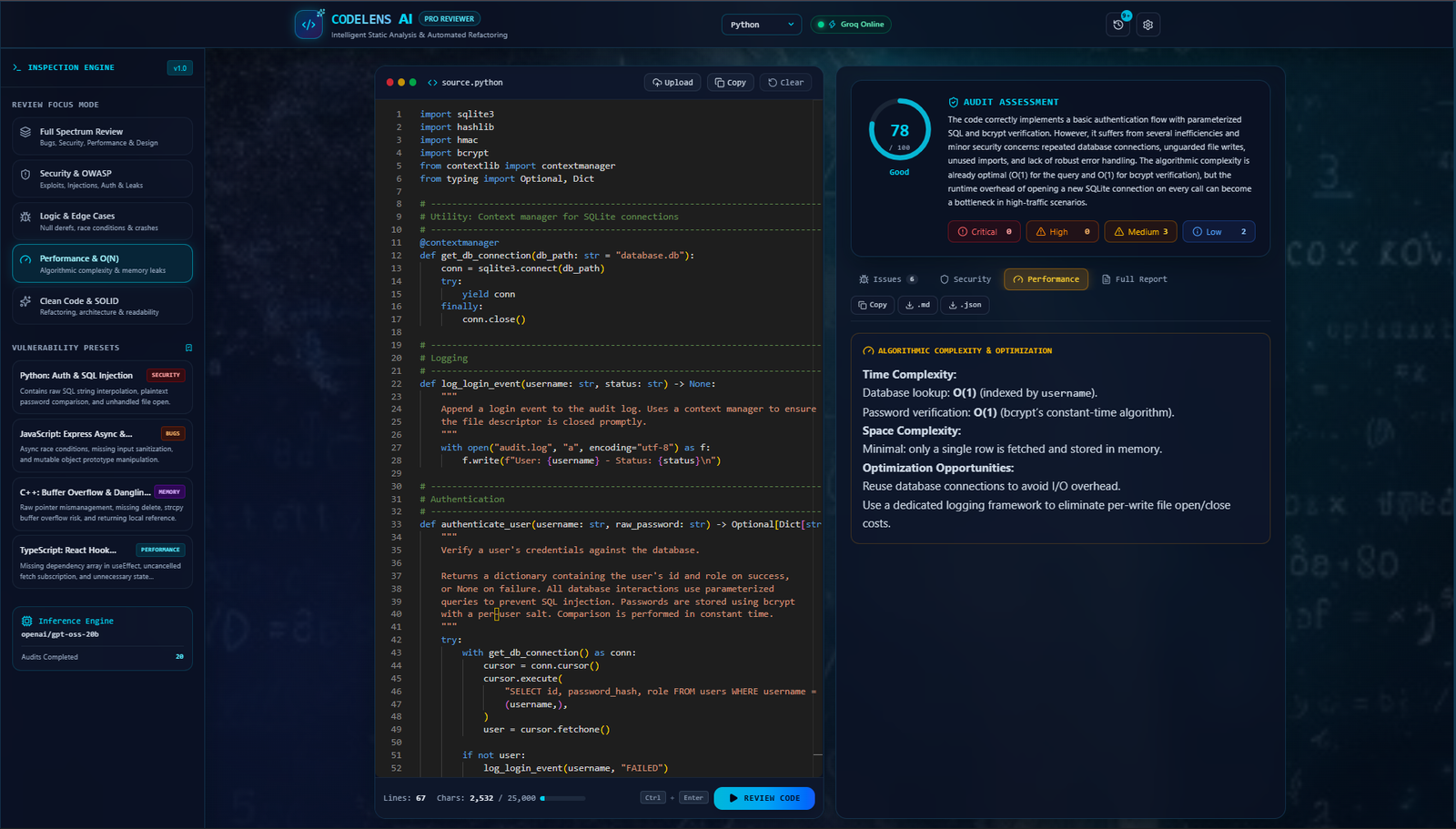

Distinctive, technical, and intriguing. It communicates that your application goes beyond simply checking syntax.
Introduction: Rethinking the Code Review Process
Writing code is only one part of software development. Understanding its quality, identifying potential vulnerabilities, improving performance, and maintaining readability are equally important.
Traditional code reviews often require developers to examine source code line by line, identify possible issues, and determine how to improve their implementation. While this process is essential, it can become time-consuming, particularly when working with complex codebases.
This raised an interesting question:
What if developers could use Generative AI to make code analysis more accessible, interactive, and insightful?
Exploring this idea led to the development of CodeLens AI, an AI-powered code review web application built as part of my internship at Valentius Kryptix.
The objective was to combine Large Language Models with a modern web interface to create a tool that analyses code, highlights potential problems, and provides actionable suggestions for improvement.
Introducing CodeLens AI
CodeLens AI is an AI-powered code review assistant designed to help developers examine their code from multiple perspectives.
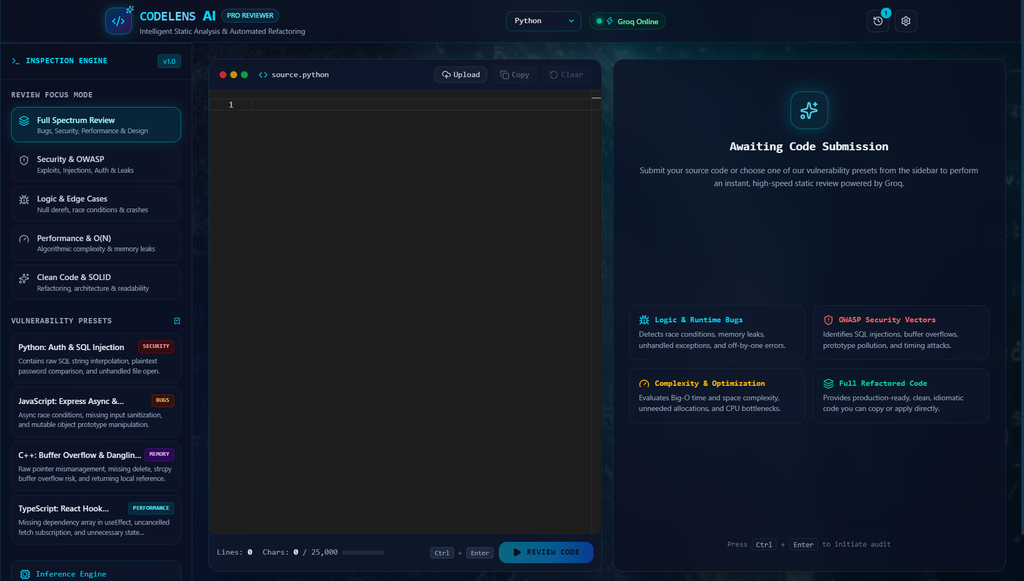
Users can write or upload source code, select a programming language, and request an AI-powered review. The application processes the submitted code through a Large Language Model and presents the resulting analysis in a structured format.
Rather than simply identifying errors, the application aims to provide context around potential issues and suggest ways to improve the implementation.
The Technology Behind the Application
Building CodeLens AI involved bringing together several technologies, each serving a specific purpose.
| Technology | Purpose |
|---|---|
| Next.js | Application framework and backend API routes |
| React | Interactive user interface |
| TypeScript | Type-safe application development |
| Tailwind CSS | Responsive styling and layout |
| Groq API | Large Language Model integration |
| Monaco Editor | Interactive source-code editing |
| Vercel | Application deployment |
The combination of these technologies provided a foundation for building an interactive AI application with both frontend and backend functionality.
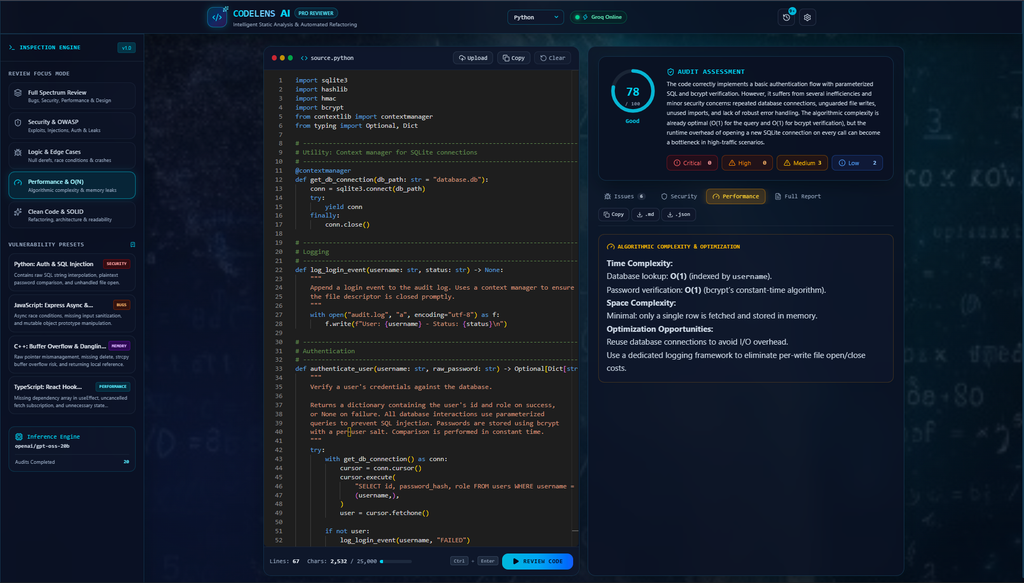
Core Capabilities and Implementation
1. Intelligent Code Analysis
The central component of CodeLens AI is its integration with a Large Language Model through the Groq API.
When a user submits code, the application sends the relevant input to its backend, where the model processes the request and generates a structured review.
The analysis can highlight potential bugs, questionable coding practices, and areas that may benefit from improvement.
The goal is to make code-review feedback easier to understand and act upon.
2. Security-Oriented Code Review
Software security is an important part of writing reliable applications.
CodeLens AI includes a security-focused review that can identify potentially unsafe coding patterns, including injection risks and insecure handling of sensitive information.
It also presents security-related observations to help developers understand where additional attention may be required.
Importantly, AI-generated findings should be treated as review suggestions that require developer verification, rather than definitive security guarantees.
3. Performance and Code Quality Insights
Code quality involves more than whether a program executes successfully.
The application also examines aspects such as code readability, efficiency, complexity, and maintainability.
Based on its analysis, it provides suggestions that may help developers improve their implementation and adopt cleaner coding practices.
4. AI-Generated Code Refactoring
One of the most practical capabilities is the generation of suggested refactored code.
After analysing the original implementation, the model can propose an alternative version with improvements and explanations.
Users can inspect the suggested changes and apply the refactored code directly within the editor.
This connects AI-generated feedback with an actual development workflow instead of limiting the experience to a simple text-based response.
5. Interactive Development Environment
CodeLens AI integrates Monaco Editor to provide an interactive coding environment.
Users can write, edit, upload, and review code without leaving the application.
The interface also includes language selection, editing controls, and a dedicated area for presenting review results.
6. Responsive User Experience
An AI application should remain accessible across different devices.
The interface was designed to adapt to mobile phones, tablets, and desktop screens.
This involved implementing mobile navigation, responsive editor dimensions, adaptable review panels, and touch-friendly controls while retaining the desktop experience.
Engineering Behind the Experience
An important part of this project was understanding how the different application layers communicate.
The frontend collects the source code and review preferences. A server-side API route validates the request and communicates with the Groq API. The generated response is then streamed back to the interface and presented to the user.
This architecture helped separate the user interface from the external AI integration.
Additional implementation considerations included:
- Streaming responses: Displaying AI-generated output progressively instead of requiring users to wait for the entire response.
- Input validation: Handling requests appropriately before sending them to the model.
- Error handling: Providing meaningful feedback when an API request fails.
- API key security: Keeping sensitive credentials on the server side through environment variables.
- Deployment: Making the application accessible through a public Vercel deployment.
These details were important in moving the application beyond a basic demonstration and towards a usable web-based tool.
Challenges That Shaped the Development
The development process also involved several practical challenges.
Model compatibility and API integration
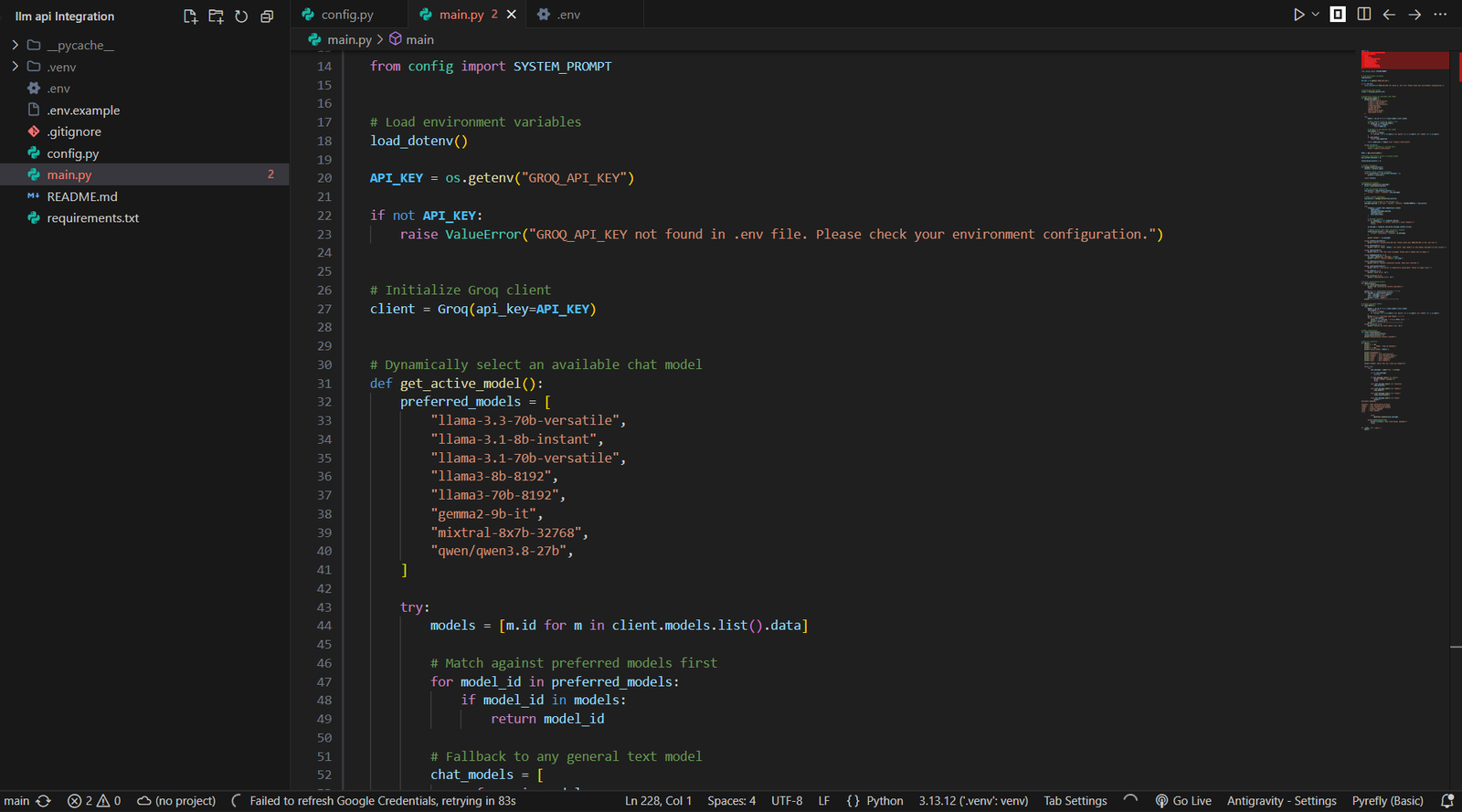
Working with external LLM services required understanding model availability, API configurations, and response formats. Resolving model compatibility issues helped strengthen my understanding of integrating third-party AI services.
Handling AI-generated responses
Generating useful feedback required attention to request structure, prompting, response formatting, and streaming behaviour.
Designing an effective interface
Presenting detailed code-review results without overwhelming the user required careful consideration of layout, navigation, and information organization.
Cross-device responsiveness
Adapting a feature-rich development interface to smaller screens required changes to navigation, editor sizing, component layouts, and scrolling behaviour.
Working through these challenges provided practical insight into the engineering considerations involved in building AI-powered applications.
Key Technical Takeaways
This project strengthened my understanding of several areas of AI and software development.
1. Practical LLM Integration
I gained experience connecting a Large Language Model to a real web application, structuring prompts, managing requests, and processing AI-generated responses.
2. Full-Stack Application Architecture
Working with Next.js, React, TypeScript, and server-side API routes improved my understanding of how frontend and backend components work together.
3. Building for Real-World Usability
Streaming responses, validation, error handling, API security, and responsive design demonstrated why reliable application development requires more than implementing the core AI functionality.
Final Thoughts
CodeLens AI represents an exploration of how Generative AI can support everyday software development activities.
The most valuable part of building this application was understanding the relationship between an AI model and the software surrounding it. A model may generate intelligent suggestions, but delivering a useful experience also depends on application architecture, secure API integration, response handling, and thoughtful interface design.
Through this project, I had the opportunity to turn concepts involving Large Language Models and modern web development into a working, publicly accessible application.
I am grateful to Valentius Kryptix for the opportunity to explore, experiment, and strengthen my practical skills in AI application development.
For me, this project is another step towards building more intelligent, useful, and reliable AI-powered solutions.
Explore the project:
- Live Application: https://codelens-ai-nu.vercel.app/
- Source Code: https://github.com/kirrathana/CODELENS-AI
#GenerativeAI #ArtificialIntelligence #LLM #CodeReview #NextJS #ReactJS #TypeScript #GroqAPI #WebDevelopment #AIProjects #Internship #ValentiusKryptix

Leave a Reply
You must be logged in to post a comment.