

Introduction
Generative Artificial Intelligence (GenAI) is transforming the way people access information, solve problems, and interact with technology. Large Language Models (LLMs) can generate human-like responses, summarize information, and answer questions. However, they can sometimes produce incorrect information or struggle to answer questions about private documents and specific knowledge sources.
To address these challenges, Retrieval-Augmented Generation (RAG) provides a practical approach to building more context-aware AI applications. In this article, I explain the fundamentals of RAG, how it works, its advantages, and its real-world applications.
What Is Retrieval-Augmented Generation (RAG)?
Retrieval-Augmented Generation, commonly known as RAG, is an AI architecture that combines information retrieval with text generation. Instead of relying only on the information learned during model training, a RAG system retrieves relevant information from an external knowledge source and provides it to a Large Language Model (LLM) to generate an answer.
For example, imagine an employee asking an AI assistant, “What is our company’s leave policy?” A general-purpose language model may not know the company’s internal rules. A RAG system can retrieve the relevant policy document and use its contents to answer the question.
This approach helps AI applications provide responses grounded in relevant source material.
How Does a Retrieval-Augmented Generation System Work?
A typical RAG system follows several important steps.
1. Document Ingestion
The process begins by collecting information from sources such as PDF files, text documents, knowledge bases, or other supported data sources. The system extracts the available text so that it can be processed.
2. Text Chunking
Large documents are divided into smaller sections called chunks. Chunking helps the retrieval system identify specific passages related to a user’s question rather than processing an entire document at once.
The size and overlap of chunks can influence retrieval quality.
3. Embeddings and Vector Storage
Each text chunk can be converted into a numerical representation called an embedding. Embeddings help represent the semantic meaning of text.
These vectors are stored in a vector database or another suitable search index, alongside useful metadata such as document names and page numbers.
4. User Query
When a user submits a question, the system processes the query and searches for relevant chunks from the available knowledge source.
5. Retrieval
The retrieval component identifies passages that are semantically or otherwise relevant to the question. Depending on the implementation, this may involve vector search, keyword search, metadata filtering, or a combination of techniques.
6. Context-Augmented Generation
The retrieved passages are included in the prompt sent to the LLM. The model uses this context to formulate an answer that addresses the user’s question.
7. Response and Source References
The application returns the generated answer. When source metadata is available and correctly preserved, the application can also show references to the original documents or pages so users can verify the information.
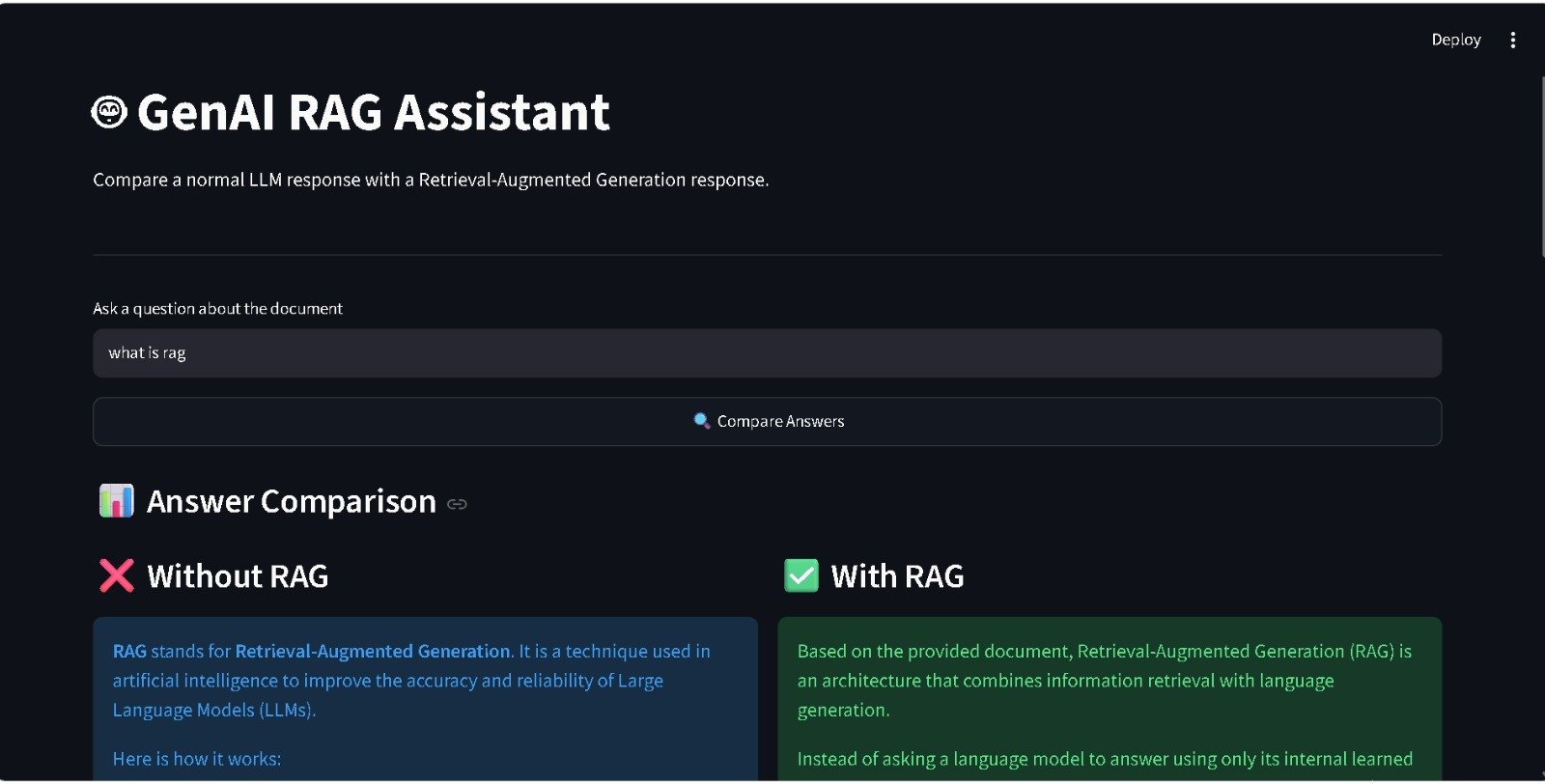
RAG Without Retrieval vs. RAG With Retrieval
A language model answering a question without retrieval relies on its existing learned knowledge and the context provided in the prompt. It may not have access to current or private information.
With RAG, the application first retrieves relevant information from an external knowledge source and supplies it to the model.
For example, if a user asks, “What does the company policy say about annual leave?”, a model without access to the policy might provide a generic explanation. A RAG-enabled assistant can retrieve the relevant policy passage and generate an answer based on that content.
RAG can improve relevance and make responses easier to verify, but it does not guarantee accuracy. Results still depend on the quality of the documents, retrieval process, prompt, and generated response.
Key Benefits of Retrieval-Augmented Generation
1. Access to external knowledge: RAG applications can use information that is not part of the model’s original training data, provided that the information is available in the connected sources.
2. Improved contextual relevance: Retrieved passages help the model answer questions using information related to the user’s specific request.
3. Easier knowledge updates: In many implementations, updating the knowledge source and its search index is sufficient to make new information retrievable without retraining the entire language model.
4. Source traceability: When retrieval metadata is retained, applications can display document names, page references, or links to support verification.
5. Flexible applications: The same architecture can support document assistants, internal knowledge search, customer support, and research tools.
Real-World Applications of RAG
RAG has practical applications across multiple industries.
- Education: Students can ask questions about textbooks, study materials, and lecture notes.
- Healthcare information systems: Authorized users can search approved medical documents and guidelines, with appropriate privacy controls and professional oversight.
- Customer support: AI assistants can retrieve relevant information from product manuals, FAQs, and support documentation.
- Enterprise knowledge management: Employees can search company policies, technical documentation, and internal knowledge bases.
- Research and analysis: Users can retrieve relevant passages from collections of papers, reports, and other documents.
These examples demonstrate how retrieval can connect language models with domain-specific knowledge.
Challenges and Limitations
Although RAG is useful, it introduces several challenges. Poor document extraction, inappropriate chunk sizes, irrelevant retrieval results, and missing context can lead to incorrect answers.
Large document collections may also require careful indexing, access control, and performance optimization. Sensitive documents must only be retrieved for users who are authorized to access them.
Furthermore, a language model may still misinterpret retrieved passages or generate unsupported claims. Effective evaluation, source verification, appropriate prompts, and clear handling of unanswered questions are important parts of a reliable RAG application.
My Learning Experience and Conclusion
Working on a RAG System project has helped me explore how information retrieval and Large Language Models can work together to build practical AI applications. It has strengthened my understanding of the relationship between document processing, embeddings, retrieval, contextual prompting, and response generation.
One important lesson is that building a useful AI application requires more than connecting a language model to a user interface. The quality of the knowledge source, retrieval strategy, and generated answer all contribute to the overall experience.
Retrieval-Augmented Generation is an important approach for developing AI systems that work with specialized and frequently updated information. As Generative AI continues to evolve, RAG will remain a valuable technique for connecting language models with relevant external knowledge.
I look forward to continuing to learn, experiment, and build AI applications that solve real-world problems.

Leave a Reply
You must be logged in to post a comment.