


Introduction
CNN for Image Classification is an important application of deep learning that enables computers to recognize and classify objects in images. In this project, we build a Convolutional Neural Network (CNN) using PyTorch to classify images from the CIFAR-10 dataset. We will explore the model architecture, training process, data augmentation, and performance evaluation.
As part of my internship at Valentius Kryptix, I worked on a project titled “CNN for Image Classification.” The main objective was to understand how Convolutional Neural Networks (CNNs) work and use them to classify images from the CIFAR-10 dataset.
For this project, I developed CIFARVision, a deep learning project implemented using Python and PyTorch. Through this work, I explored CNN architecture, image preprocessing, data augmentation, model training, and performance evaluation.
Understanding Convolutional Neural Networks
A Convolutional Neural Network is a deep learning model designed to process visual data, especially images. Unlike traditional machine learning approaches that often require manually designed features, CNNs can learn useful image features directly from training data.
CNNs identify patterns at different levels. Early layers may learn simple features such as edges and textures, while deeper layers can learn more complex patterns that help distinguish different objects.
A typical CNN architecture contains several important components:
- Convolutional Layers: Extract visual features from images using learnable filters.
- Activation Functions: ReLU introduces non-linearity, helping the model learn complex relationships.
- Pooling Layers: Reduce spatial dimensions and computational requirements.
- Batch Normalization: Helps stabilize and improve the training process.
- Dropout: Reduces overfitting by randomly disabling some activations during training.
- Fully Connected Layers: Use the learned features to produce class predictions.
Combining these components allows CNNs to learn meaningful representations and perform image classification effectively.
Understanding the CIFAR-10 Dataset
The CIFAR-10 dataset is a widely used benchmark for image classification research and educational projects. It contains 60,000 colour images, each measuring 32 × 32 pixels.
The dataset contains ten classes:
- Airplane
- Automobile
- Bird
- Cat
- Deer
- Dog
- Frog
- Horse
- Ship
- Truck
It includes 50,000 training images and 10,000 test images. In my project, I divided the original training data into 45,000 training images and 5,000 validation images, keeping the separate 10,000-image test set for final evaluation.
This division allowed me to monitor the model during training while reserving independent test data for performance evaluation.
Tools and Technologies Used
I used Python as the programming language and PyTorch to implement and train the CNN model.
The main technologies included:
- Python: For implementing the complete workflow.
- PyTorch: For building the CNN architecture and training the model.
- NumPy: For numerical operations and data handling.
- Matplotlib: For plotting training curves and visualizing results.
- Scikit-learn: For evaluating classification performance and generating a confusion matrix.
These tools provided a practical environment for implementing deep learning techniques and analyzing model performance.
Building the CNN Architecture
The CNN model was designed with multiple convolutional layers to extract image features progressively. ReLU activation functions introduced non-linearity, while max-pooling layers reduced the spatial dimensions of the feature maps.
Batch normalization was included to help stabilize training, and dropout was used to reduce overfitting. The final classification layer produced scores for the ten CIFAR-10 classes.
The model was trained using the cross-entropy loss function, which is commonly used for multiclass classification. The Adam optimizer updated the model parameters during training to minimize the loss.
During training, I monitored training and validation accuracy and loss to understand how the model learned and whether it generalized well to unseen data.
Improving Generalization with Data Augmentation
One of the important parts of this project was exploring data augmentation.
Data augmentation creates modified versions of training images to help a model learn more robust features. Instead of relying only on the original images, the model is exposed to slightly different versions of the same examples.
I used two basic augmentation techniques:
Random Horizontal Flipping: This technique randomly flips an image horizontally, helping the model learn from different orientations when the transformation is appropriate.
Random Cropping: This technique crops a region from an image, with padding used to allow small variations in the visible image area.
These transformations were applied to training images, while validation and test images were evaluated without random augmentation. This helped maintain a consistent evaluation process.
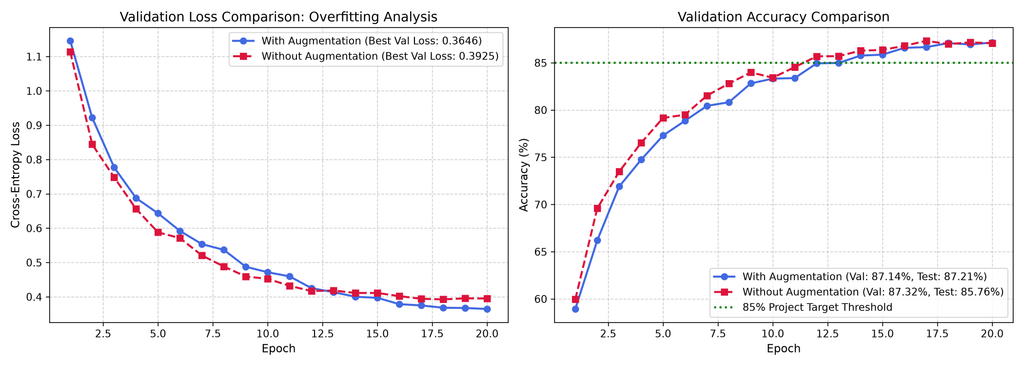
I then compared the baseline CNN with the augmented CNN to investigate how data augmentation affected model performance.
Model Training and Evaluation
Evaluating a model requires more than checking its training accuracy. A model may perform well on training data but struggle with unseen images if it overfits.
To analyze performance, I used several evaluation techniques:
- Accuracy: Measures the proportion of correctly classified images.
- Training and Validation Curves: Show how accuracy and loss change across epochs.
- Confusion Matrix: Shows which classes are correctly classified and which classes are confused with one another.
- Classification Report: Provides precision, recall, and F1-score for each class.
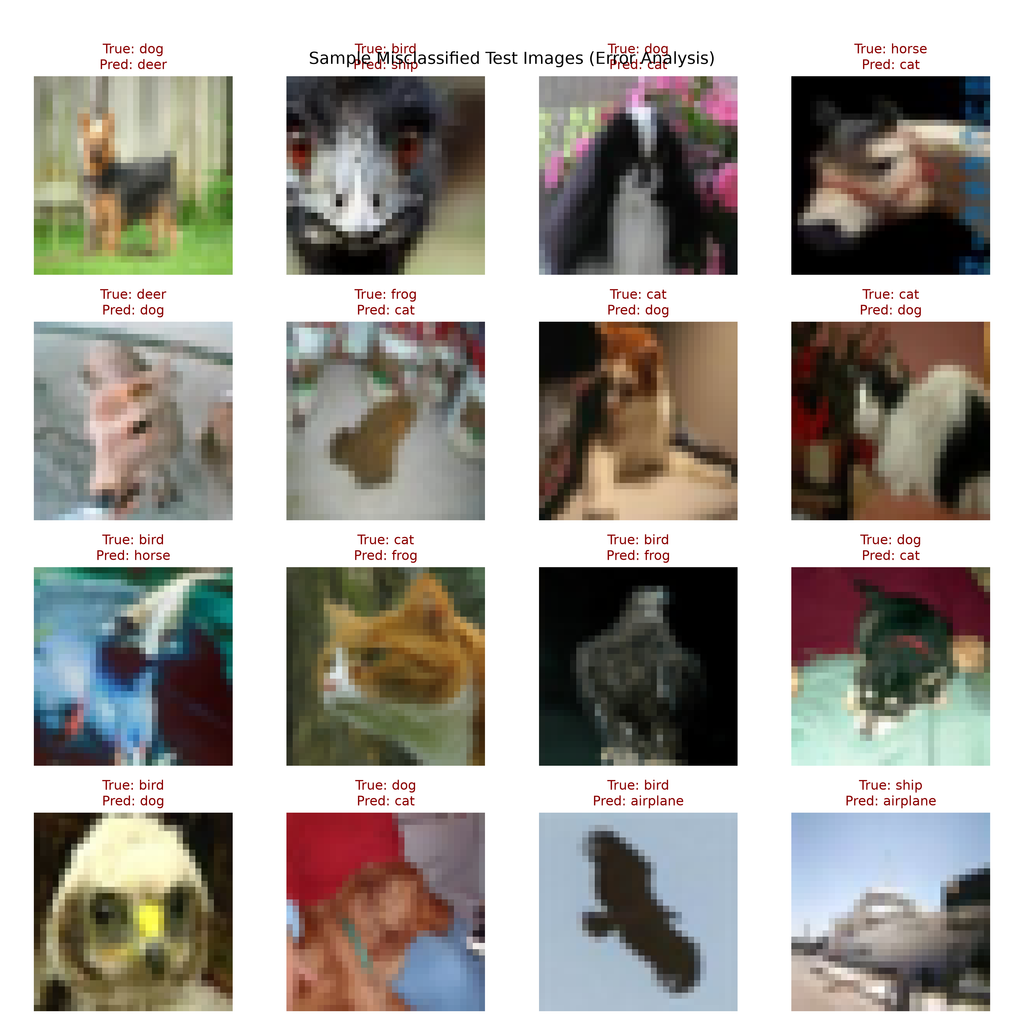
- Misclassified Examples: Helps identify individual images that the model predicts incorrectly.
Comparing the baseline and augmented models provided a practical way to study the effect of augmentation. The results should be interpreted using the final, verified evaluation outputs generated by the notebook.

A confusion matrix helps identify which classes the model predicts correctly and which classes are commonly confused.

Reviewing misclassified examples helps us understand the limitations of the model, especially when different objects have similar visual features.
Key Learnings
Working on CIFARVision helped me develop a better understanding of several deep learning concepts.
First, I learned how convolutional and pooling layers extract useful features from images and how these features support classification.
Second, I gained practical experience with data augmentation and learned why training-time transformations can help a model generalize to unseen examples.
Third, I learned the importance of systematic model evaluation. Accuracy alone does not explain every model behaviour, so confusion matrices, classification reports, and misclassified examples provide additional insight.
Finally, this project strengthened my skills in Python, PyTorch, data visualization, and organizing a machine learning project for reproducibility.
Conclusion
The CNN for Image Classification project was a valuable step in my learning journey in Deep Learning and Computer Vision. By building CIFARVision, I explored the complete workflow, from dataset preparation and CNN implementation to data augmentation and model evaluation.
The project also showed me the importance of experimentation, careful validation, and understanding model errors rather than focusing only on a single performance metric.
I look forward to applying these concepts to more challenging machine learning problems and continuing to improve my skills in Artificial Intelligence.
I am grateful for the opportunity to work on this project during my internship at Valentius Kryptix.
Explore the project on GitHub:
https://github.com/student-Madhumitakhatua/CIFARVision


Leave a Reply
You must be logged in to post a comment.