

Introduction
REST APIs play an important role in modern web development by allowing applications to communicate with each other through HTTP requests. They help developers build scalable, maintainable, and reusable backend services that can support websites, mobile applications, and other software systems.
As part of my internship work at Valentius Kryptix, I developed a Task Management REST API using Node.js and Express. The primary goal of this project was to understand backend development, implement CRUD operations, create user authentication, and protect API endpoints from unauthorized access.
This project provided practical experience in designing RESTful endpoints, handling requests and responses, validating input data, and testing API functionality.
What Is a REST API?
REST stands for Representational State Transfer. It is an architectural style used to design web services that communicate over HTTP.
A REST API allows clients to interact with server-side resources using standard HTTP methods:
GET: Retrieves information from the server.
POST: Creates a new resource.
PUT or PATCH: Updates an existing resource.
DELETE: Removes a resource.
For example, a task management application can use a REST API to create tasks, display task lists, update task status, and delete completed tasks. This approach separates the frontend from the backend, making the application easier to maintain and extend.
Technologies Used
The project was developed using the following technologies:
Node.js: A JavaScript runtime used to execute JavaScript on the server.
Express.js: A lightweight framework for creating API routes and handling HTTP requests.
JavaScript: Used to implement application logic and process data.
Authentication middleware: Used to protect routes and verify authentication credentials.
Password hashing: Used to store passwords securely rather than saving them as plain text.
Git and GitHub: Used for version control and project hosting.
HTTP request testing: Used to test API endpoints and verify their responses.
These technologies provided a practical foundation for understanding backend application development.
Project Architecture and Functionality
The Task Management REST API follows a straightforward client-server architecture. A client sends an HTTP request to an endpoint, Express processes the request, and the server returns an appropriate response.
The application includes authentication routes and task-management routes. The authentication functionality allows users to register and log in. The task routes support creating, retrieving, updating, and deleting tasks.
The API also uses middleware to check authentication before allowing access to protected endpoints. This helps ensure that only requests containing valid authentication credentials can access the relevant functionality.
Implementing CRUD Operations
One of the main parts of this project was implementing CRUD operations for tasks.
1. Create a task
The client sends a POST request with task information, such as its title and status. The server processes the request and returns the newly created task.
2. Read tasks
GET requests retrieve the task list or individual task information. This functionality allows clients to view and track their tasks.
3. Update a task
PUT or PATCH requests modify existing task information. During testing, I updated a task title and changed its status from pending to in-progress.
4. Delete a task
A DELETE request removes a task. I tested this functionality and verified that the deleted task no longer appeared in the task list.
Implementing these operations helped me understand how backend applications manage resources and respond to different HTTP methods.
User Authentication and Security
Authentication was another important component of the project. The API provides registration and login endpoints so users can establish an authenticated session for accessing protected functionality.
Passwords are hashed before storage to improve security. During login, the application verifies the supplied credentials and returns an authentication token when the credentials are valid.
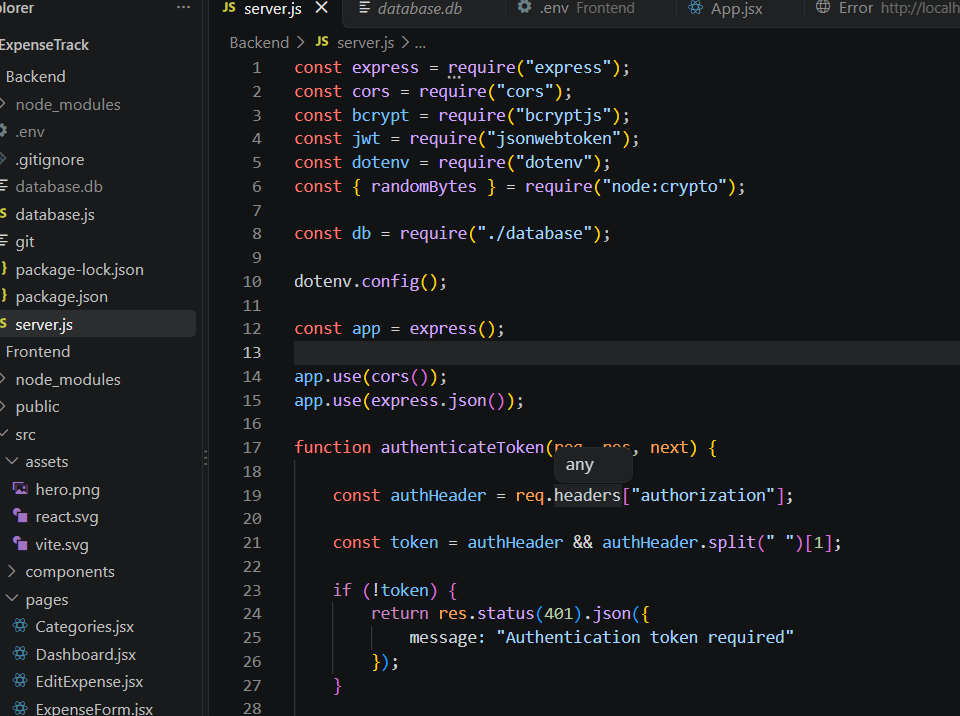
Protected requests use the Authorization header with the Bearer token format. The authentication middleware checks this header before allowing the request to continue.
For example, a request without the required Authorization header should receive an authentication error rather than access to a protected endpoint.
This implementation helped me understand why authentication, password security, and access control are essential parts of backend development.
API Testing and Validation
Testing was an important part of the development process. I tested the registration and login functionality, created a task, retrieved the task list, updated task information, and deleted the task.
I also tested authentication failures to verify that protected routes rejected requests without the required credentials.
The testing process helped me identify and resolve issues, understand HTTP status codes, and verify that each endpoint behaved as expected.
Input validation and appropriate error responses are also important in a reliable API. They help prevent invalid data from being processed and make it easier for clients to understand unsuccessful requests.
Challenges and Key Learnings
While developing the project, I gained practical experience in several areas:
Understanding REST principles and HTTP methods.
Organizing backend functionality into routes and middleware.
Implementing user registration and login.
Protecting endpoints using Bearer-token authentication.
Handling API requests, responses, and errors.
Testing CRUD operations and authentication scenarios.
Using Git and GitHub to manage and share source code.
One of the important lessons was that an API is not complete simply because its endpoints work. Security, input validation, meaningful error responses, and consistent behavior are also necessary for building a dependable backend service.
Future Improvements
The project can be extended with additional features such as role-based access control, task deadlines, task priorities, filtering, pagination, automated testing, API documentation, and deployment to a cloud platform.
Adding these improvements would make the application more suitable for real-world use and provide further opportunities to learn backend engineering practices.
Conclusion
Building the Task Management REST API with Node.js and Express was a valuable hands-on learning experience. It helped me connect theoretical concepts with practical implementation, from designing RESTful endpoints to implementing authentication and testing complete CRUD workflows.
This project strengthened my understanding of backend development, API security, and version control. I look forward to applying these skills to more complex applications and continuing to develop my technical abilities during my internship at Valentius Kryptix.
Project Repository: https://github.com/yogisagumale-ai/task-management-api
Technologies: Node.js, Express.js, JavaScript, REST API, Authentication, Git, and GitHub.

You May Love
-
Proven Steps to Build a Smart Task REST API with Express
.
Introduction REST APIs play an important role in modern web development by allowing applications to communicate with each other through HTTP…
-
Easy Steps to Build a REST API in Node and Django
.
Introduction Modern web applications often need to communicate with different systems. For example, an e-commerce website needs to retrieve product details,…
-
Essential Steps to Launch Your Dream Portfolio Website
.
Introduction A portfolio website is an important tool for developers who want to showcase their skills, projects, and professional journey. It…
Leave a Reply
You must be logged in to post a comment.