
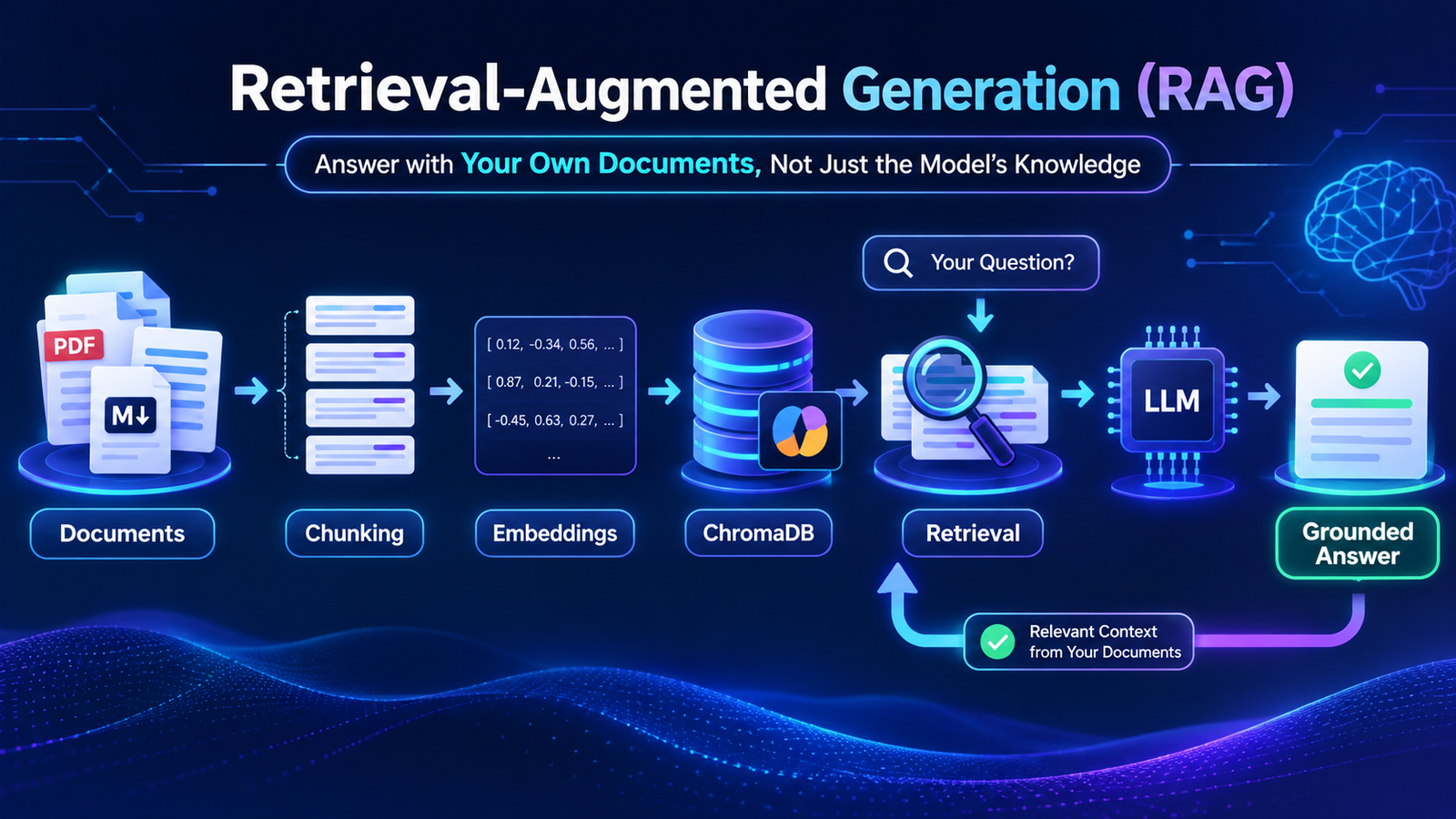

Artificial Intelligence has always fascinated me, especially the way Large Language Models (LLMs) understand questions and generate human-like responses. While exploring AI technologies, I became interested in understanding how AI could work with information beyond its existing training knowledge. This curiosity led me to explore Retrieval-Augmented Generation (RAG) and eventually develop my own RAG-based question-answering system.
The idea behind this project was simple but interesting: What if I could build an AI assistant that understands my own documents and answers questions based on their actual content?
Traditional AI chatbots are powerful, but when it comes to specific information stored in personal documents, research papers, or technical resources, they need access to that information before they can provide reliable answers. I wanted to explore how this limitation could be addressed by combining document retrieval with language models.
That is how my journey of building a RAG system began.
The Idea Behind My Project
When I started exploring RAG, I realized that connecting an AI model with an external knowledge source could make AI applications much more useful.
Instead of depending entirely on the information a model already knows, a RAG system can search through a collection of documents, identify relevant information, and provide that information to an LLM before generating an answer.
I wanted to experience this concept practically rather than just understand it theoretically.
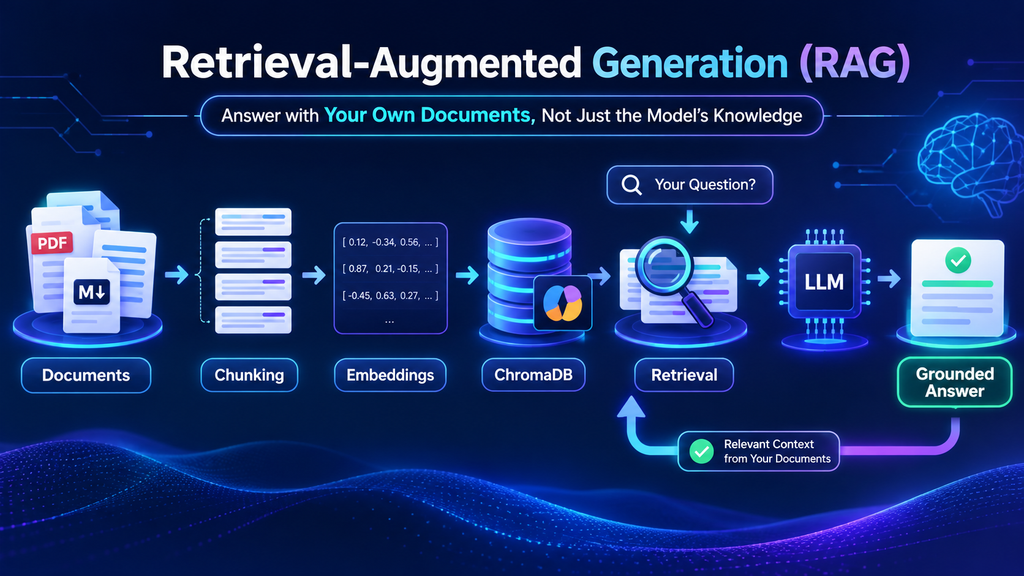
My objective was to develop a system where users could ask questions in natural language and receive responses based on the information available in their own document collection. I also wanted to understand how different components, such as embeddings, semantic search, vector databases, and LLMs, work together in a real-world AI application.
Understanding the Technology Behind RAG
One of the most interesting parts of this project was understanding how different AI technologies communicate with one another.
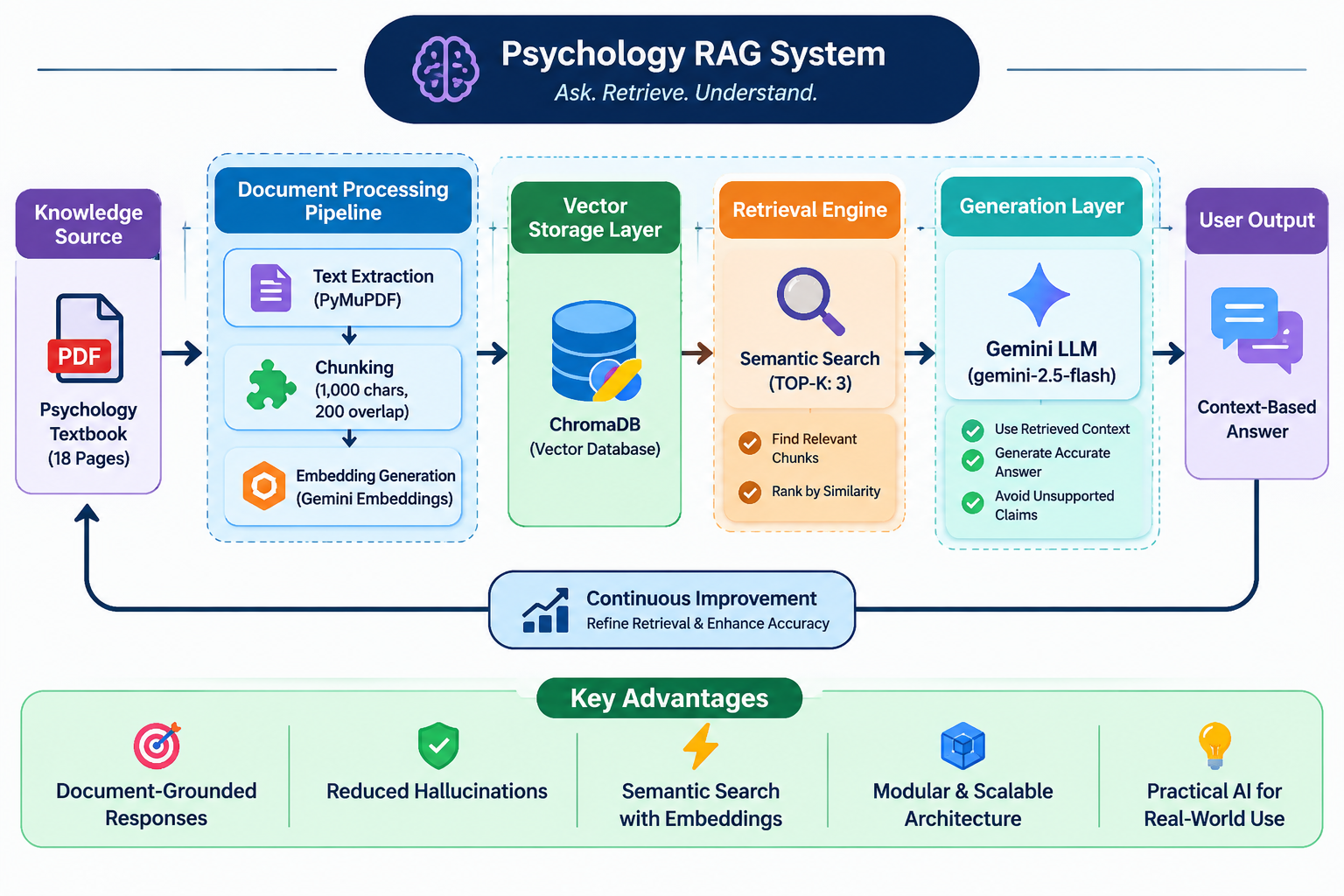
I worked with Python as the primary programming language and explored document processing, text chunking, embedding generation, vector storage, and semantic retrieval.
For language generation, I integrated OpenAI and Llama. Working with these models helped me explore how different LLMs can be connected to a retrieval pipeline to generate answers using externally supplied context.
Another important technology in my project was ChromaDB, which I used as the vector database. It became an essential component for storing document embeddings and retrieving relevant information when questions were submitted.
I also explored Sentence Transformers for generating text embeddings. Understanding how sentences are converted into numerical vectors was particularly interesting because it demonstrated how machines can identify relationships between text based on semantic meaning rather than just matching keywords.
My Experience Working with Document Processing
One of the first interesting things I discovered during development was that an AI system cannot simply understand a collection of PDF files without proper processing.
Before retrieving information, the documents need to be converted into readable text. I worked with PDF text extraction and explored how document content could be prepared for further processing.
Another important concept I experienced was text chunking.
Initially, I understood that splitting documents into smaller sections was necessary, but during development, I realized why it matters so much. If a complete document is treated as one large block of text, finding specific information becomes difficult. On the other hand, dividing it into extremely small sections can remove important context.
Finding a suitable balance between chunk size and overlap helped me better understand the relationship between document structure and retrieval quality.
This experience showed me that the quality of a RAG application depends not only on the language model but also on how effectively the original information is prepared.
Exploring Embeddings and ChromaDB
Working with embeddings was another important learning experience.
I learned how text can be represented as numerical vectors and how those vectors help identify semantically related information.
For example, a user might ask a question using different words from those used in a document. A traditional keyword search may struggle to identify the relationship, but semantic search can retrieve relevant information based on meaning.
This is where ChromaDB became particularly useful in my project.
I used ChromaDB to store the generated embeddings along with their associated document content. Whenever a question was submitted, the system could search the stored vectors and retrieve relevant document chunks.
Seeing how the retrieval mechanism connected a user’s question with information from the document collection helped me understand the practical value of vector databases.
It was one of the most interesting parts of the entire development experience because it transformed document searching into something much closer to intelligent question answering.
Connecting OpenAI and Llama with the Retrieval System
After understanding document processing and retrieval, connecting the language models was another important part of my development experience.
I integrated OpenAI and Llama into the project to explore LLM-based answer generation.
The interesting part of this integration was understanding that the language model should not receive only the user’s question. It should also receive the relevant information retrieved from the document collection.
The retrieved content becomes additional context for the model. Using this information, the model generates a response related to the user’s question.
This made me understand the actual difference between a traditional chatbot and a RAG-powered assistant.
A normal LLM responds using its existing knowledge and supplied conversation context, whereas a RAG application can retrieve additional information from an external knowledge base before generating a response.
This approach makes the system useful for working with specialized documents and information that may not be available in the model’s original training data.
Challenges and Lessons During Development
Developing this project was not just about connecting different technologies. It also involved understanding how each component affects the overall performance of the system.
One of the important areas I focused on was document processing. Extracting meaningful text and maintaining its context was necessary to prepare documents for retrieval.
I also learned that generating embeddings does not automatically guarantee accurate results. The retrieval mechanism needs to return information that is genuinely relevant to the user’s question.
Another interesting learning experience was understanding the relationship between retrieval quality and generated answers. Even a powerful LLM may produce an incorrect or incomplete response when the retrieved information is irrelevant or insufficient.
Working with ChromaDB, embeddings, OpenAI, and Llama helped me understand how these components contribute to the complete RAG architecture.
Most importantly, this project changed the way I think about AI application development. I realized that building an effective AI system requires more than selecting a powerful model. Data preparation, information retrieval, context management, and answer generation are equally important.
What Makes This Project Interesting?
For me, the most interesting part of this project is the ability to connect AI with information from my own document collection.
Rather than manually searching through multiple documents, users can interact with the knowledge base through natural-language questions.
I see several possibilities for this approach:
- Students can interact with their academic notes and textbooks.
- Researchers can search through multiple research papers.
- Developers can retrieve information from technical documentation.
- Organizations can build knowledge assistants using internal documents.
- Professionals can access information from reports and specialized resources.
These possibilities demonstrate how RAG can be used to develop practical AI applications across different domains.
What I Learned from This Project
This project provided me with valuable practical experience in several areas of Artificial Intelligence and Machine Learning.
I gained a better understanding of Retrieval-Augmented Generation, Large Language Models, text embeddings, semantic search, document processing, and vector databases.
More importantly, I experienced how these individual technologies can be integrated into one working application.
Working with OpenAI and Llama expanded my understanding of language-model integration, while ChromaDB helped me explore the practical implementation of vector-based information retrieval.
I also developed a stronger understanding of how AI applications can use external knowledge sources to generate more relevant and context-aware responses.
What’s Next?
Completing the core RAG system is an important milestone, but I see many opportunities to extend this project further.
I am interested in improving the overall user experience by developing a more interactive interface, adding document-upload capabilities, displaying source references alongside generated answers, and exploring conversational memory.
I would also like to explore advanced retrieval techniques, such as hybrid search and reranking, to improve the relevance of retrieved information.
These improvements could make the system more useful as a personal AI knowledge assistant.
Final Thoughts
Building my own RAG system has been a valuable learning experience and an opportunity to move beyond theoretical knowledge into practical AI development.
What started as curiosity about how AI could understand personal documents turned into a project that helped me explore document processing, embeddings, semantic search, ChromaDB, OpenAI, and Llama.
The biggest takeaway from this experience is that AI becomes much more useful when it can access relevant information at the right time.
I enjoyed exploring how retrieval and generation work together to create an intelligent document-based question-answering system. This project has also motivated me to explore more advanced AI architectures and build applications that solve practical problems.
For me, this project is not just about building another AI chatbot. It is about exploring how we can make AI understand, retrieve, and work with our own knowledge.
The journey of building intelligent AI systems continues!


Leave a Reply
You must be logged in to post a comment.