

Introduction to Supervised Learning
Artificial Intelligence (AI) and Machine Learning (ML) are transforming the way we interact with technology. From email spam detection to product recommendations and weather forecasting, machine learning plays an important role in solving real-world problems. One of the most widely used approaches in machine learning is Supervised Learning.
Supervised Learning is a machine learning technique in which a model learns from labeled datasets. This means that the training data contains both input features and their corresponding correct outputs. By studying these examples, the model learns patterns and relationships that help it predict outcomes for new, unseen data.
What Is Supervised Learning?
Supervised Learning is a type of machine learning where an algorithm is trained using a dataset containing input-output pairs.
For example, consider a dataset containing information about houses, including their location, size, number of bedrooms, and prices. The model studies these examples to understand how different features influence house prices. After training, it can estimate the price of a new house based on its characteristics.
The main objective of supervised learning is to develop a model that can make accurate predictions when provided with new data.
How Does Supervised Learning Work?
Supervised learning generally follows these steps:
1. Data Collection
The first step is collecting relevant data from reliable sources. The quality and quantity of data directly influence model performance.
2. Data Preprocessing
Raw data may contain missing values, duplicate records, or inconsistent information. Data preprocessing involves cleaning and preparing the dataset before training.
3. Splitting the Dataset
The dataset is generally divided into training and testing sets. The training set helps the model learn patterns, while the testing set evaluates its performance on unseen data.
4. Model Selection
An appropriate machine learning algorithm is selected based on the problem. Different algorithms are suitable for different prediction tasks.
5. Model Training
The selected algorithm learns relationships between input features and known output labels using the training dataset.
6. Model Evaluation
The trained model is evaluated using suitable performance metrics. Accuracy, precision, recall, F1-score, and mean squared error are examples of evaluation metrics.
7. Prediction
After successful evaluation, the model can predict outcomes for new input data.
Types of Supervised Learning
Supervised learning is mainly divided into two categories.
1. Classification
Classification is used when the output belongs to a specific category or class.
Examples include:
- Email spam detection (Spam or Not Spam).
- Disease prediction (Positive or Negative).
- Customer churn prediction (Will Leave or Will Stay).
- Image recognition (Cat, Dog, or Bird).
Popular classification algorithms include:
- Logistic Regression
- Decision Tree
- Random Forest
- Support Vector Machine (SVM)
- K-Nearest Neighbors (KNN)
- Naive Bayes
2. Regression
Regression is used when the output is a continuous numerical value.
Examples include:
- House price prediction.
- Sales forecasting.
- Temperature prediction.
- Salary prediction.
- Predicting product demand.
Popular regression algorithms include:
- Linear Regression
- Polynomial Regression
- Decision Tree Regression
- Random Forest Regression
- Support Vector Regression
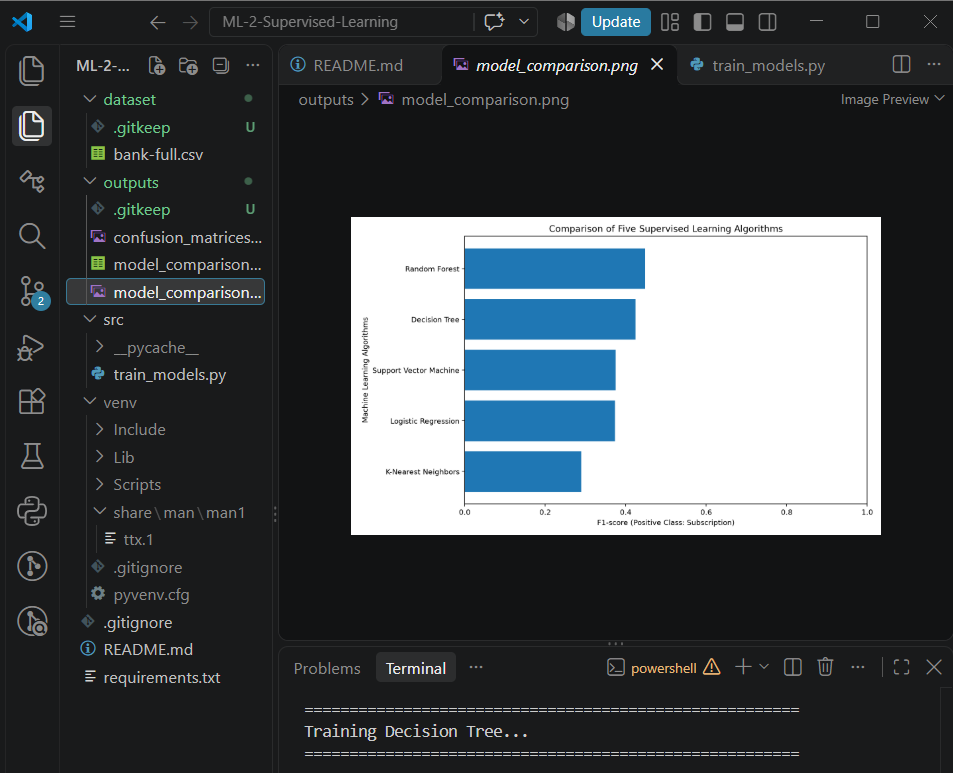
5 Most Popular Supervised Learning Algorithms
Several algorithms are commonly used in supervised machine learning.
Linear Regression: This algorithm predicts continuous numerical values by identifying the relationship between input variables and an output variable.
Logistic Regression: Despite its name, Logistic Regression is commonly used for classification problems. It estimates the probability that an observation belongs to a particular class.
Decision Tree: A Decision Tree makes predictions using a tree-like structure of conditions and decisions. It is relatively easy to understand and interpret.
Random Forest: Random Forest combines multiple decision trees to improve prediction performance and reduce overfitting.
Support Vector Machine: SVM identifies an optimal decision boundary that separates different classes of data.
Real-World Applications of Supervised Learning
Supervised learning is used across many industries.
Healthcare: It helps predict diseases, classify medical images, and support medical decision-making.
Banking and Finance: Financial institutions use supervised learning for fraud detection, credit risk assessment, and loan approval prediction.
E-commerce: Online shopping platforms use machine learning to predict customer preferences and improve product recommendations.
Education: Educational institutions can analyze student performance and identify students who may need additional academic support.
Weather Forecasting: Historical weather observations can be used to train models that estimate future weather conditions.
Advantages of Supervised Learning
- It can produce accurate predictions when trained with suitable, representative data.
- Its performance can be evaluated using known output labels.
- It supports both classification and regression problems.
- It has applications across multiple industries.
- Different algorithms are available for different types of problems.
Challenges and Limitations
Although supervised learning is powerful, it also has certain limitations.
- It requires labeled training data, which can be expensive and time-consuming to prepare.
- Poor-quality or insufficient data can reduce prediction accuracy.
- Overfitting may occur when a model performs well on training data but poorly on unseen data.
- Biased training data can produce biased predictions.
- Complex models may require significant computational resources.
To overcome these challenges, data preprocessing, feature selection, cross-validation, regularization, and proper model evaluation are important.
Conclusion
Supervised Learning is one of the fundamental concepts of Machine Learning. It enables computers to learn from labeled examples and make predictions on new data.
By understanding classification, regression, algorithms, and model evaluation techniques, beginners can develop a strong foundation in machine learning.
As Artificial Intelligence continues to advance, supervised learning will remain an important technology for building intelligent applications and solving real-world problems.
For anyone beginning their journey in Artificial Intelligence and Machine Learning, learning supervised learning is an essential first step toward developing practical machine learning solutions.


Leave a Reply
You must be logged in to post a comment.