

Introduction
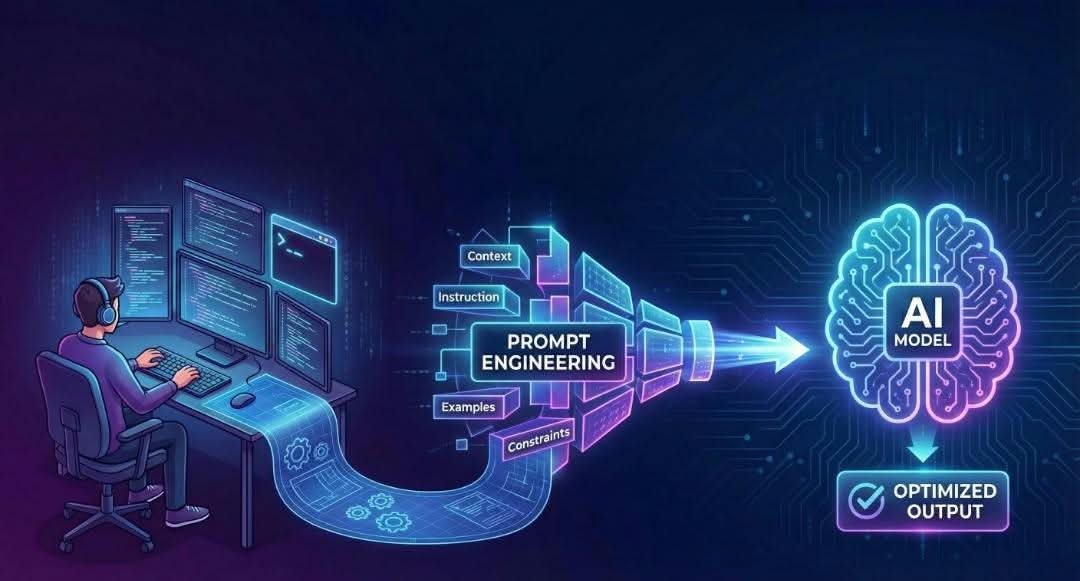
Artificial Intelligence (AI) has become an important part of modern technology, transforming how people work, learn, communicate, and solve problems. From chatbots and virtual assistants to content generation and coding tools, AI systems are capable of performing a wide range of tasks. However, the quality of the output generated by these systems often depends on how effectively we communicate with them. This is where Prompt Engineering plays a significant role.
Prompt engineering is the process of designing, structuring, and refining instructions given to AI models to obtain accurate, relevant, and useful responses. It helps users interact with AI more effectively and unlock its full potential.
What Is Prompt Engineering?
Prompt engineering involves creating clear and specific inputs, known as prompts, that guide an AI model toward producing the desired output. A prompt can be a question, instruction, description, or a combination of these.
For example, instead of asking an AI tool, “Explain technology,” a more effective prompt would be:
“Explain how Artificial Intelligence is used in healthcare in simple language. Provide five real-world applications and examples suitable for a college student.”
The second prompt provides context, specifies the topic, defines the expected level of explanation, and describes the desired format. This allows the AI model to generate a more relevant and structured response.
Why Is Prompt Engineering Important?
Prompt engineering is important because AI models interpret the instructions provided by users. Vague or incomplete prompts may result in generic, inaccurate, or irrelevant answers. Well-designed prompts improve the quality and usefulness of AI-generated content.
Some key benefits of prompt engineering include:
- Improved Accuracy: Clear instructions help AI generate responses that closely match the user’s requirements.
- Increased Productivity: Users can obtain useful results faster, reducing the time spent on repetitive tasks.
- Better Creativity: Prompts can encourage AI to generate creative ideas, stories, designs, and solutions.
- Efficient Problem Solving: AI can assist with coding, debugging, research, analysis, and decision-making when provided with sufficient context.
- Personalized Responses: Users can specify tone, audience, format, and complexity to receive customized outputs.
Common Prompt Engineering Techniques
1. Zero-Shot Prompting
Zero-shot prompting involves asking an AI model to perform a task without providing any examples.
Example:
“Summarize the importance of cybersecurity in five bullet points.”
The AI relies on its existing knowledge to complete the task.
2. Few-Shot Prompting
Few-shot prompting provides the AI with a few examples of the expected output before asking it to perform a similar task.
Example:
“Positive: The product is excellent. Sentiment: Positive.
Negative: The service was disappointing. Sentiment: Negative.
The application is easy to use. Sentiment:”
Providing examples helps the model understand the expected pattern.
3. Role-Based Prompting
Role-based prompting instructs the AI to act as a particular professional or expert.
Example:
“Act as a data science instructor and explain the difference between supervised and unsupervised learning using real-world examples.”
This technique helps generate responses that match a particular perspective or level of expertise.
4. Chain-of-Thought or Step-by-Step Prompting
Step-by-step prompting encourages the AI to approach complex problems systematically by breaking them into smaller parts.
Example:
“Solve this mathematical problem by explaining the key steps and showing the calculations clearly.”
This can make complex answers easier to understand and verify.
Best Practices for Writing Effective Prompts
To obtain better results from AI tools, users should follow a few important practices:
- Be clear and specific about what you want.
- Provide sufficient background information and context.
- Specify the desired output format, such as paragraphs, bullet points, tables, or code.
- Define the intended audience and tone.
- Avoid ambiguous or overly broad instructions.
- Refine your prompt based on the response received.
- Verify important information generated by AI.
Prompt engineering is an iterative process. A prompt may need to be modified several times before producing the ideal response.
Real-World Applications of Prompt Engineering
Prompt engineering is widely used across different industries. In education, it helps students understand complex concepts and generate study materials. In software development, developers use prompts to generate code, identify errors, and understand programming concepts. In business, AI can assist with writing emails, preparing reports, analyzing data, and generating marketing content.
It is also useful in healthcare research, customer support, content creation, data analysis, and automation. As AI tools continue to evolve, the ability to communicate effectively with these systems will become an increasingly valuable skill.
Conclusion
Prompt engineering is more than simply asking questions to an AI system. It is a skill that involves understanding how to communicate instructions clearly, provide context, and refine inputs to achieve better results. By learning effective prompting techniques, individuals can improve productivity, creativity, and problem-solving capabilities.
As Artificial Intelligence continues to transform various industries, prompt engineering will play an important role in bridging the gap between human intentions and AI capabilities. Developing this skill can help students, professionals, developers, and businesses make better use of AI technologies and prepare for the future of digital innovation.


Leave a Reply
You must be logged in to post a comment.