

Introduction to Retrieval-Augmented Generation
Artificial Intelligence has evolved rapidly from simple chat interfaces to sophisticated systems capable of reasoning over private, custom datasets. One of the most powerful paradigms in modern AI engineering is Retrieval-Augmented Generation (RAG). By combining vector search capabilities with large language models, RAG bridges the gap between static model weights and dynamic, real-time knowledge retrieval. In this milestone update, we explore the architecture, development process, and practical implementation of building a fully functional RAG-powered application.
Understanding the Core Problem
Standard large language models are trained on massive public corpora, but they suffer from critical limitations:
- Knowledge Cutoffs: They lack awareness of events or documents generated after their training period.
- Lack of Proprietary Data: They cannot inherently access confidential internal documents, corporate wikis, or user-specific files.
- Hallucinations: When forced to answer questions outside their core training distribution, models often generate plausible-sounding but incorrect information.
Retrieval-Augmented Generation directly addresses these bottlenecks by shifting the burden of memory from the neural network’s parameters to an external, searchable vector database.
Architecture and Workflow
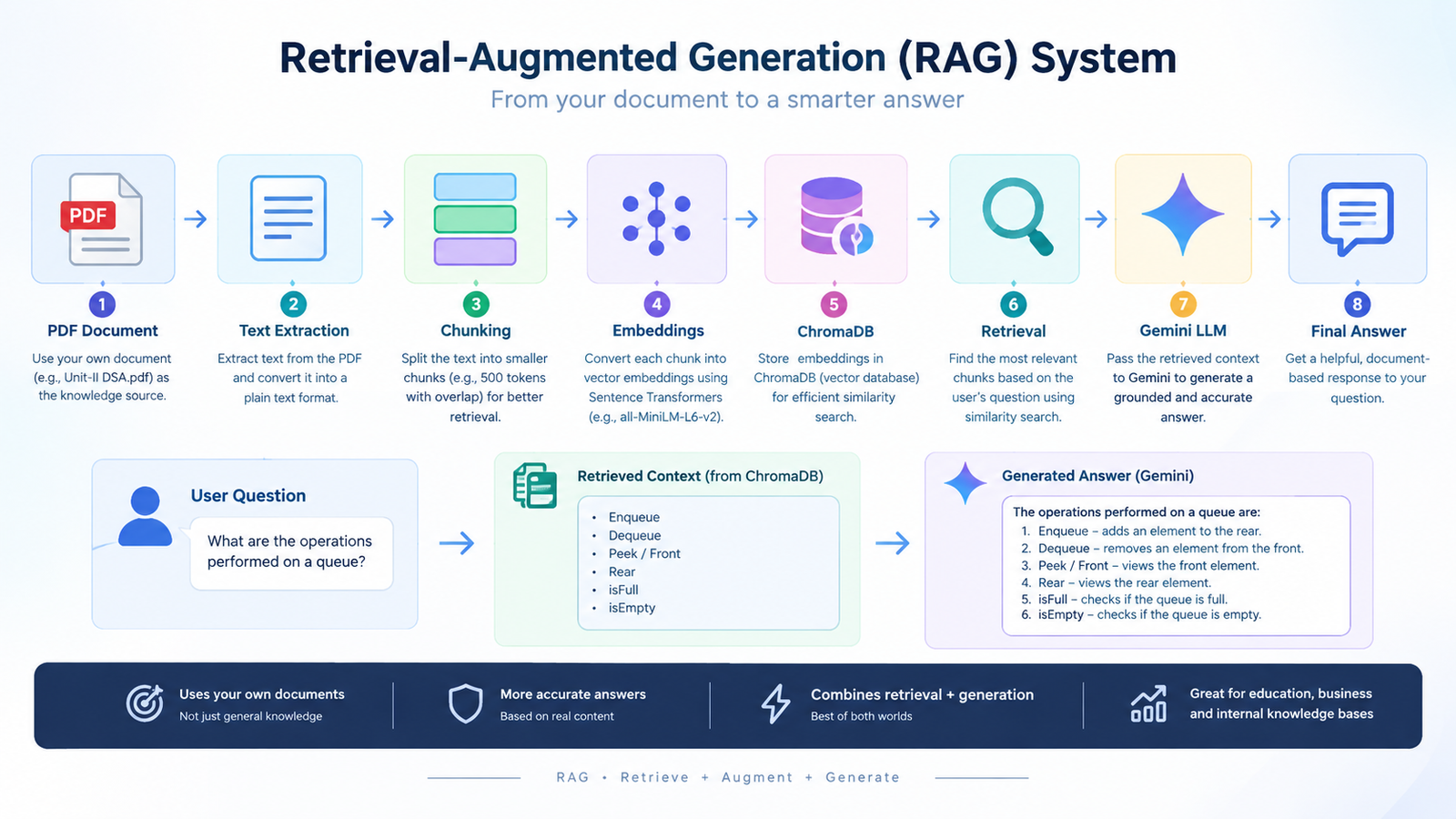
Building a robust RAG application involves several critical stages, moving from raw unstructured text to precise context-aware generation:
- Document Ingestion and Parsing: Raw data sources—ranging from PDFs and markdown files to internal knowledge bases—are ingested into the system.
- Text Chunking: Large documents are broken down into smaller, semantically meaningful segments (chunks) to ensure precise vector embedding representation and stay within token context limits.
- Embedding Generation: Each text chunk is passed through an embedding model to convert textual semantics into dense numerical vectors.
- Vector Storage: These vectors are indexed and stored in a high-performance vector database optimized for similarity search (such as ChromaDB, Pinecone, or FAISS).
- Retrieval Phase: When a user queries the application, the query is similarly vectorized, and the database performs a semantic similarity search to fetch the top-$k$ most relevant document chunks.
- Augmented Generation: The retrieved context chunks are injected alongside the original user prompt into the LLM, instructing the model to formulate an accurate answer grounded strictly in the provided reference text.
Technical Implementation Details
Developing this application required integrating multiple cutting-edge tools and frameworks. Below is a conceptual look at how vector embedding and similarity matching connect to the generation pipeline:
$$Similarity(q, d) = \frac{q \cdot d}{\vert{}\vert{}q\vert{}\vert{} \times \vert{}\vert{}d\vert{}\vert{}}$$
Where $q$ represents the query vector and $d$ represents the document chunk vector. By computing cosine similarity, the system instantly isolates the most pertinent sections of text before handing them over to the language model.
Key Engineering Challenges Overcome
- Managing Context Windows: Balancing chunk sizes to retain sentence completeness while preventing noise injection into the prompt.
- Optimizing Retrieval Latency: Ensuring that vector indices are properly indexed to maintain sub-second response times during queries.
- Prompt Engineering for Grounding: Crafting strict system instructions that compel the LLM to admit when retrieved context is insufficient, thereby virtually eliminating hallucinations.
Practical Applications and Future Scope
RAG-powered applications open up incredible possibilities across industries. From intelligent enterprise search engines that parse thousands of internal PDFs instantly to automated customer support agents trained on dynamic product manuals, the utility is vast.
As we hit this major development milestone, the next steps involve scaling the vector database infrastructure, introducing hybrid keyword-semantic search strategies, and deploying multi-modal document parsing capabilities to handle tables and images seamlessly.


Leave a Reply
You must be logged in to post a comment.