

1. Introduction to Supervised Learning
Supervised Learning is one of the most important concepts in Machine Learning. It is a type of Machine Learning in which a model learns from labelled data. Labelled data means that the dataset contains input features and their corresponding output values.
The main objective of Supervised Learning is to train a model that can predict the correct output for new and unseen data.
For example, a machine learning model can predict whether a person’s annual income is above or below $50K based on different factors such as age, education, occupation, working hours, and other relevant information.
Supervised Learning is widely used in healthcare, banking, finance, business analytics, customer prediction, and many other industries.
2. Types of Supervised Learning
Supervised Learning is mainly divided into two categories:
A. Classification
Classification is used when the target variable contains categories or classes.
Examples:
- Email classification (Spam or Not Spam).
- Customer classification.
- Income prediction (Above $50K or Below $50K).
- Disease prediction (Positive or Negative).
B. Regression
Regression is used when the target variable contains continuous numerical values.
Examples:
- House price prediction.
- Salary prediction.
- Sales forecasting.
- Temperature prediction.
Both techniques help solve different real-world prediction problems.
3. Dataset Description
For my practical work, I explored a dataset related to income classification.
The dataset contains information about individuals, including demographic and employment-related features.
Some important features include:
- Age
- Education
- Occupation
- Workclass
- Hours-per-week
- Capital-gain
- Capital-loss
- Income
The target variable is Income, which is divided into two categories:
- <=50K
- 50K
During Exploratory Data Analysis (EDA), I examined the dataset structure, checked missing values, analysed data distributions, and studied relationships between different features.
I also analysed the relationship between working hours and income to understand how working hours vary across different income categories.
Understanding the dataset is an important step because data quality directly affects machine learning model performance.
4. Machine Learning Algorithms
Different classification algorithms can be used to solve supervised learning problems. Comparing multiple algorithms helps us understand their strengths and weaknesses.
Some commonly used classification algorithms include:
A. Logistic Regression
Logistic Regression is a classification algorithm used to predict the probability of a particular class. It is simple, efficient, and useful as a baseline classification model.
B. Decision Tree
A Decision Tree makes predictions using a tree-like structure. It divides the dataset into smaller groups based on feature conditions.
C. Random Forest
Random Forest is an ensemble learning algorithm that combines multiple decision trees to improve prediction performance and reduce overfitting.
D. K-Nearest Neighbors (KNN)
KNN predicts the class of a new data point by examining the nearest data points in the training dataset.
E. Support Vector Machine (SVM)
SVM is a powerful classification algorithm that identifies an optimal decision boundary to separate different classes.
These algorithms provide different approaches to solving classification problems.
5. Python Implementation
Python is widely used in Machine Learning because of its powerful libraries and simple syntax.
For this project, Python provides an effective environment for data preprocessing, visualization, model training, and evaluation.
Some important libraries used in Machine Learning include:
- Pandas: Used for data loading, cleaning, and manipulation.
- NumPy: Used for numerical operations.
- Matplotlib: Used for data visualization.
- Seaborn: Used for statistical visualization.
- Scikit-learn: Used for data preprocessing, model training, and evaluation.
The general implementation process involves the following steps:
- Import the required Python libraries.
- Load the dataset using Pandas.
- Perform Exploratory Data Analysis.
- Handle missing values and prepare the data.
- Separate input features and the target variable.
- Convert categorical features into numerical representations.
- Split the dataset into training and testing sets.
- Train classification models.
- Evaluate model performance using different metrics.
Following these steps helps create a structured and reliable Machine Learning workflow.
6. Model Evaluation Metrics
Evaluating a Machine Learning model is important because accuracy alone does not always explain how well a model performs.
The following metrics are commonly used for classification problems:
Accuracy
Accuracy measures the percentage of correctly predicted observations out of all observations.
Precision
Precision measures how many of the positive predictions made by the model are actually correct.
Recall
Recall measures how many actual positive cases are correctly identified by the model.
F1-Score
F1-score is the harmonic mean of Precision and Recall. It is useful when we need to balance both metrics.
Confusion Matrix
A Confusion Matrix provides a detailed comparison between actual and predicted classes using True Positive, True Negative, False Positive, and False Negative values.
These metrics help evaluate models from different perspectives.
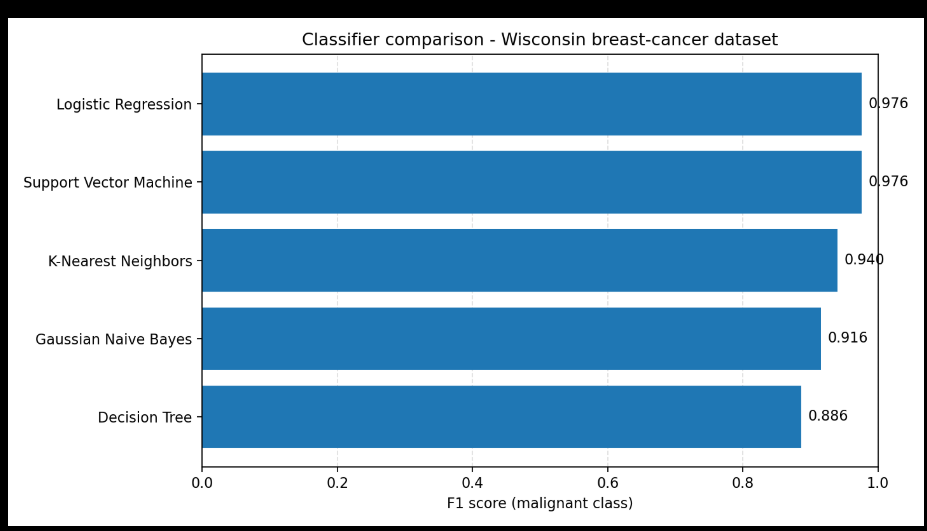
7. Comparison of Results
Comparing different classification algorithms is an important part of a Machine Learning project.
Each algorithm may produce different results depending on the dataset, feature selection, preprocessing techniques, and model parameters.
A model comparison can be performed using Accuracy, Precision, Recall, and F1-score.
By comparing these evaluation metrics, we can understand which algorithm performs better for a particular classification problem.
It is also important to consider class imbalance. When one class contains significantly more observations than another, accuracy alone may give a misleading impression of model performance.
Therefore, selecting the best model should depend on the problem requirements and multiple evaluation metrics rather than accuracy alone.
8. Conclusion
Working on Supervised Learning helped me understand how Machine Learning models learn from labelled datasets and make predictions on unseen data.
Through this practical learning experience, I explored dataset analysis, data preprocessing, Exploratory Data Analysis, classification algorithms, and model evaluation techniques.
I also understood the importance of comparing different algorithms and evaluating their performance using multiple metrics.
Python and Scikit-learn make it easier to implement Machine Learning workflows and develop practical solutions.
Overall, this project strengthened my understanding of Supervised Machine Learning and provided valuable practical experience in solving classification problems.
I look forward to exploring more advanced Machine Learning techniques and building real-world Data Science and AI applications.


Leave a Reply
You must be logged in to post a comment.