

Introduction
Artificial Intelligence is transforming the way people interact with software applications. Large Language Models (LLMs) have become an important part of this transformation by enabling applications to understand natural language, generate meaningful responses, and support intelligent conversations.
As part of my internship at Valentius Kryptix, I worked on an assignment titled LLM API Integration. The objective was to understand how to connect a real-world Large Language Model API with a Python application and develop an interactive chatbot.
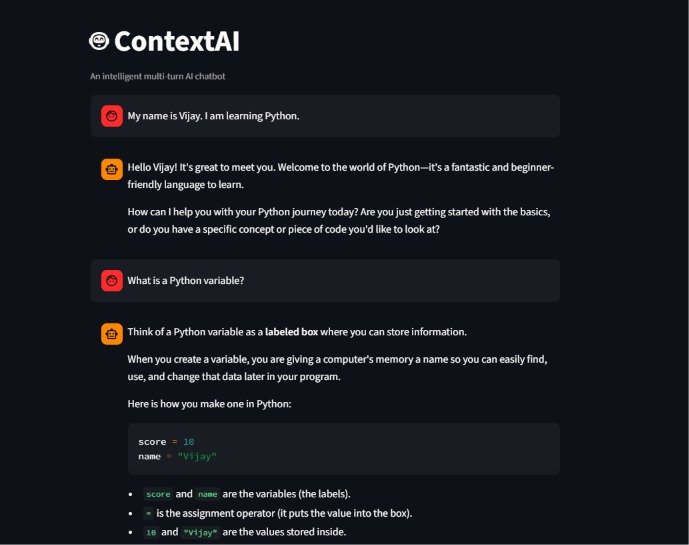
For this project, I developed ContextAI – an Intelligent Multi-Turn AI Chatbot using Python, Google Gemini API, and Streamlit. The application allows users to communicate with an AI assistant while maintaining conversational context across multiple interactions.
Understanding Large Language Model API Integration
A Large Language Model is an artificial intelligence model trained on large amounts of text data to understand and generate human-like language.
Instead of developing and training an entire language model from scratch, developers can integrate existing LLMs into their applications using APIs.
An LLM API acts as a communication interface between an application and an AI model. The application sends a user prompt to the API, the model processes the input, and the generated response is returned.
For this project, I used Google’s Gemini API to generate AI-powered responses.
The integration helped me understand how modern applications can use externally hosted AI models without requiring the resources needed to train and deploy a large model independently.
Project Overview: ContextAI
ContextAI is an intelligent chatbot designed to provide conversational responses while retaining relevant information from previous interactions.
The main objective was not simply to generate individual responses but to create a chatbot capable of following a conversation.
For example, when a user introduces themselves as Vijay and mentions that they are learning Python, they can later ask, “What is my name, and which programming language am I learning?”
ContextAI uses the conversation history to provide an appropriate response based on the earlier interaction.
Key Features
- LLM API Integration: Connects the application with Google’s Gemini API.
- Multi-Turn Conversations: Maintains conversation history across multiple messages.
- Context Management: Retains the most recent 10 messages to provide relevant conversational context.
- Custom System Prompt: Defines the chatbot’s role, behaviour, and response guidelines.
- Streaming Responses: Displays generated responses progressively.
- Error Handling: Handles API-related failures and displays appropriate error messages.
- Clear Conversation: Allows users to reset the current conversation.
Technologies Used
The project was developed using the following technologies:
Python: Used as the primary programming language for implementing the chatbot logic and API integration.
Google Gemini API: Used as the Large Language Model service to understand user prompts and generate responses.
Streamlit: Used to develop a simple, interactive web interface for communicating with the chatbot.
Python-dotenv: Used to load environment variables and securely manage the API key.
Logging: Used to record errors and support debugging when API requests fail.
Implementation and Working Process
The development process involved several important steps.
1. Configuring the Gemini API
The first step was integrating the Google Gemini API with the Python application.
The API key was stored in an environment file rather than directly inside the source code. Python-dotenv was used to load the key into the application.
This approach helps prevent sensitive credentials from being exposed in the source code or accidentally uploaded to a public GitHub repository.
2. Creating a Custom System Prompt
A system prompt defines how an AI assistant should behave.
For ContextAI, I created a custom system prompt that instructs the chatbot to behave as a friendly and intelligent assistant.
It guides the model to answer questions clearly, maintain conversational context, explain technical concepts in simple language, and respond directly to the user’s latest message.
This helped me understand the importance of prompt engineering when developing applications powered by LLMs.
3. Implementing Multi-Turn Conversation History
One of the most important features of this project is conversation history management.
A basic chatbot processes each user message independently. However, this approach does not provide continuity between interactions.
To address this limitation, ContextAI stores user and assistant messages using Streamlit session state.
Before generating a response, the application retrieves the most recent 10 messages and sends them as conversational context to the Gemini API.
This allows the model to refer to earlier messages while generating its next response.
4. Building the Streamlit Interface
Streamlit was used to create the chatbot interface without requiring a separate frontend framework.
The interface includes:
- A chatbot title and description.
- User and assistant message containers.
- A chat input field.
- Streaming AI-generated responses.
- A Clear Conversation button.
The interface provides a straightforward way for users to interact with the application.
5. Error Handling and Response Generation
API integration can sometimes fail because of network issues, invalid API credentials, service limitations, or model availability.
To handle these situations, I implemented exception handling and logging.
The application displays a user-friendly error message instead of terminating unexpectedly. The logging mechanism also helps identify technical problems during development.
Key Technical Learnings
Working on ContextAI helped me understand several important concepts in practical AI application development.
1. Working with LLM APIs
I gained practical experience integrating an externally hosted language model into a Python application and processing generated responses.
2. Conversation Context Management
I learned how maintaining previous messages improves conversational continuity and how limiting conversation history helps control the amount of context sent to an LLM.
3. Prompt Engineering
I understood how custom system instructions influence an AI assistant’s behaviour, communication style, and response structure.
4. Secure API Key Management
I learned the importance of environment variables and keeping API credentials separate from publicly accessible source code.
5. Building Interactive AI Applications
Using Streamlit helped me understand how backend AI functionality can be connected to a simple and interactive user interface.
Challenges and Solutions
During development, one important consideration was maintaining conversation context without sending the entire conversation repeatedly.
I addressed this by retaining the latest 10 messages before making an API request.
Another consideration was handling API errors and model availability. I learned that selecting a supported model and implementing proper exception handling are essential for reliable API integration.
Securely managing the API key was also an important part of the implementation.
These challenges provided practical experience in developing applications that depend on external AI services.
Applications of LLM API Integration
The concepts used in ContextAI can be extended to several real-world applications, including:
- AI-powered customer support assistants.
- Educational chatbots and learning assistants.
- Personal productivity assistants.
- Technical support applications.
- Document-based question-answering systems.
- Conversational interfaces for business applications.
With additional features such as document retrieval, database integration, and authentication, this basic chatbot architecture can be extended into more advanced AI-powered solutions.
Conclusion
Developing ContextAI was a valuable learning experience that strengthened my understanding of Large Language Models and API integration.
Through this project, I gained practical experience with Python, Google Gemini API, Streamlit, prompt engineering, multi-turn conversation management, and secure API key handling.
This assignment helped me connect theoretical knowledge of generative AI with practical application development.
I would like to thank Valentius Kryptix for providing this learning opportunity as part of my internship. I look forward to exploring more advanced applications of Artificial Intelligence, Generative AI, and Data Science.
Project Repository
GitHub: https://github.com/VijayReddy-07/LLM-API-Integration-ContextAI-Task-1
Project: ContextAI – Intelligent Multi-Turn AI Chatbot
Technologies: Python | Google Gemini API | Streamlit | Python-dotenv
Building practical AI applications, one integration at a time.


Leave a Reply
You must be logged in to post a comment.