

Introduction
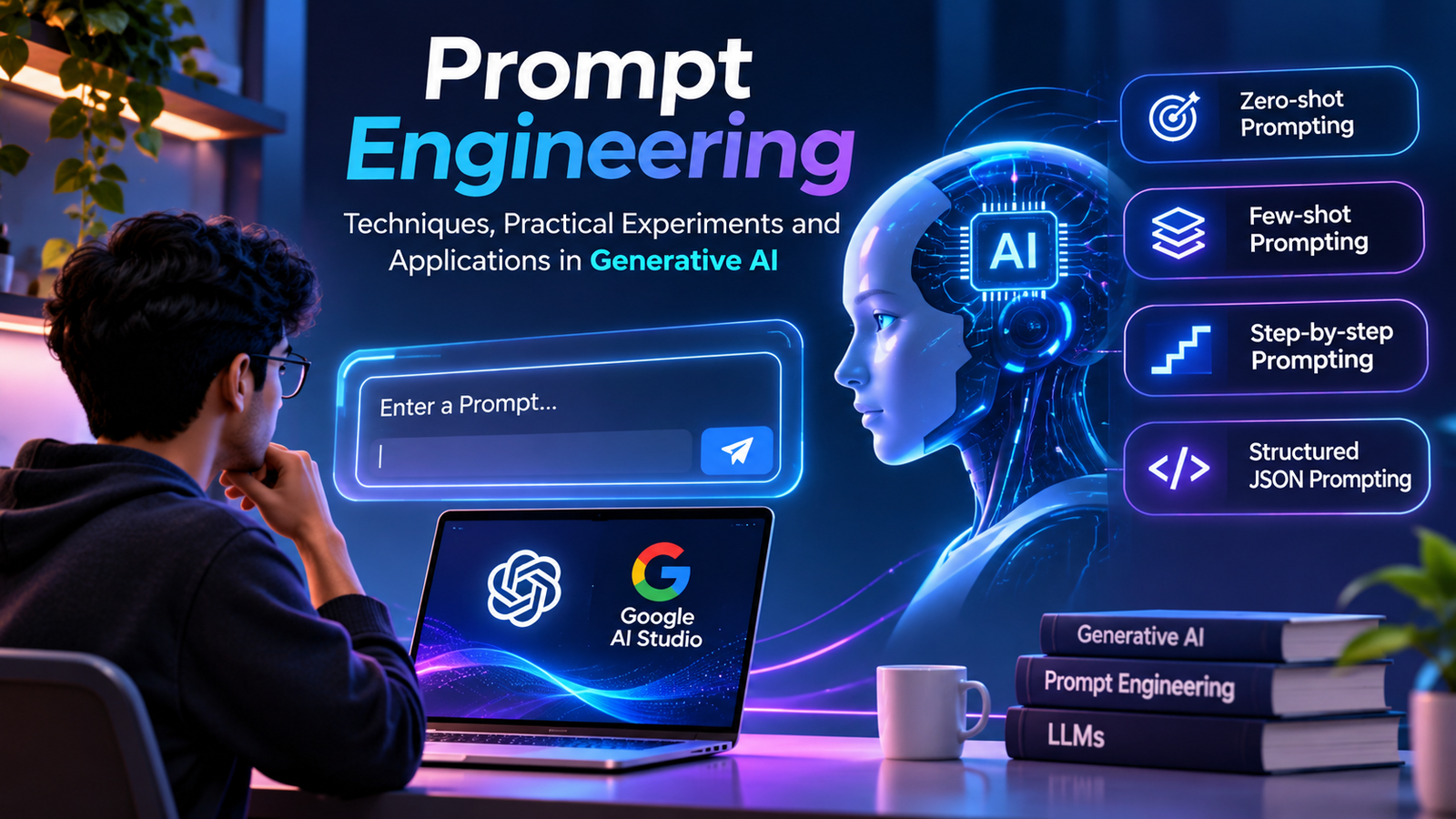
Artificial Intelligence (AI) has become an important part of modern technology, especially with the development of Generative AI. Tools such as ChatGPT and Google AI Studio allow users to generate text, understand information, write code and solve different problems using natural language instructions.
However, the quality of the generated response depends significantly on how instructions are provided to an AI model. This is where Prompt Engineering becomes important.
Prompt Engineering is the process of designing, structuring and improving instructions given to an AI model to obtain accurate, relevant and useful outputs. It helps users communicate effectively with AI systems by providing clear instructions, sufficient context and expected output formats.
As part of my internship at Valentius Kryptix, I explored different prompt engineering techniques using Google AI Studio and conducted practical experiments to understand how different prompting approaches influence AI-generated responses.
1. Zero-shot Prompting
Zero-shot prompting is a technique in which an AI model receives an instruction without being provided with any examples.
The model uses its existing knowledge and understanding to generate an appropriate response.
Example Prompt:
“Explain the concept of Machine Learning in simple terms.”
The AI model generates an explanation based only on the instruction.
Applications:
- General question answering.
- Text summarization.
- Basic content generation.
- Simple classification tasks.
Zero-shot prompting is useful when the task is straightforward and does not require specific examples.
2. Few-shot Prompting
Few-shot prompting involves providing a small number of examples before asking the AI model to perform a task.
These examples help the model understand the expected response pattern, structure and format.
Example Prompt:
Classify the following sentences as Positive or Negative.
Example 1:
Input: “The product is excellent.”
Output: Positive.
Example 2:
Input: “The service was disappointing.”
Output: Negative.
Now classify:
Input: “I really enjoyed using this application.”
Output: Positive.
The model uses the provided examples as guidance to generate its response.
Applications:
- Sentiment analysis.
- Text classification.
- Data extraction.
- Structured content generation.
Few-shot prompting is particularly useful when a task requires a consistent response format.
3. Step-by-step Prompting
Step-by-step prompting encourages an AI model to approach a task through clearly defined stages instead of generating an unstructured response immediately.
The prompt specifies the sequence of activities that should be followed.
Example Prompt:
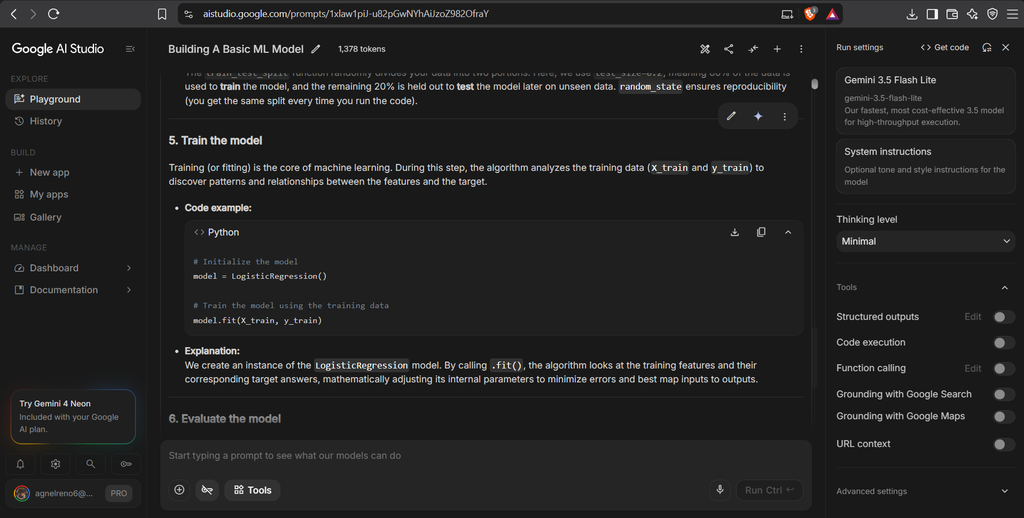
“Explain how to build a basic machine learning model. Organize your response into the following steps:
- Import the required libraries.
- Load the dataset.
- Perform data preprocessing.
- Split the dataset.
- Train the model.
- Evaluate the model.”
This approach helps organize complex instructions into manageable stages.
Applications:
- Programming assistance.
- Technical explanations.
- Problem-solving tasks.
- Learning and educational activities.
Structured instructions make the generated output easier to understand and follow.
4. Structured JSON Prompting
Structured JSON prompting is a technique used to obtain responses in a predefined JSON format.
JSON stands for JavaScript Object Notation. It is commonly used for exchanging structured information between applications and systems.
Example Prompt:
“Provide information about Python in JSON format with the following fields: language, category, applications and difficulty_level. Return only valid JSON.”
Expected Output:
{
  "language": "Python",
  "category": "General-purpose programming language",
  "applications": [
    "Web Development",
    "Data Science",
    "Artificial Intelligence",
    "Machine Learning",
    "Automation",
    "Software Testing"
  ],
  "difficulty_level": "Beginner-friendly"
}
This technique is useful when AI-generated information needs to be processed by applications or integrated into software systems.
Applications:
- API integration.
- Data extraction.
- Automated workflows.
- Application development.
5. Practical Experiments Using Google AI Studio
As part of my Prompt Engineering internship task at Valentius Kryptix, I used Google AI Studio to explore different prompting techniques.
The experiments focused on understanding how variations in instructions influence the generated responses.
The following approaches were explored:
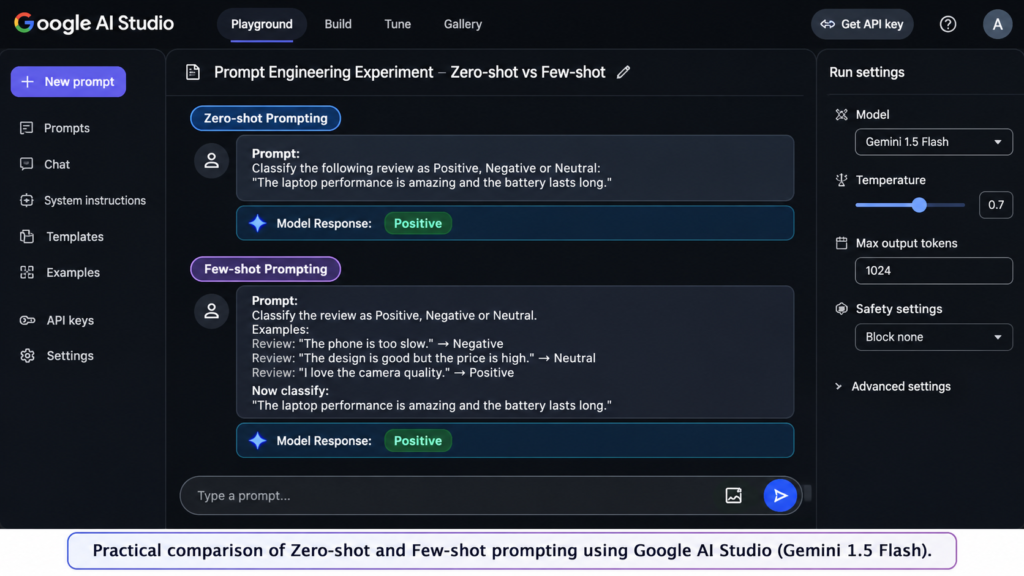
Experiment 1: Zero-shot vs Few-shot Prompting
I compared prompts with no examples against prompts containing example inputs and outputs. This helped me understand how examples can guide the model towards a particular response pattern.
Experiment 2: Step-by-step Prompting
I provided structured instructions for technical tasks and examined how organizing the requirements into individual steps influenced the clarity and organization of the generated output.
Experiment 3: Structured JSON Prompting
I experimented with instructions that required responses in JSON format. This helped me understand the importance of specifying output structures when working with AI-generated data.
These practical exercises provided an opportunity to explore prompt design, instruction clarity and output formatting using a generative AI platform.
6. Importance of Prompt Engineering
Prompt Engineering plays an important role in improving interactions between humans and AI systems.
Some of its major benefits include:
- Better communication: Clear instructions help AI models understand the intended task.
- Improved output quality: Well-designed prompts can produce more relevant and useful responses.
- Consistency: Structured prompts help maintain a consistent response format.
- Time efficiency: Effective instructions reduce unnecessary revisions.
- Automation: Structured outputs can support automated applications and workflows.
- Flexibility: Different prompting techniques can be selected depending on the task requirements.
However, prompt engineering does not guarantee that every AI-generated response will be correct. Outputs should always be reviewed and verified, especially when they involve technical or factual information.
7. Conclusion
Prompt Engineering is an important skill in the growing field of Generative AI. It helps users communicate effectively with AI models and obtain outputs that better match their requirements.
Through my internship at Valentius Kryptix, I explored Zero-shot Prompting, Few-shot Prompting, Step-by-step Prompting and Structured JSON Prompting using Google AI Studio.
These practical experiments helped me understand how prompt structure, examples and output requirements influence AI-generated responses.
As Generative AI continues to evolve, Prompt Engineering will remain a valuable skill for developers, data scientists, researchers and technology professionals.
This experience has strengthened my understanding of Generative AI and encouraged me to explore more advanced AI applications and practical implementations.

Leave a Reply
You must be logged in to post a comment.