

Large Language Models (LLMs) have transformed the way people interact with information. However, getting reliable answers from information contained in a specific document can still be challenging. Manually searching through lengthy PDFs or text files takes time, particularly when users need answers to specific questions.Building AskWise AI: A RAG-Powered Application for Intelligent Document Question Answering
Introduction
Large Language Models (LLMs) have transformed the way people interact with information. However, getting reliable answers from information contained in a specific document can still be challenging. Manually searching through lengthy PDFs or text files takes time, particularly when users need answers to specific questions.
To explore this problem, I developed AskWise AI, a Retrieval-Augmented Generation (RAG)-powered web application, as part of the “Milestone: RAG-Powered AI App” project during my internship at Valentius Kryptix.
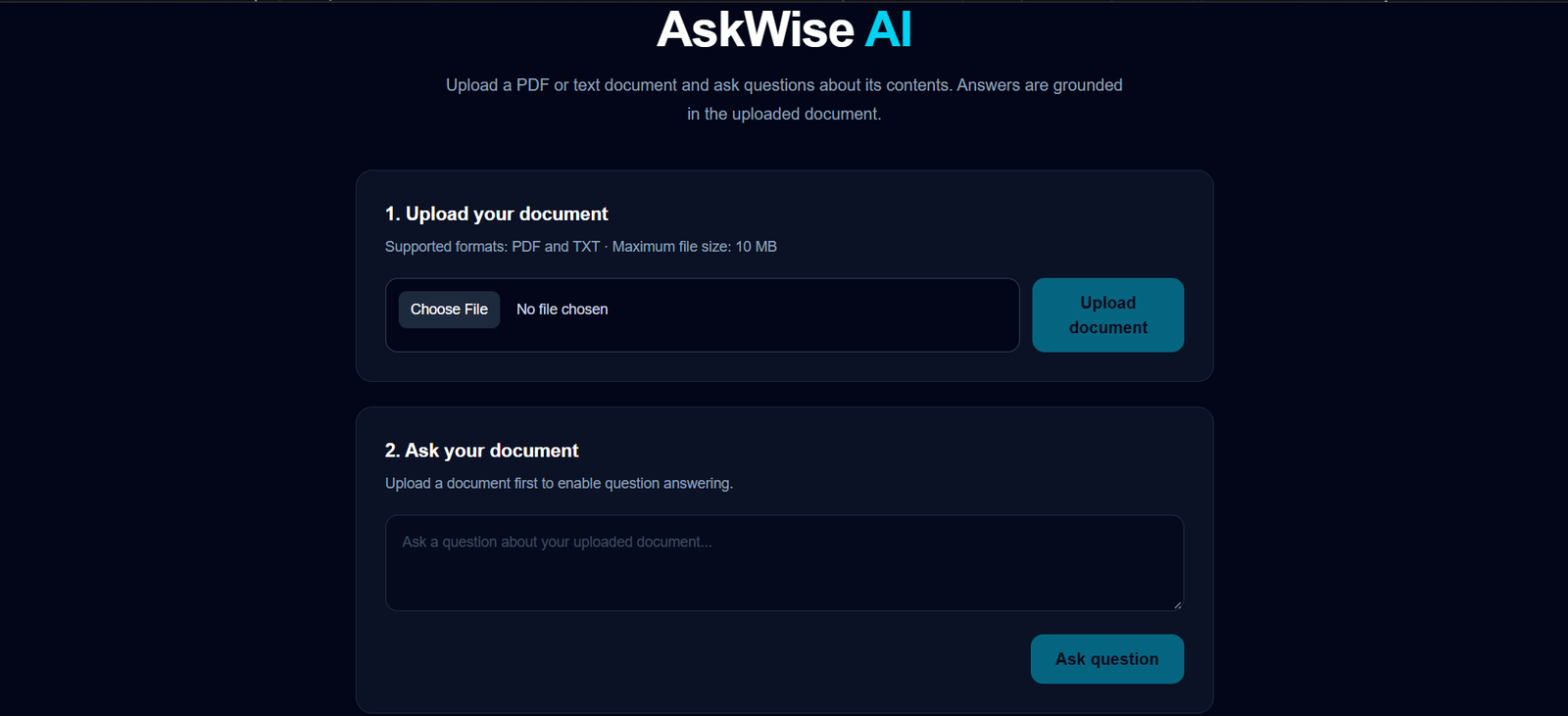
The application allows users to upload PDF or TXT documents and ask questions about their contents. It retrieves relevant information from the uploaded document and uses an AI model to generate answers grounded in the available context.
Understanding Retrieval-Augmented Generation
Retrieval-Augmented Generation combines information retrieval with large language model generation. Instead of relying exclusively on information learned during model training, a RAG system retrieves relevant passages from a supplied knowledge source and includes them as context when generating an answer.
This approach is particularly useful for document question-answering applications. It helps the system focus on the information available in a user’s document and can reduce unsupported answers when appropriate retrieval and prompting strategies are used.
A typical RAG workflow involves document ingestion, text chunking, embedding generation, vector storage, similarity-based retrieval, and answer generation.
What I Built: AskWise AI
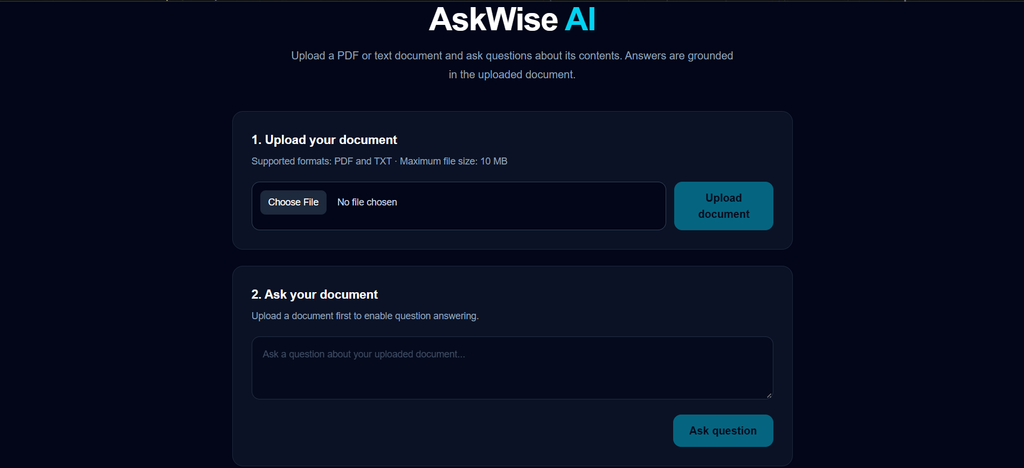
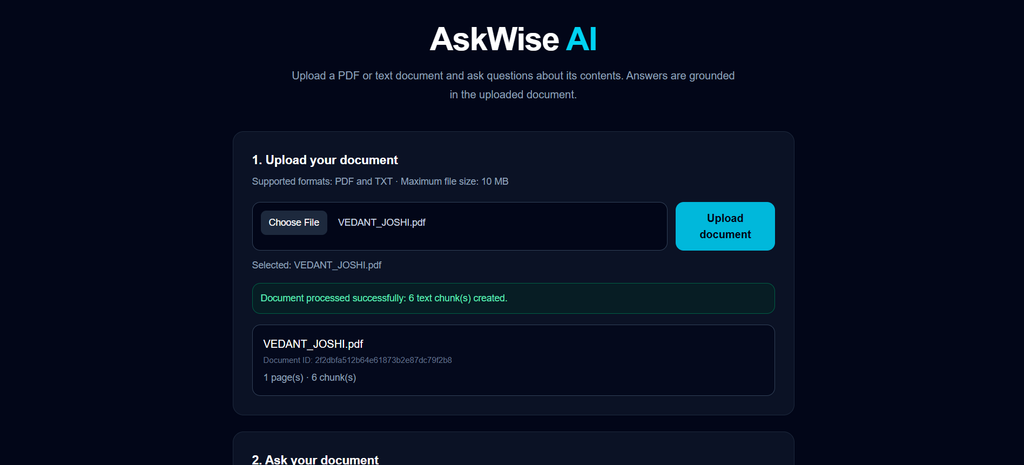
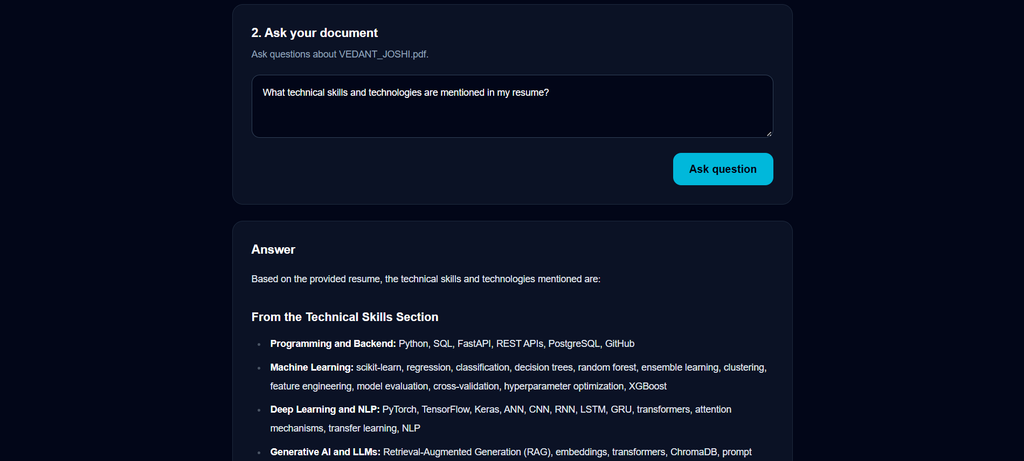
AskWise AI provides a simple interface for interacting with personal documents. Users can upload a PDF or TXT file, wait for it to be processed, and then enter questions about its contents.
The application includes the following capabilities:
- Document upload: Supports PDF and TXT files, with a maximum upload size of 10 MB.
- Document processing: Extracts text from uploaded documents and divides it into smaller chunks.
- Context retrieval: Uses embeddings and a vector database to find relevant document passages.
- AI-powered answers: Uses Google Gemini to generate responses based on retrieved context.
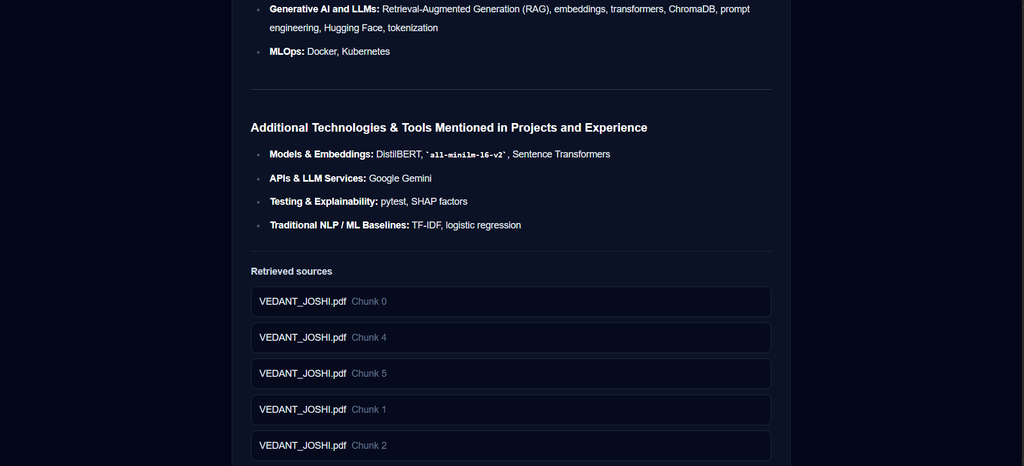
- Source visibility: Displays retrieved source chunks so users can see which parts of the document were used.
- Readable responses: Presents answers in a formatted interface that supports structured text and lists.
Technology Stack
The project combines backend development, frontend development, and AI components.
Python and FastAPI: Python handles the backend logic, while FastAPI exposes API endpoints for uploading documents and asking questions.
Next.js and TypeScript: The frontend provides the user interface for document uploads, question submission, loading states, error messages, and answer presentation.
Sentence Transformers: Embedding models convert text into numerical vector representations. These representations make it possible to compare the semantic similarity of a question and document passages.
ChromaDB: ChromaDB stores and retrieves vector embeddings and associated document information for similarity-based search.
Google Gemini: Gemini generates natural-language responses using the retrieved document context.
Deployment: The frontend is deployed through Vercel, while the backend API runs on Railway.
How the RAG Pipeline Works
The workflow begins when a user uploads a document. The backend extracts the available text and splits it into smaller chunks. Chunking is important because processing an entire document as one large unit can make retrieval less precise and complicate context management.
Next, the embedding model converts the chunks into vectors. These vectors are stored in ChromaDB along with relevant document information.
When a user asks a question, the system processes the query and retrieves document chunks that are semantically relevant to it. The retrieved passages are then provided to the language model as context.
Finally, Google Gemini generates an answer based on the question and retrieved information. The application also displays the retrieved sources, helping users understand which document sections informed the response.
An important design principle is to instruct the model to answer using the provided context and acknowledge when the requested information is not available. This does not guarantee that every answer will be correct, but it helps encourage document-grounded responses.
Key Learnings and Technical Challenges
1. Designing an End-to-End RAG Pipeline
One of the most valuable lessons was understanding how individual components work together. Document extraction, chunking, embeddings, vector storage, retrieval, and generation must be integrated carefully for the overall system to perform effectively.
2. Improving the Reliability of AI Responses
A language model can produce plausible answers even when the source does not contain the requested information. Grounding prompts in retrieved passages and making sources visible helped me understand the importance of context, retrieval quality, and transparent limitations.
3. Integrating and Deploying Full-Stack AI Applications
Connecting a FastAPI backend with a Next.js frontend provided practical experience with API integration, request handling, environment variables, error handling, and cloud deployment. Testing the deployed application also highlighted the importance of validating the complete workflow rather than testing individual components alone.
Conclusion
Building AskWise AI was a valuable opportunity to apply concepts from Generative AI, semantic search, and full-stack development to a practical problem. The project demonstrates how RAG can make information in uploaded documents easier to retrieve and explore through natural-language questions.
The work strengthened my understanding of embeddings, vector databases, context-grounded generation, API integration, and application deployment. It also reinforced an important lesson: a useful AI application depends not only on the language model, but also on the quality of the information retrieval pipeline and the way the system handles uncertainty.
I would like to thank Valentius Kryptix for the opportunity to work on this milestone and apply these technologies in a hands-on project.
As I continue learning about AI engineering, I look forward to exploring more advanced retrieval strategies, evaluation techniques, and improvements to RAG-based applications.
Explore the live application: https://rag-powered-ai-app.vercel.app/
To explore this problem, I developed AskWise AI, a Retrieval-Augmented Generation (RAG)-powered web application, as part of the “Milestone: RAG-Powered AI App” project during my internship at Valentius Kryptix.
The application allows users to upload PDF or TXT documents and ask questions about their contents. It retrieves relevant information from the uploaded document and uses an AI model to generate answers grounded in the available context.
Live Demo: https://rag-powered-ai-app.vercel.app/


Leave a Reply
You must be logged in to post a comment.