

Introduction
Artificial Intelligence (AI) is becoming an important part of our daily lives. Large Language Models (LLMs), such as ChatGPT and Gemini, can understand questions and generate human-like responses. However, these models may sometimes provide incorrect information or lack access to the latest data.
To overcome these limitations, Retrieval-Augmented Generation (RAG) is used. RAG is a technique that combines information retrieval with text generation. It allows AI models to retrieve relevant information from external knowledge sources before generating an answer.
RAG helps AI systems provide more accurate, relevant, and context-based responses.
1. What is a RAG System?
Retrieval-Augmented Generation (RAG) is an AI architecture that connects a Large Language Model with an external knowledge source.
Instead of depending only on the information learned during training, the system searches for relevant information from documents, databases, or other sources.
The retrieved information is then provided to the language model as additional context to generate an answer.
In simple words:
RAG first searches for the required information and then uses an AI model to generate an understandable answer based on that information.
2. Why Do We Need RAG?
Traditional Large Language Models have some limitations:
- They may generate incorrect or misleading answers.
- Their training knowledge may not contain recent information.
- They may not have access to private company or personal documents.
- They may produce answers without providing sufficient supporting context.
RAG helps overcome these problems by connecting language models with external and updated information sources.
For example, imagine a college develops an AI chatbot to answer questions about examination rules. Instead of expecting the chatbot to memorize every college regulation, RAG allows it to retrieve information directly from the college handbook and provide relevant answers.
3. Architecture of a RAG System
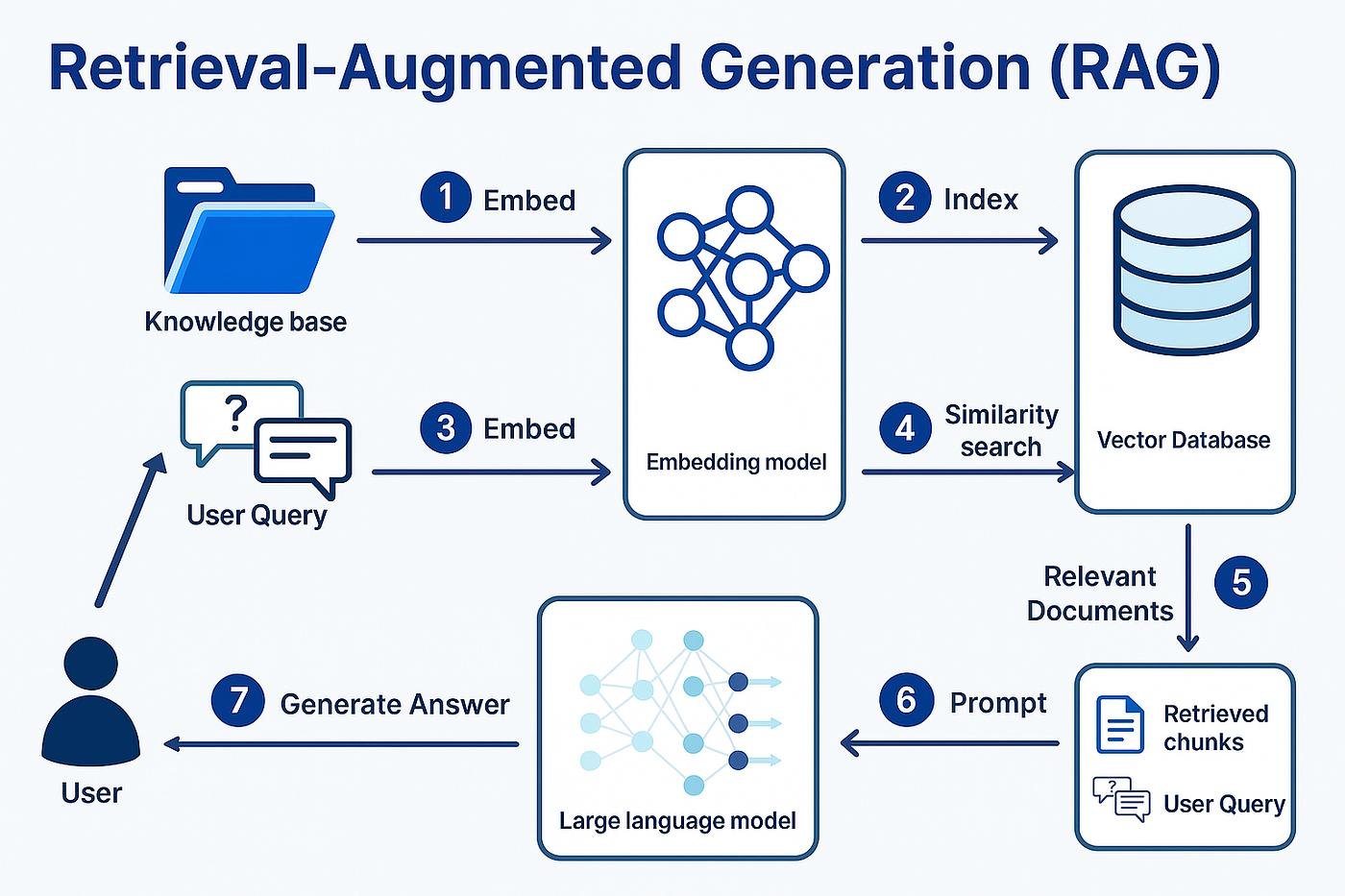
A typical RAG system consists of the following components:
1. Knowledge Source
The knowledge source contains information such as PDF files, Word documents, text files, websites, and databases.
2. Document Processing
The collected documents are converted into readable text. Unnecessary information is removed, and the content is prepared for further processing.
3. Text Chunking
Large documents are divided into smaller sections called chunks. This makes it easier to search for relevant information.
4. Embedding Model
An embedding model converts text chunks into numerical representations called vectors. These vectors capture the meaning of the text.
5. Vector Database
The generated embeddings are stored in a vector database. It helps retrieve information based on semantic similarity.
Examples include FAISS, Chroma, Pinecone, and Weaviate.
6. Retriever
When a user asks a question, the retriever searches the vector database and identifies the most relevant information.
7. Large Language Model (LLM)
The retrieved information is combined with the user’s question and sent to the LLM. The model generates a meaningful response using the provided context.
4. Working Process of RAG
The working process of a RAG system can be divided into two main stages.
A. Indexing Stage
This stage prepares the knowledge source for searching.
- Collect documents from different sources.
- Extract text from the documents.
- Divide the text into smaller chunks.
- Convert each chunk into numerical embeddings.
- Store the embeddings and corresponding text in a vector database.
B. Retrieval and Generation Stage
This stage generates answers for user questions.
- The user enters a question.
- The question is converted into an embedding.
- The retriever searches for similar information in the vector database.
- The most relevant document chunks are selected.
- The retrieved information is combined with the original question.
- The combined context is sent to the Large Language Model.
- The LLM generates a relevant answer and displays it to the user.
This process helps the AI system provide answers based on the available knowledge rather than relying only on its training data.
5. Technologies Used in RAG Systems
Several technologies are used to develop a RAG application.
- Python: Used to develop the application and connect different components.
- LangChain: Helps build applications using language models, retrievers, and document loaders.
- LlamaIndex: Helps connect LLMs with external data sources.
- Embedding Models: Convert text into numerical vectors.
- Vector Databases: Store and retrieve embeddings efficiently.
- Large Language Models: Generate human-readable answers from the retrieved information.
These technologies can be combined to develop intelligent question-answering applications.
6. Applications of RAG Systems
RAG systems are useful in many real-world applications.
1. AI Chatbots: They provide accurate responses by retrieving information from relevant knowledge sources.
2. Customer Support: Businesses can develop chatbots that answer customer questions using product manuals and company documents.
3. Educational Applications: Students can ask questions about textbooks, study materials, and lecture notes.
4. Healthcare Information Systems: RAG can help retrieve relevant information from medical documents and research publications. Such systems require appropriate professional validation.
5. Enterprise Document Search: Employees can search through company reports, policies, and internal documents using natural language.
6. Research Assistance: Researchers can retrieve relevant information from scientific papers and other research documents.
7. Advantages of RAG
- Improved Accuracy: Answers can be based on retrieved information.
- Updated Knowledge: External knowledge sources can be updated without retraining the entire LLM.
- Reduced Hallucinations: Providing relevant context can reduce unsupported AI responses.
- Cost Effective: It can avoid the need to retrain a language model whenever the knowledge base changes.
- Domain-Specific Responses: It can answer questions using company documents, educational materials, or other specific datasets.
- Flexible Integration: Different language models and knowledge sources can be connected.
8. Limitations of RAG
Although RAG provides many benefits, it also has certain limitations.
- Poor Retrieval Quality: Incorrectly retrieved documents can result in incorrect answers.
- Processing Time: Searching documents and generating answers may increase response time.
- Data Quality: Unclear or outdated documents can affect the output.
- Implementation Complexity: Building and maintaining a RAG pipeline requires proper configuration of multiple components.
- Context Limitations: Sending too much retrieved information to an LLM can exceed its context window.
Therefore, document quality, retrieval methods, and prompt design are important for developing an effective RAG application.
9. Conclusion
Retrieval-Augmented Generation is an important technology in modern Artificial Intelligence. It combines the information retrieval capabilities of search systems with the text generation capabilities of Large Language Models.
By retrieving relevant information from external knowledge sources, RAG helps AI applications generate more accurate, meaningful, and context-aware responses.
RAG is widely useful in chatbots, education, customer support, enterprise applications, and research assistance. As AI technology continues to develop, RAG will play an important role in building intelligent applications that can work with external knowledge efficiently.
RAG is an important step towards making AI systems more knowledgeable, reliable, and useful in real-world applications.

Leave a Reply
You must be logged in to post a comment.