
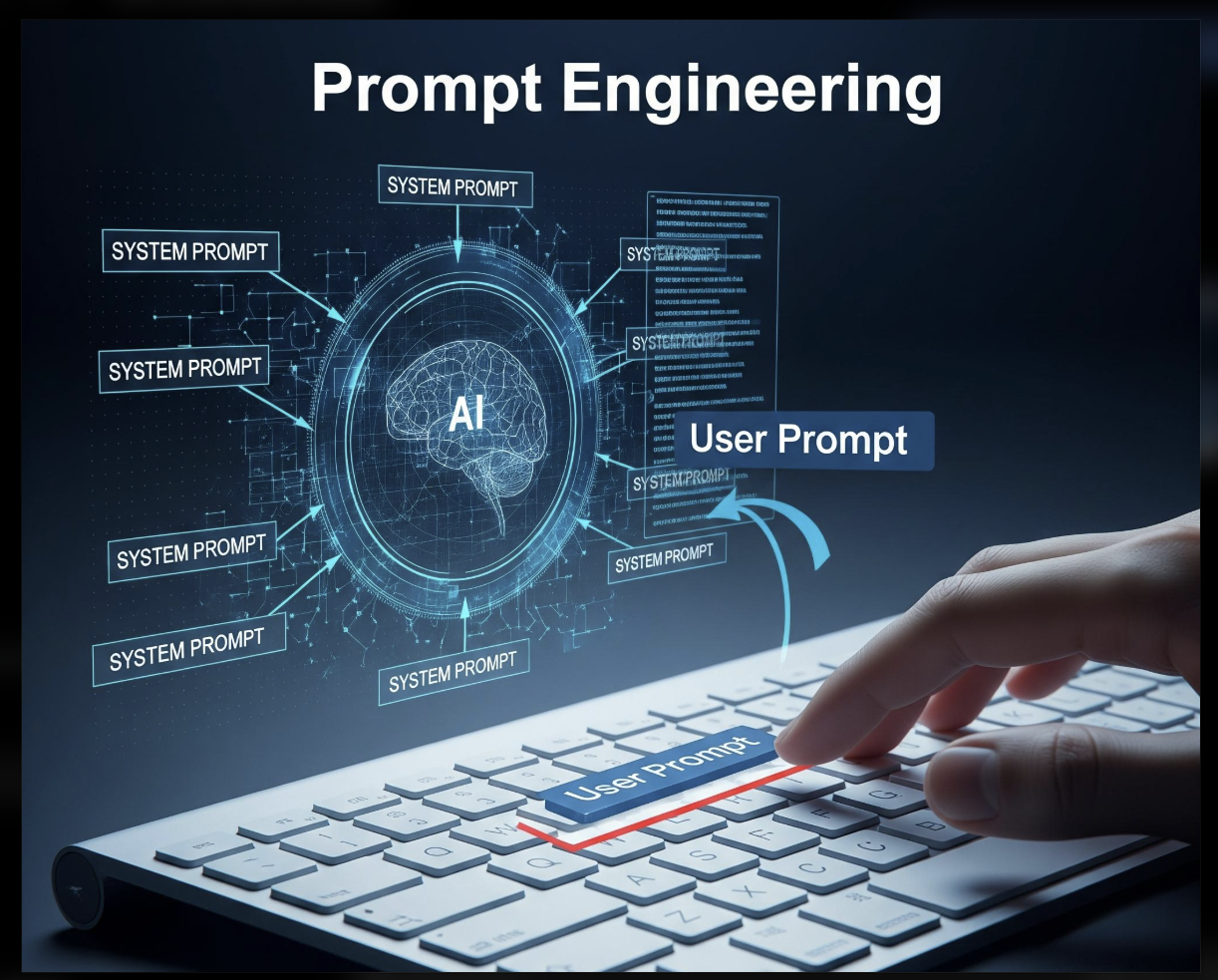

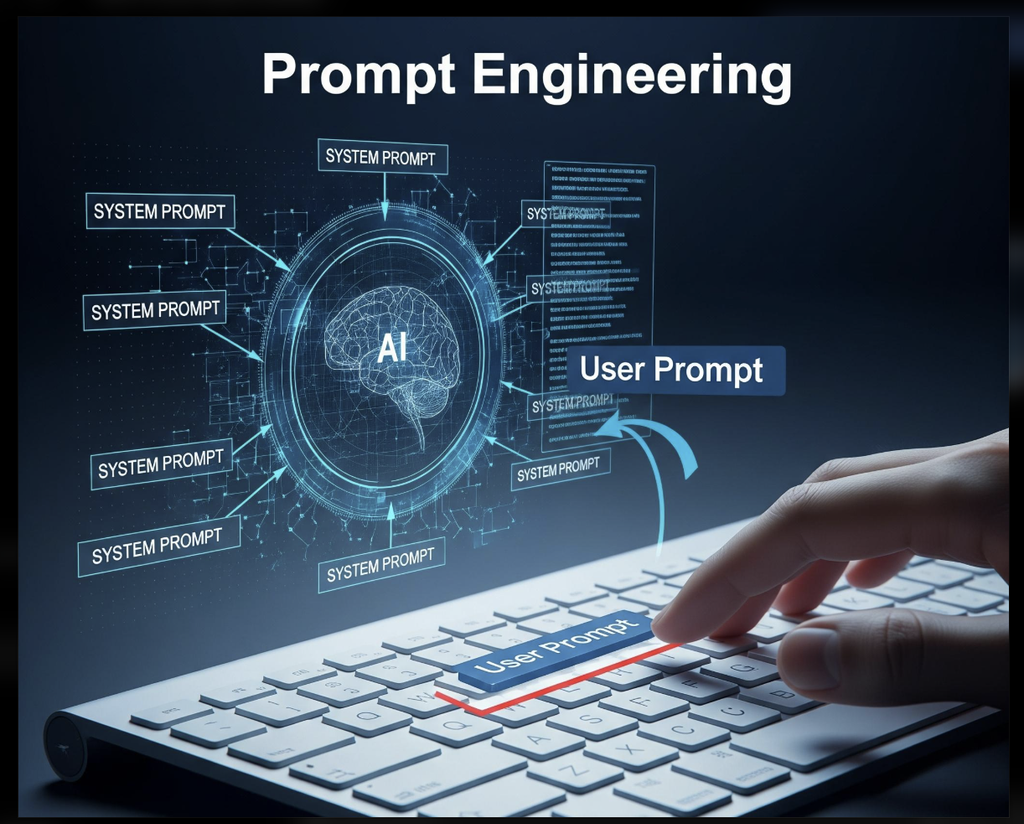
Artificial Intelligence is growing rapidly, and tools powered by Large Language Models (LLMs) are becoming an important part of modern technology. One of the key skills required to work effectively with these models is Prompt Engineering.
Prompt Engineering is the process of designing and improving instructions given to AI models to generate accurate, relevant, and useful responses. A well-written prompt helps an AI model understand what the user expects and produce better results.
During my internship at Valentius Kryptix, I explored Prompt Engineering techniques and worked on a practical project to understand how different prompting methods influence AI-generated responses.
What is Prompt Engineering?
Prompt Engineering involves creating clear and structured instructions for AI models. Instead of asking general questions, we provide specific instructions, context, examples, and expected output formats.
For example:
A basic prompt:
“Explain Machine Learning.”
An improved prompt:
“Explain Machine Learning in simple English, include three real-world applications, and provide one practical example for a beginner.”
The second prompt provides more direction and helps the AI generate a more useful response.
Important Prompt Engineering Techniques
1. Zero-Shot Prompting
Zero-shot prompting means asking an AI model to complete a task without providing examples.
For example:
“Classify this sentence as positive, negative, or neutral: I really enjoyed this product.”
The model performs the task using its existing knowledge.
This technique is useful for simple classification, summarization, and question-answering tasks.
2. Few-Shot Prompting
Few-shot prompting involves providing a few examples before asking the model to perform a task.
For example:
Example 1:
Input: I love this phone.
Output: Positive
Example 2:
Input: This product is terrible.
Output: Negative
Now classify:
Input: The service was excellent.
Output:
By learning from the provided examples, the model can better understand the expected response pattern.
3. Chain-of-Thought Prompting
Chain-of-Thought prompting encourages an AI model to approach complex problems in a structured, step-by-step manner.
For example:
“Solve this mathematical problem and provide a clear explanation of the main steps.”
This approach can be useful for mathematical problems, logical reasoning, and complex question-answering tasks.
4. Structured Output Prompting
Structured output prompting means instructing an AI model to return information in a specific format, such as JSON.
For example:
“Provide information about Python in JSON format with the following fields: language, type, and applications.”
Expected output:
{
“language”: “Python”,
“type”: “Programming Language”,
“applications”: [“AI”, “Machine Learning”, “Web Development”]
}
Structured outputs are useful when integrating AI models with applications and APIs.
My Practical Experience with Prompt Engineering
As part of my internship learning at Valentius Kryptix, I worked on a project called Prompt Engineering Mastery Lab.
The main objective of this project was to explore different prompting techniques and understand how they affect the responses generated by AI models.
I worked with the following concepts:
- Zero-shot and Few-shot prompting to compare how examples influence AI responses.
- Chain-of-Thought prompting to explore structured reasoning approaches.
- Structured JSON output to generate responses in a predefined format.
- Multiple test inputs to observe and analyze the consistency of generated outputs.
I also explored using the Gemini API to interact with an AI model and understand how prompts can be integrated into practical applications.
This project helped me understand that the quality of an AI response depends not only on the model but also on how effectively instructions are designed.
Applications of Prompt Engineering
Prompt Engineering has many real-world applications:
- AI Chatbots: Creating useful and context-aware conversations.
- Content Generation: Generating articles, summaries, and social media content.
- Data Analysis: Extracting and organizing information from unstructured data.
- Software Development: Assisting with code generation, debugging, and explanations.
- Education: Creating personalized learning materials and explanations.
Key Learnings
Through this learning experience, I understood several important concepts:
- Clear and specific prompts improve the usefulness of AI responses.
- Few-shot prompting helps models follow expected patterns through examples.
- Structured output makes AI responses easier to integrate into applications.
- Testing prompts with different inputs is important for evaluating their performance.
- Prompt Engineering is an important skill for developing practical Generative AI applications.
Conclusion
Prompt Engineering is an important skill in the growing field of Generative AI. It helps users communicate effectively with AI models and obtain more relevant and structured responses.
Working on the Prompt Engineering Mastery Lab during my internship at Valentius Kryptix gave me practical exposure to different prompting techniques and their applications.
I look forward to exploring more advanced Generative AI concepts and building useful AI-powered applications in the future.


Leave a Reply
You must be logged in to post a comment.