

1. Introduction
As part of my one-month Full Stack Web Development Internship at Valentius Kryptix, I developed a personal portfolio website to showcase my technical skills, projects, professional background, and learning journey.
The main objective of this project was to create a professional online presence where visitors, recruiters, and potential collaborators could learn about my background, explore my technical abilities, and connect with me.
I designed the portfolio with a clean structure, user-friendly navigation, and responsive web design principles. The website brings together my personal introduction, technical skills, project showcases, and contact information in one place.
2. Project Objectives
The primary goal was to develop a professional and responsive personal portfolio website that communicates my technical capabilities effectively.
The key objectives included:
- Creating a professional homepage with a personal introduction.
- Developing an About section to introduce my background.
- Organizing technical skills into different categories.
- Showcasing at least three projects with relevant information.
- Providing accessible contact details and social media links.
- Ensuring a consistent and responsive experience across different screen sizes.
- Applying semantic HTML and modern web development practices.
3. Technologies and Technical Skills
During this project, I focused on applying fundamental frontend development concepts and organizing my technical knowledge into a structured portfolio.
My technical skills are presented in the following categories:
Frontend Development:
- HTML5 and semantic HTML.
- Modern JavaScript.
- CSS Flexbox and CSS Grid.
- Responsive Web Design.
- DOM Manipulation.
- Fetch API and REST API integration.
Backend Development:
- Node.js.
- Express.js.
- RESTful API Design.
- JSON.
- Async/Await.
Database Technologies:
- SQL and PostgreSQL.
- MongoDB.
- Authentication concepts.
- Redis.
Tools and Workflow:
- Git and GitHub.
- Visual Studio Code.
- Chrome Developer Tools.
- Terminal.
- Figma.
- Postman.
These skills represent the technical areas I have explored and organized within my portfolio.
4. Main Features and Website Structure
I divided the website into five major sections to provide visitors with a clear and organized browsing experience.
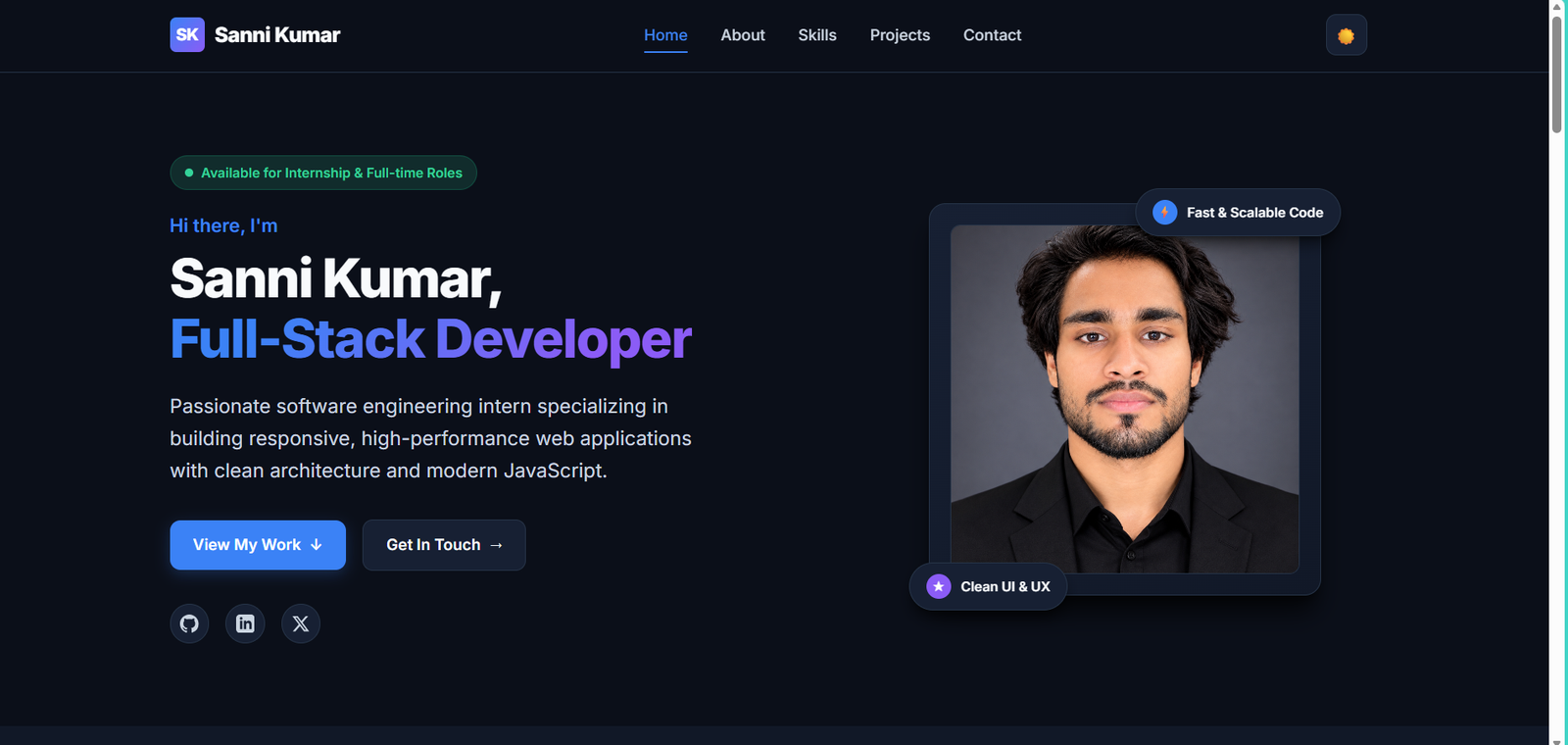
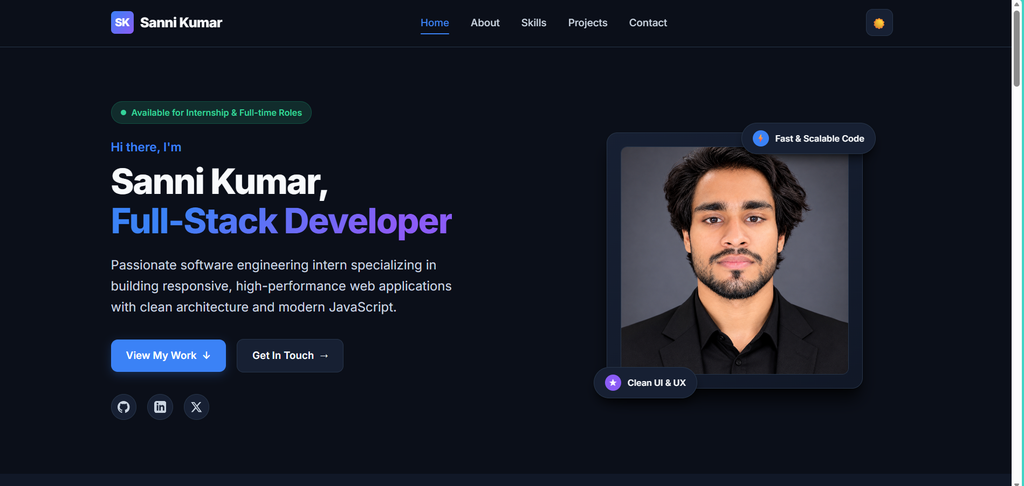
A. Home Section
The Home section serves as the first point of interaction for visitors. It introduces me through my profile and a short professional introduction.
It includes two important navigation options:
- View My Work: Allows visitors to explore my projects.
- Get in Touch: Provides a convenient way to reach me.
I also included links to my GitHub, LinkedIn, and Twitter profiles so visitors can explore my professional activities and technical work.
B. About Section
The About section provides information about my background, interests, technical journey, and professional goals.
Its purpose is to help visitors understand who I am, what I am interested in, and my motivation for exploring software development and new technologies.
C. Skills Section
The Skills section presents my technical knowledge in an organized format.
Instead of displaying all technologies together, I categorized them into frontend, backend, databases, and tools and workflow.
This structure makes it easier for recruiters and visitors to identify my technical strengths and areas of interest.
D. Projects Section
The Projects section is one of the most important parts of my portfolio because it demonstrates my practical learning and development experience.
I included three project showcases:
- Cloud Elementary
- Flow Board Organizer
- Nexus Market Storefront
Each project is presented as part of my development portfolio to demonstrate my interest in building practical applications and improving my programming skills.
E. Contact Section
The Contact section provides my email address and location information.
It gives recruiters, developers, and other interested visitors a direct way to connect with me regarding professional opportunities, collaboration, or technical discussions.
5. Responsive Web Design
One of the important requirements of this project was ensuring that the website works properly across different screen sizes.
I focused on responsive design so visitors could access the portfolio using desktop computers, tablets, and mobile devices.
The website was designed with the following screen widths in mind:
- Mobile: 375px.
- Tablet: 768px.
- Desktop: 1280px and above.
I used modern CSS layout concepts, including Flexbox and CSS Grid, to organize website elements and maintain a consistent layout across different devices.
6. Development Process
I followed a structured development approach throughout the project.
First, I planned the website structure and identified the sections required for a professional portfolio.
Next, I developed the HTML structure using semantic elements to improve organization and readability.
After creating the structure, I worked on the CSS styling to establish the layout, spacing, typography, and responsive behavior.
I also focused on JavaScript concepts to support interactive website functionality.
Finally, I tested the website at different screen widths and checked its navigation, links, and overall usability before publishing the project on GitHub.
7. Challenges and Key Learnings
Working on this project helped me understand how different web development concepts come together to create a complete website.
Some important learning outcomes included:
- Responsive Design: Improved my understanding of creating layouts that adapt to different screen sizes using CSS Flexbox and Grid.
- Semantic HTML: Learned the importance of using meaningful HTML elements to organize website content and improve code readability.
- JavaScript and DOM Manipulation: Strengthened my understanding of JavaScript concepts and how interactive website elements can improve the user experience.
- Git and GitHub: Gained practical experience in managing source code, maintaining a public repository, and publishing a website using GitHub Pages.
- Project Organization: Learned how to organize different sections of a website and present technical information in a professional manner.
8. Conclusion
Developing my personal portfolio website was a valuable learning experience during my Full Stack Web Development Internship at Valentius Kryptix.
This project allowed me to apply web development concepts in a practical environment and create a platform to showcase my technical skills, projects, and professional journey.
It also helped me understand the importance of responsive design, clean website structure, usability, and version control in modern web development.
I would like to express my gratitude to Valentius Kryptix and its mentors for providing this learning opportunity and encouraging me to improve my technical skills.
I look forward to building more projects, exploring new technologies, and continuing my journey as a developer.
Explore My Work:
- Live Portfolio: https://sani75.github.io/Sanni_portfolio/
- GitHub Repository: https://github.com/sani75/Sanni_portfolio/
Thank you for reading!


Leave a Reply
You must be logged in to post a comment.