
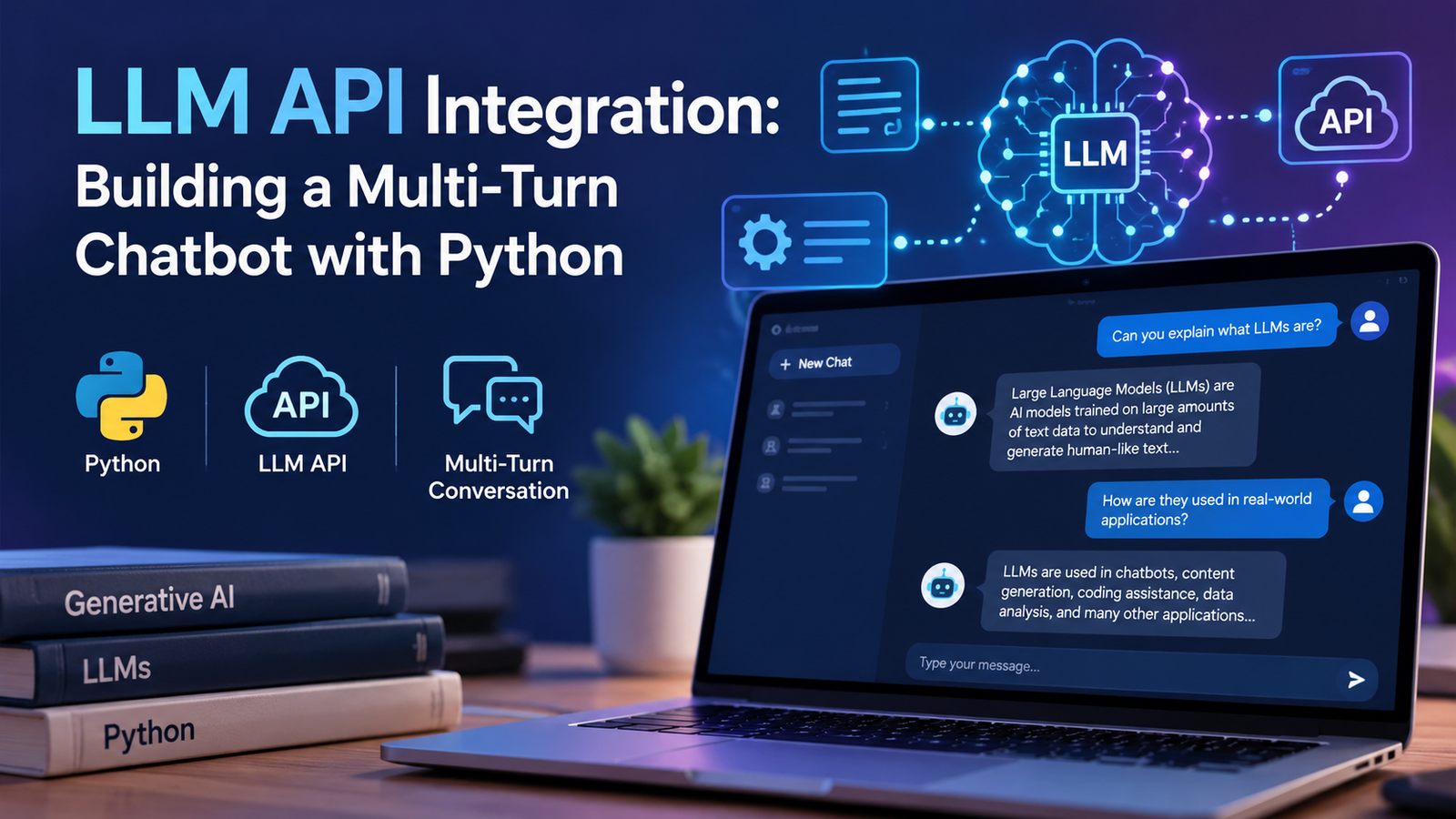

LLM API Integration: Building a Multi-Turn Chatbot
During my internship at Valentius Kryptix, I worked on an LLM API Integration project using Python.
The project focused on building a multi-turn chatbot that can maintain conversation context and generate relevant responses.
Key Learnings:
- LLM API integration using Python
- Managing conversation history and context
- Handling prompts and AI-generated responses
An LLM-powered chatbot consists of several components that work together to create a conversational experience. The user first enters a message through the chatbot interface. The application then receives the input and prepares it for processing. The relevant conversation history can be included along with the new message so that the language model has sufficient context.
The prepared request is then sent to the LLM API. The API processes the request and returns a generated response. The application receives this response and displays it to the user. When the user sends another message, the application can use the previous conversation along with the new message to create a continuous interaction.
This architecture demonstrates an important concept in modern AI applications: the language model itself is only one part of the complete system. The application surrounding the model is responsible for handling user input, managing conversation history, communicating with the API, processing responses, and presenting the results.
Understanding this complete workflow helped me see how artificial intelligence models can be integrated into practical software applications.
Role of Python in the Project
Python was used as the main programming language for the chatbot because it provides a simple and flexible environment for developing AI applications. Python has a large ecosystem of libraries and tools that make it suitable for working with APIs, artificial intelligence, machine learning, and data processing.
In an LLM application, Python can be used to collect user input, prepare API requests, manage conversation history, handle responses, and control the overall application flow. Its readable syntax also makes it easier to understand and maintain the code.
During this project, I gained more confidence in using Python for an application that communicates with an external AI service. Previously, I had mainly used Python for programming and machine learning tasks. Working with an LLM API helped me understand another important use of Python in modern AI development.
The experience also showed me that successful AI application development requires both programming knowledge and an understanding of how AI services communicate with applications.
Importance of API Communication
An API, or Application Programming Interface, allows different software components to communicate with each other. In the case of an LLM application, the Python program communicates with an external language model through an API.
The application sends information to the API in a structured format. This information can include the user’s prompt and relevant conversation context. The API processes the request and returns a response that can be used by the application.
Learning this process was one of the important parts of the project. It helped me understand that developers do not always need to build an AI model from the beginning. Instead, existing AI models can be integrated into applications through APIs.
API-based development also makes it possible to create different types of applications around the same underlying AI capability. For example, an LLM API can be used in chatbots, educational assistants, customer support applications, content generation systems, programming assistants, and many other solutions.
Managing Conversation History
Conversation history is one of the most important concepts in a multi-turn chatbot. If every user message is treated independently, the chatbot may not understand follow-up questions properly.
Consider a simple conversation where a user asks, “What is machine learning?” After receiving an explanation, the user might ask, “What are its applications?” The second question depends on the previous conversation because the user is referring to machine learning.
A multi-turn chatbot therefore needs a mechanism for maintaining relevant previous messages. The conversation history provides the model with additional context that can help it understand what the user means.
Managing context also requires careful consideration of the amount of information sent to the model. Very long conversations can contain a large amount of previous information. Therefore, developers need to think about how conversation history should be stored and how relevant information should be provided to the model.
This project helped me understand why context management is an important part of conversational AI systems.
Prompt Design and User Input
Another important learning from this project was the role of prompts. A prompt is the information or instruction provided to a language model to guide its response.
The quality and structure of the input can influence the response generated by an LLM. Clear and meaningful prompts can help the model understand what the user is asking and provide a more relevant answer.
For a chatbot, user input can be very different from one conversation to another. Some users may ask direct questions, while others may provide incomplete information or ask follow-up questions. The application therefore needs to handle different forms of input.
Working on the chatbot gave me practical exposure to the relationship between user input, conversation context, and generated output. It also encouraged me to think about how prompt design can be improved for different use cases.
Handling API Responses
After a request is sent to an LLM API, the application receives a response. The response needs to be processed correctly before it is displayed to the user.
This involves understanding the structure of the returned data and extracting the useful generated content. Proper response handling is important because the application should provide a clear and readable answer rather than exposing unnecessary technical information.
Response handling is also connected to error handling. API requests can fail for different reasons, such as incorrect configuration, network problems, unavailable services, invalid requests, or authentication issues.
Therefore, an application should be designed with appropriate error-handling mechanisms. During the project, I learned that connecting an AI model to an application involves more than simply sending a request. The application must also be prepared to handle different situations that may occur during communication.
Security and API Credentials
Security is an important consideration when developing applications that use external APIs. API credentials should not be exposed publicly in source code or shared through public repositories.
During LLM API integration, configuration information and credentials need to be handled carefully. Developers should use secure methods for storing sensitive information and avoid placing private keys directly in code that may be shared.
This project helped me become more aware of security considerations in API-based application development. Even when the primary objective is learning or experimentation, protecting credentials is an important development practice.
Secure handling of API keys becomes even more important when applications are deployed for real users. Accidentally exposing a credential can result in unauthorized API usage and unexpected costs.
Testing the Chatbot
Testing was another important part of the development process. A chatbot needs to be tested using different types of conversations rather than only a single question.
For example, users may ask simple factual questions, follow-up questions, clarification questions, or questions that depend heavily on previous messages. Testing these different situations helps identify problems with conversation context and response handling.
I also learned that AI applications can produce different responses for similar prompts. Therefore, testing an LLM application is different from testing a simple program where the output may always be identical for the same input.
The focus is not only on whether the application runs successfully but also on whether the interaction is useful, understandable, and consistent with the intended purpose of the application.
Challenges Faced During Development
One of the main challenges was understanding how multi-turn conversations should be managed. A chatbot that supports multiple turns needs to maintain sufficient context without unnecessarily sending unrelated information.
Another challenge was understanding the communication between the Python application and the external LLM service. API requests, responses, authentication, configuration, and error handling all need to work together correctly.
Designing the flow of the application was also an important learning experience. The chatbot needs to continuously accept user input, process it, communicate with the model, display the response, and then wait for the next interaction.
These challenges helped me understand that building an AI application requires integration of several different concepts. Programming, API communication, prompt handling, context management, and user interaction all contribute to the final system.
Practical Applications of LLM Chatbots
LLM-based chatbots have many practical applications across different industries. In education, chatbots can help students understand concepts, generate explanations, and answer questions.
In customer support, conversational AI can help users find information and receive assistance. Businesses can also use AI assistants to automate repetitive communication tasks.
LLM chatbots can also be used for programming assistance, document analysis, content generation, research support, and productivity applications.
The ability to maintain conversation context makes multi-turn systems especially useful because users can communicate naturally without repeating the same information in every message.
This project helped me understand why conversational AI has become an important area of modern artificial intelligence.
Future Improvements
There are several ways in which the chatbot could be improved in the future. One possible improvement would be to develop a more advanced user interface that provides a smoother conversational experience.
Another improvement could involve better conversation-history management. Instead of keeping every message indefinitely, the system could identify and retain the most relevant information.
The chatbot could also include additional features such as conversation export, user authentication, session management, response formatting, and improved error messages.
Another possible direction would be integrating retrieval-augmented generation techniques so that the chatbot can use information from a specific knowledge base while generating responses.
The system could also be evaluated using a larger collection of test conversations to understand its performance under different situations.
These improvements demonstrate that an initial LLM chatbot can serve as a foundation for developing more advanced AI applications.
Skills Developed During the Internship
Working on the LLM API Integration project helped me develop both technical and problem-solving skills. I gained practical experience with Python and learned how applications communicate with AI services through APIs.
I also developed a better understanding of multi-turn conversations, prompt handling, context management, and API response processing.
In addition to technical knowledge, the project improved my ability to troubleshoot problems. When an application does not behave as expected, developers need to identify whether the issue is related to user input, application logic, API communication, configuration, or response processing.
This experience also improved my understanding of how concepts learned in artificial intelligence can be applied to practical software projects.
Conclusion
The LLM API Integration project was an important learning experience during my internship at Valentius Kryptix. Developing a multi-turn chatbot helped me understand how modern language models can be connected to Python applications through APIs.
The project introduced me to important concepts including API communication, conversation history, prompt design, response handling, security, testing, and conversational AI architecture.
One of the most valuable lessons was that building an AI application is not only about using a powerful language model. The surrounding application logic is equally important. A useful chatbot needs to correctly manage user input, conversation context, API communication, generated responses, and errors.
Through this project, I gained practical exposure to Large Language Models and Generative AI application development. The experience strengthened my Python skills and helped me understand how AI technologies can be integrated into real-world applications.
I am grateful to Valentius Kryptix for providing the opportunity to work on a practical LLM-based project during my internship. This experience has encouraged me to explore more areas of Generative AI, Large Language Models, AI APIs, prompt engineering, and intelligent application development.
Project Repository
The complete project can be found on GitHub:
The project represents my practical learning in LLM API integration and multi-turn conversational AI using Python.
GitHub:
https://github.com/malaladdiyavar/llm-multiturn-chatbot

Leave a Reply
You must be logged in to post a comment.