

Introduction
Database design is an important part of software development because it determines how application data is stored, organized, connected, and retrieved. A well-structured database helps maintain data consistency, reduces unnecessary duplication, and makes it easier to manage information.
As part of my internship at Valentius Kryptix, I completed a Database Design task in which I designed and implemented a relational database for an E-Commerce Management System using MySQL 5.7 and MySQL Workbench.
The objective of this task was to understand how a real-world application can organize information about customers, products, orders, payments, and reviews through related database tables.
Project Overview
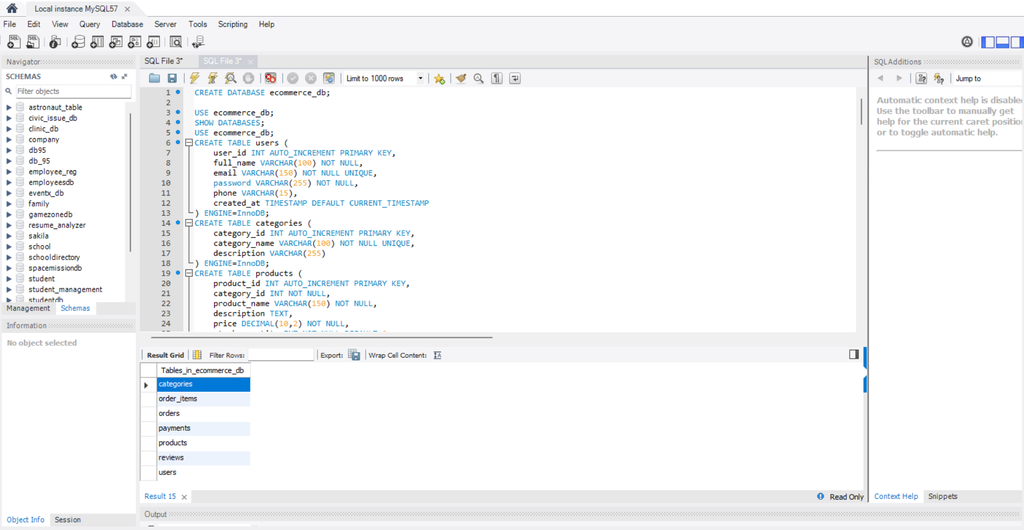
For this project, I created a database named ecommerce_db. I designed seven related tables to represent the main entities of an e-commerce application:
- Users: Stores customer information, including names, email addresses, and account details.
- Categories: Stores product category information.
- Products: Contains product details such as product names, prices, SKU, and category references.
- Orders: Stores customer order information, including order status and shipping address.
- Order Items: Connects orders with products and stores the quantity and unit price of each product in an order.
- Payments: Stores payment information associated with orders.
- Reviews: Stores customer reviews and ratings for products.
Separating these details into individual tables helps organize the database and makes relationships between different types of information easier to manage.
Database Relationships and ER Diagram
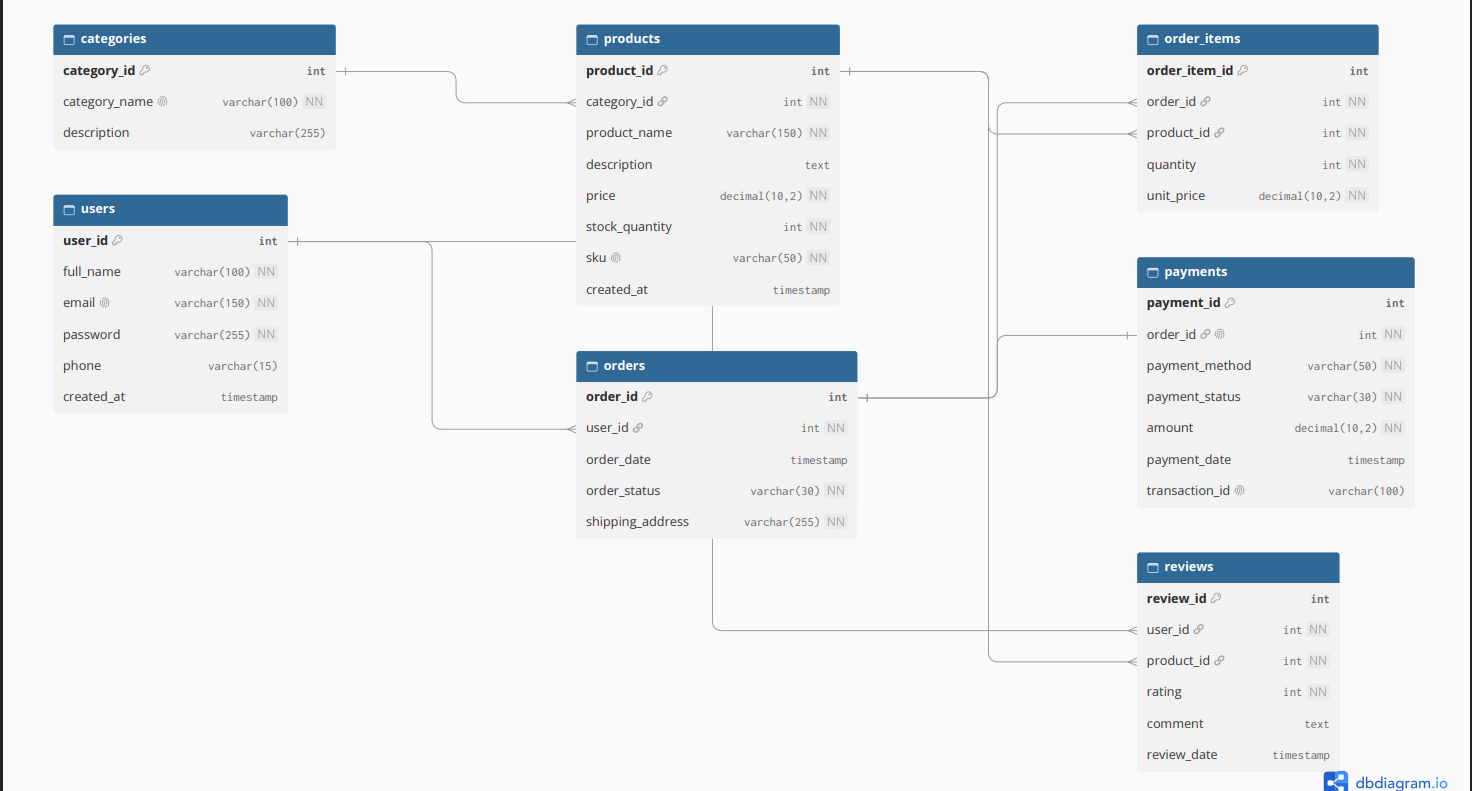
After creating the tables, I designed an Entity Relationship Diagram (ER Diagram) to understand how the entities are connected.
The database includes several one-to-many relationships. One user can place multiple orders, one category can contain multiple products, and one product can receive multiple reviews.
The relationship between orders and products is many-to-many. To manage this relationship, I created an intermediate table called order_items. It connects the orders and products tables and stores details such as quantity and unit price.
The payments table is connected to orders through a unique order reference, allowing an order to have at most one associated payment record.
The ER diagram helped me understand the overall database structure before working with the data.
Database Normalization
One of the important parts of this task was understanding database normalization. Normalization helps organize data and reduce unnecessary duplication.
I studied and applied the following normalization concepts:
First Normal Form (1NF): Each table stores atomic values, and repeating groups are avoided. Each record can be identified using a primary key.
Second Normal Form (2NF): Non-key attributes should depend on the complete candidate key. Separating related information into appropriate tables helps avoid partial dependencies.
Third Normal Form (3NF): Non-key attributes should depend on the key, the whole key, and nothing but the key. For example, customer details are stored in the users table rather than repeatedly storing them in every order record.
Applying these principles helped me build a more organized relational database.
Primary Keys, Foreign Keys, Constraints, and Indexes
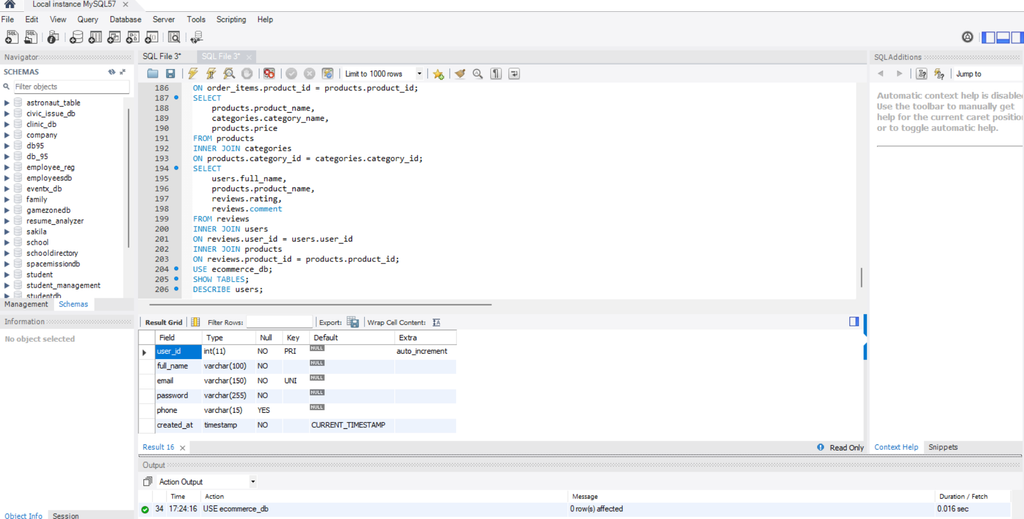
I used primary keys to uniquely identify records in each table. Foreign keys establish relationships between tables and help maintain referential integrity.
I also implemented constraints such as UNIQUE constraints to prevent duplicate values in fields such as email addresses, product SKUs, and transaction IDs.
Indexes were added to selected columns that are useful for searching and joining data, including product categories, product names, order dates, and related product references.
These database features helped me understand how to maintain data integrity and improve query efficiency.
Sample Data and SQL JOIN Queries
After creating the database structure, I inserted sample records into all seven tables. This allowed me to test the relationships and verify that the database worked as expected.
I also practised SQL JOIN queries to retrieve related information from multiple tables. I successfully executed four JOIN queries:
- Users and Orders: Retrieved customer information along with their order details.
- Order Items, Orders, and Products: Retrieved product names, quantities, and prices associated with orders.
- Products and Categories: Displayed products together with their category names.
- Reviews, Users, and Products: Retrieved customer names, product names, ratings, and review comments.
These queries helped me understand how relational databases connect information stored in separate tables.
Tools and Technologies Used
- MySQL 5.7: For creating and managing the relational database.
- MySQL Workbench: For writing SQL queries, creating tables, inserting sample data, and testing JOIN operations.
- dbdiagram.io: For creating the Entity Relationship Diagram.
Key Learnings
This task gave me practical experience in database design and relational database management. Some of my key learnings were:
- Understanding how to identify entities, attributes, primary keys, and foreign keys before creating tables.
- Applying normalization principles to organize data and reduce duplication.
- Using SQL constraints, indexes, and JOIN queries to maintain relationships and retrieve meaningful information.
I also learned the importance of planning database relationships carefully because a good database structure makes application development and data management easier.
Conclusion
Completing this Database Design task was a valuable learning experience during my internship at Valentius Kryptix. Building the E-Commerce Management System database helped me connect theoretical database concepts with practical SQL implementation.
I gained hands-on experience in designing seven related tables, creating an ER diagram, inserting sample data, and executing JOIN queries. This task strengthened my understanding of MySQL and gave me a better foundation for designing databases for real-world applications.
I look forward to applying these concepts in future full-stack development projects and continuing to improve my technical skills.

Leave a Reply
You must be logged in to post a comment.