

Introduction
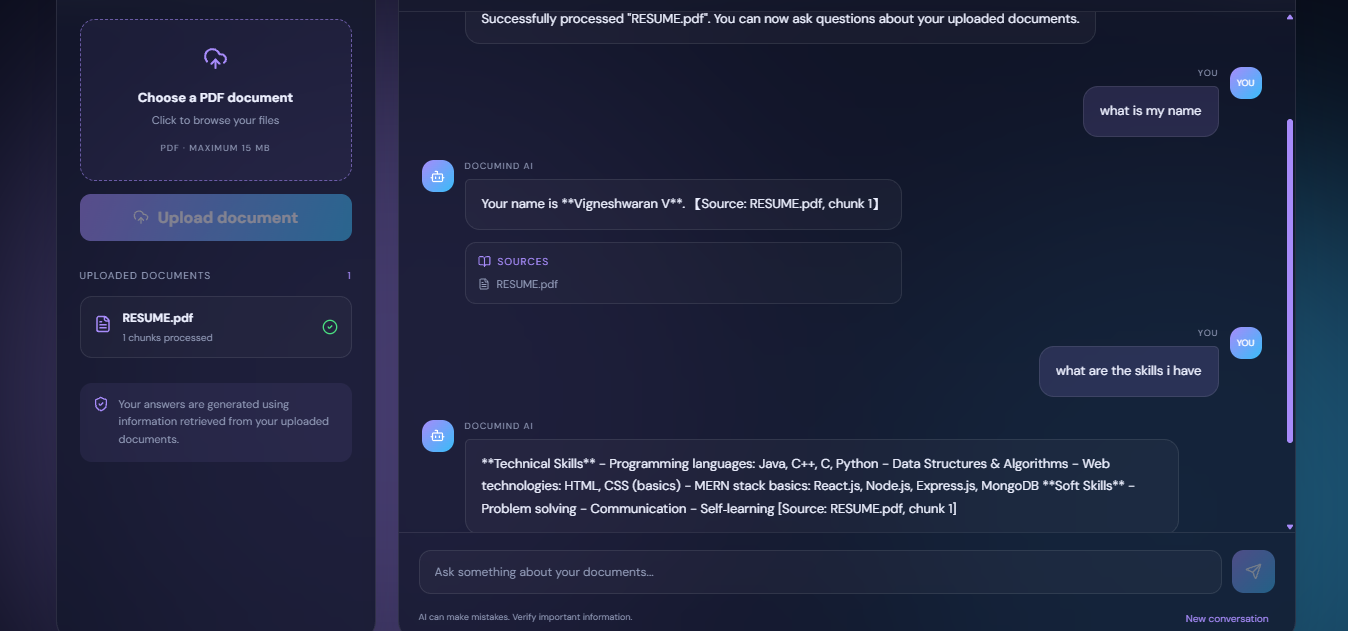
As part of my internship at Valentius Kryptix, I have reached an exciting milestone by developing a Retrieval-Augmented Generation (RAG) powered AI application called DocuMind AI.
The main objective of this project was to build an intelligent document-based question-answering system that allows users to upload documents and interact with their content using AI. Instead of providing generic responses, the application retrieves relevant information from uploaded documents and generates answers based on the available context.
This project helped me understand how modern AI applications combine Large Language Models (LLMs), embeddings, vector databases, and backend development to solve practical problems.
What Is DocuMind AI?
DocuMind AI is an AI-powered document assistant designed to make information retrieval easier and faster.
Users can upload documents and ask questions related to their content. The application processes the uploaded files, extracts relevant information, converts the content into embeddings, and stores those embeddings in a vector database.
When a user asks a question, the system searches for relevant document sections and provides them as context to the AI model. The model then generates a response based on the retrieved information.
The application also provides source references so users can understand where the generated information comes from.
Technologies Used
During development, I worked with several technologies:
- React: Used to build the interactive frontend and user interface.
- Node.js and Express.js: Used to develop backend APIs and handle application requests.
- Gemini and Groq: Integrated AI model services for intelligent response generation.
- Embeddings: Used to represent document content as numerical vectors.
- Qdrant: Used as the vector database for storing and retrieving relevant document information.
- Vercel: Used for deploying the application.
Combining these technologies helped me understand how different components work together in a complete AI-powered application.
How the RAG System Works
One of the most interesting parts of this project was implementing the RAG workflow.
The application follows these major steps:
- Document Upload
Users upload their documents through the application interface. The backend receives the files and processes their content.
- Text Extraction and Chunking
The extracted text is divided into smaller chunks. This makes it easier to process and retrieve relevant information without sending the entire document to the AI model.
- Embedding Generation
The text chunks are converted into vector embeddings. These embeddings capture the semantic meaning of the text.
- Vector Database Storage
The generated embeddings and associated document information are stored in Qdrant.
- Similarity Search
When a user submits a question, the system converts the query into an embedding and searches the vector database for semantically similar document chunks.
- AI Response Generation
The retrieved information is passed as context to the AI model, which generates a relevant answer based on the uploaded documents.
Key Learnings and Challenges
This milestone provided me with valuable hands-on experience in AI application development.
Some of my major learnings include:
- Understanding the complete Retrieval-Augmented Generation workflow.
- Learning how embeddings and vector databases support semantic search.
- Understanding document chunking and why it is important for efficient retrieval.
- Integrating frontend and backend APIs in a real-world application.
- Working with external AI services and handling API requests.
- Understanding deployment challenges and environment variable configuration.
I also faced challenges during backend integration and deployment, particularly while connecting the frontend with backend APIs and configuring external services. Debugging these issues helped me improve my problem-solving skills and understand the importance of proper API configuration.
Another important learning was understanding that generating an AI response is only one part of an AI application. Retrieving the correct context and providing reliable information are equally important.
Project Outcome
Successfully developing DocuMind AI gave me practical exposure to building an end-to-end RAG-powered application.
The project demonstrates how users can interact with their own documents through an AI assistant rather than manually searching through large amounts of information.
It also helped me gain confidence in working with modern AI technologies, backend development, vector databases, and application deployment.
Conclusion
Completing this milestone at Valentius Kryptix has been a valuable learning experience in my development journey.
Working on DocuMind AI helped me move beyond theoretical knowledge and understand how RAG systems are implemented in practical applications.
I am grateful for this opportunity and excited to continue exploring AI, machine learning, and full-stack development through future projects.
Project Link: https://documind-ai-eight-pi.vercel.app
#ValentiusKryptix #Internship #RAG #ArtificialIntelligence #GenerativeAI #Qdrant #ReactJS #NodeJS #DataScience


Leave a Reply
You must be logged in to post a comment.