

# Supervised Learning: Understanding the Basics of Machine Learning
Machine learning is one of the most important areas of modern technology. It allows computers to learn from data and make predictions or decisions without being explicitly programmed for every possible situation. One of the most widely used approaches in machine learning is **Supervised Learning**.
Supervised learning is a machine learning technique where a model learns from a dataset containing both input data and the correct output, also known as a label. The main objective is to learn the relationship between the input and output so that the trained model can make accurate predictions on new and unseen data.
## How Supervised Learning Works
The supervised learning process begins with collecting a dataset. Each example in the dataset contains input features and a known target value. For example, if we want to predict house prices, the input features could include area, number of rooms, location, and age of the house, while the target value would be the actual house price.
The dataset is usually divided into training and testing sets. The training data is used to teach the machine learning model, while the testing data is used to evaluate how well the model performs on unseen examples.
During training, the algorithm identifies patterns and relationships between the input features and the target output. The model adjusts its internal parameters to reduce the difference between its predictions and the actual values. Once training is complete, the model can be used to make predictions on new data.
## Types of Supervised Learning
Supervised learning is mainly divided into two categories: **Regression** and **Classification**.
### Regression
Regression is used when the output is a continuous numerical value. For example, predicting house prices, temperature, sales revenue, or student marks are regression problems.
One of the simplest regression algorithms is **Linear Regression**. It attempts to find the best relationship between input variables and a continuous target value. The model tries to minimize the prediction error between actual and predicted values.
For example, a simple linear regression model can be represented as:
**y = mx + c**
Here, `y` represents the predicted output, `x` represents the input feature, `m` is the model parameter or slope, and `c` is the intercept.
### Classification
Classification is used when the output belongs to a specific category. Examples include identifying whether an email is spam or not spam, detecting whether a transaction is fraudulent, or predicting whether a customer will leave a service.
Common classification algorithms include Logistic Regression, Decision Trees, Support Vector Machines, K-Nearest Neighbors, and various ensemble learning methods.
## Importance of Data Preparation
The quality of a supervised learning model depends heavily on the quality of the training data. Before training, the dataset may need to be cleaned and prepared.
Important preprocessing steps can include handling missing values, removing duplicate records, encoding categorical variables, scaling numerical features, and selecting relevant features. Proper preprocessing helps the machine learning algorithm learn meaningful patterns from the data.
Another important step is splitting the dataset into training and testing sets. A common approach is to use a larger portion of the data for training and the remaining portion for testing. This helps evaluate whether the model can generalize to unseen data.
## Model Evaluation
After training a supervised learning model, its performance needs to be measured using suitable evaluation metrics.
For regression problems, commonly used metrics include **Mean Absolute Error (MAE), Mean Squared Error (MSE), Root Mean Squared Error (RMSE), and R² Score**.
For classification problems, common metrics include **Accuracy, Precision, Recall, F1-Score, and Confusion Matrix**.
Choosing the right evaluation metric is important because accuracy alone may not always provide a complete picture of model performance, especially when the dataset is imbalanced.
## Overfitting and Underfitting
Two common challenges in supervised learning are **overfitting** and **underfitting**.
Overfitting occurs when a model learns the training data too closely, including noise and irrelevant patterns. As a result, the model may perform very well on training data but poorly on new data.
Underfitting occurs when the model is too simple to capture the important relationships in the dataset. In this case, the model performs poorly on both training and testing data.
A good machine learning workflow tries to find a balance where the model learns useful patterns while still performing well on unseen data.
## Practical Learning Experience
While working on supervised learning, implementing algorithms step by step provides a better understanding of how machine learning works internally. For example, implementing linear regression using Python and NumPy can help demonstrate how model parameters are calculated and how prediction errors are reduced during training.
Hands-on implementation also makes it easier to understand concepts such as training data, predictions, loss functions, optimization, and evaluation metrics. Combining theoretical knowledge with practical experimentation is an effective way to build a strong foundation in machine learning.
## Real-World Applications
Supervised learning is used in many real-world applications. It can help businesses predict sales, financial institutions detect fraudulent transactions, healthcare systems support diagnosis, e-commerce platforms recommend products, and organizations classify large amounts of data automatically.
Because labeled data is available in many industries, supervised learning remains one of the most practical and widely adopted machine learning approaches.
## Conclusion
Supervised learning provides a structured way for machines to learn from labeled examples and make predictions on new data. Its two major categories, regression and classification, cover a wide range of practical problems.
Learning supervised machine learning is not only about using ready-made libraries. Understanding data preparation, model training, evaluation, and common problems such as overfitting is equally important. Practical implementation of algorithms such as linear regression can further strengthen this understanding.
As machine learning continues to grow, supervised learning remains a fundamental concept for anyone interested in artificial intelligence and data-driven applications.
Tagged in :

You May Love
-
Supervised Learning
.
# Supervised Learning: Understanding the Basics of Machine Learning Machine learning is one of the most important areas of modern technology.…
-
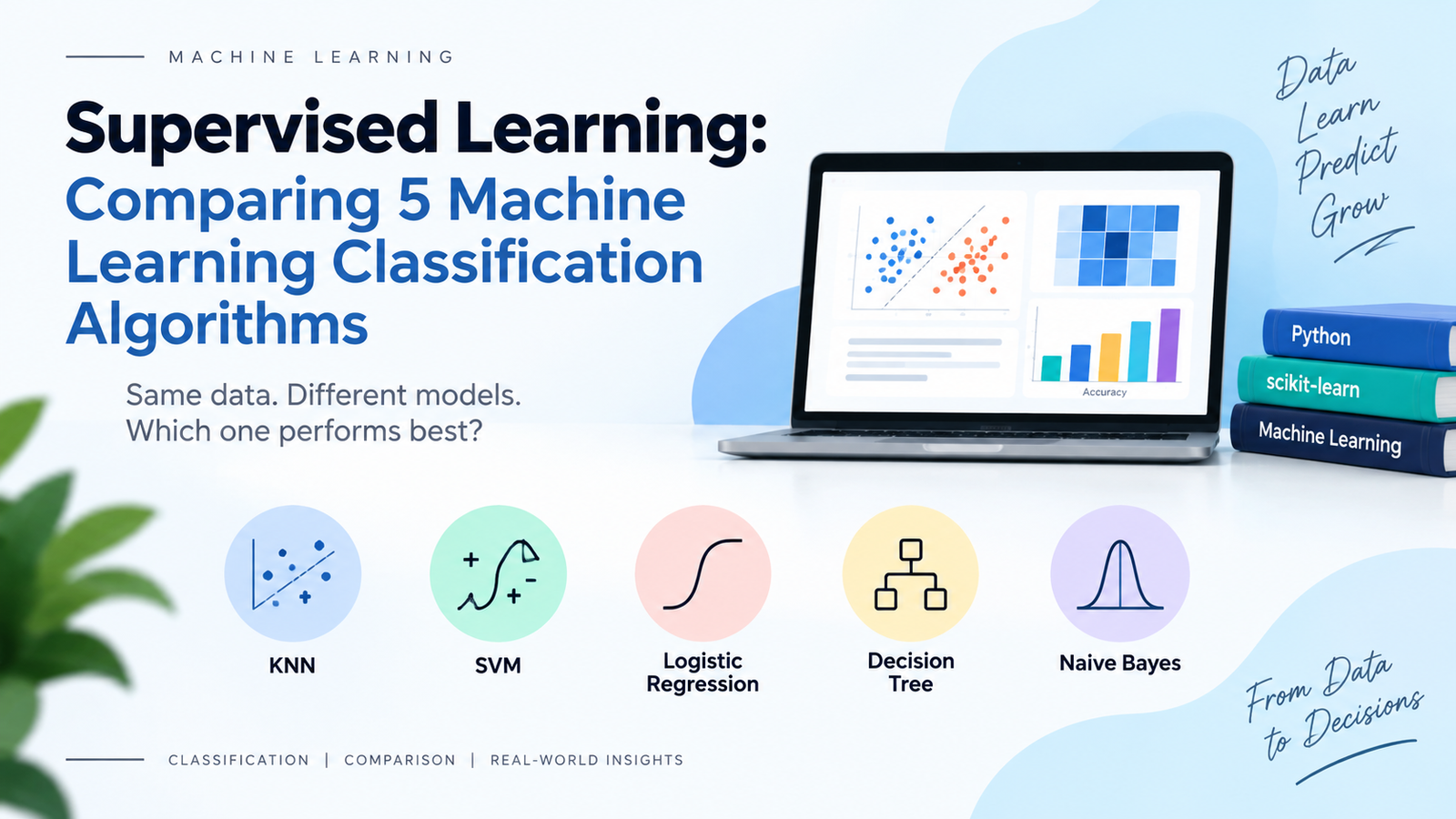
Supervised Learning: Comparing 5 Machine Learning Classification Algorithms
.
Introduction Supervised Learning is one of the most widely used approaches in machine learning for solving classification and prediction problems. In…
-
REST API with Node.js: Building a Secure Task Management API
.
REST API with Node.js: Building a Secure Task Management API As part of my internship at Valentius Kryptix, I worked on…
Leave a Reply
You must be logged in to post a comment.