

Introduction
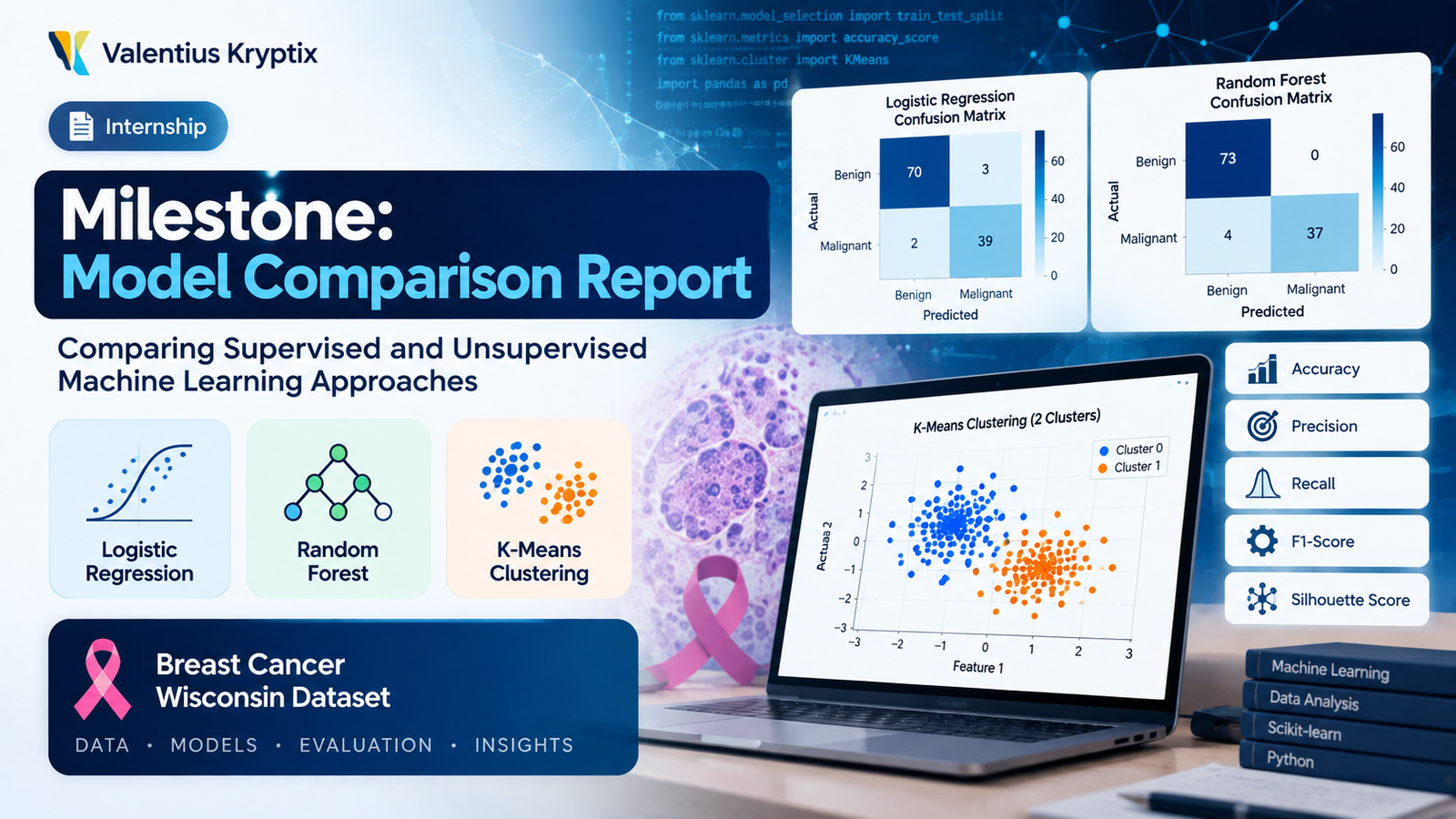
Machine learning provides a wide range of algorithms that can be used to solve prediction and classification problems. However, choosing the right model is an important part of a machine learning project because different models can produce different results depending on the dataset and problem. As part of my internship at Valentius Kryptix, I worked on a Model Comparison Report to understand how different machine learning models perform and how their results can be evaluated.
The main objective of this project was to build and compare multiple machine learning models using Python and standard machine learning techniques. Instead of relying on a single algorithm, I compared different approaches and evaluated their performance using appropriate metrics.
Project Objective
The primary goal of the Model Comparison Report was to understand the differences between machine learning models and identify how their performance changes when applied to the same dataset.
The project involved several important stages, including data preparation, model training, prediction, evaluation, and comparison. These steps helped me understand the complete machine learning workflow rather than focusing only on model training.
Data Preparation
Before training the models, the dataset needed to be prepared properly. Data preprocessing is an important step because the quality and structure of the data can directly affect machine learning performance.
The data was inspected to understand its features and target variable. Where necessary, the data was cleaned and transformed into a suitable format for machine learning algorithms. The dataset was then divided into training and testing portions so that the trained models could be evaluated on data that they had not previously seen.
Model Training and Comparison
After preparing the data, different machine learning models were trained using Python. The purpose of using multiple models was to compare their behavior and performance under the same conditions.
For each model, predictions were generated using the test dataset. These predictions were then evaluated using suitable performance metrics.
Some of the important techniques used during the project included:
- Data preprocessing
- Train-test splitting
- Machine learning model training
- Prediction generation
- Performance evaluation
- Model comparison
- Result analysis
Comparing models helped provide a clearer understanding of how different algorithms can behave differently on the same problem.
Performance Evaluation
Model evaluation is an important part of machine learning because simply training a model does not tell us how well it performs.
Depending on the type of problem, different evaluation metrics can be used. For classification problems, metrics such as accuracy, precision, recall, and F1-score can provide useful information about model performance.
For regression problems, metrics such as Mean Absolute Error (MAE), Mean Squared Error (MSE), and Root Mean Squared Error (RMSE) can be used.
In this project, the model results were compared using relevant evaluation techniques so that the strengths and differences between the models could be understood more clearly.
Key Learning
One of the most important things I learned from this project is that there is not always a single machine learning algorithm that works best for every dataset. Model performance depends on many factors, including the characteristics of the data, preprocessing techniques, selected features, and evaluation method.
I also learned that model comparison is useful because it provides a more complete view of a machine learning problem. Instead of selecting a model without testing alternatives, comparing several approaches allows us to understand their performance and limitations.
Another important learning was the importance of using proper evaluation metrics. Different metrics measure different aspects of performance, so selecting an appropriate metric is essential when analyzing machine learning results.
Conclusion
The Model Comparison Report was a valuable practical exercise that helped me understand the machine learning workflow from data preparation to model evaluation. Working with multiple models provided practical experience in training, testing, and comparing machine learning algorithms.
This project also strengthened my understanding of Python-based machine learning and showed me how systematic evaluation can be used to analyze model performance.
I am grateful to Valentius Kryptix for providing this internship opportunity and allowing me to work on practical machine learning projects. I look forward to applying these concepts to more projects and continuing to improve my skills in Python, Data Science, and Machine Learning.
Suggested tags
PythonMachine LearningData ScienceModel ComparisonArtificial IntelligenceInternship

Leave a Reply
You must be logged in to post a comment.