


Introduction
Machine Learning is an important part of modern technology. Businesses use machine learning algorithms to predict sales, identify customer behaviour, detect fraud, and make data-driven decisions. Among the most widely used supervised machine learning algorithms are Linear Regression and Logistic Regression.
Although their names are similar, they solve different types of problems. Linear Regression is mainly used to predict continuous numerical values, whereas Logistic Regression is used to predict the probability of a categorical outcome.
In this article, we will understand how both algorithms work, their mathematical concepts, practical applications, advantages, and differences.
1. What is Linear Regression?
Linear Regression is a supervised machine learning algorithm used to predict a continuous numerical value based on one or more independent variables.
It works by identifying a linear relationship between input features and the target variable.
For example, imagine an e-commerce company wants to predict its monthly sales based on advertising expenditure. By analysing historical data, a Linear Regression model can learn how advertising spending relates to sales and estimate future revenue.

Mathematical Formula
The simple Linear Regression equation is:
Y = mX + C
Where:
- Y = Predicted output
- X = Independent variable
- m = Slope or coefficient
- C = Intercept
For multiple independent variables, the equation becomes:
Y = β₀ + β₁X₁ + β₂X₂ + … + βₙXₙ
The algorithm estimates the coefficients by minimizing the sum of squared differences between actual and predicted values, known as the Residual Sum of Squares (RSS).
Example of Linear Regression
Suppose we have the following dataset:
| Advertising Spend (₹) | Sales (₹) |
|---|---|
| 1,000 | 5,000 |
| 2,000 | 8,000 |
| 3,000 | 11,000 |
| 4,000 | 14,000 |
The model learns the relationship between advertising expenditure and sales.
If the company spends ₹5,000 on advertising, the trained model can estimate the expected sales based on the learned relationship.

Applications of Linear Regression
- Sales and revenue forecasting
- House price prediction
- Demand forecasting
- Salary prediction
- Estimating business performance
2. What is Logistic Regression?
Logistic Regression is a supervised machine learning algorithm used for classification problems. Unlike Linear Regression, which predicts numerical values, Logistic Regression estimates the probability that an observation belongs to a particular category.
For example, a bank may want to predict whether a transaction is fraudulent or legitimate. Logistic Regression can analyse transaction features and estimate the probability of fraud.
How Does Logistic Regression Work?
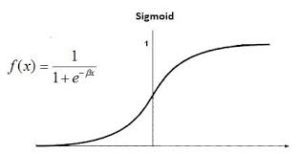
Logistic Regression first calculates a linear combination of input features. It then passes that value through a mathematical function called the Sigmoid Function.
The sigmoid function converts the output into a probability between 0 and 1.
Mathematical Formula
P = 1 / (1 + e⁻ᶻ)
Where:
- P = Predicted probability
- e = Euler’s number
- z = Linear combination of input features
A classification threshold is then applied to the predicted probability.
For example, with a threshold of 0.5:
- Probability greater than or equal to 0.5 → Class 1
- Probability below 0.5 → Class 0
The threshold can be adjusted depending on the business problem and the cost of different types of prediction errors.
Example of Logistic Regression
Consider a bank analysing customer transactions.
| Transaction Amount | Fraud |
|---|---|
| ₹500 | No |
| ₹1,000 | No |
| ₹15,000 | Yes |
| ₹20,000 | Yes |
A Logistic Regression model can learn patterns from historical transaction data and estimate the probability that a new transaction is fraudulent.
However, transaction amount alone may not be sufficient. Real fraud detection systems may also consider transaction frequency, device information, location, and other relevant features.
Applications of Logistic Regression
- Fraud detection
- Customer churn prediction
- Email spam classification
- Loan approval prediction
- Medical diagnosis classification
3. Difference Between Linear and Logistic Regression
Although both algorithms belong to the family of linear models, their purposes are different.
| Comparison | Linear Regression | Logistic Regression |
|---|---|---|
| Main purpose | Regression | Classification |
| Output | Continuous numerical value | Probability and class |
| Target variable | Numerical | Categorical |
| Function | Linear equation | Sigmoid / logistic function |
| Example | Predicting sales | Predicting fraud |
| Common evaluation metrics | MAE, MSE, RMSE, R² | Accuracy, Precision, Recall, F1-score, ROC-AUC |
The most important difference is the type of problem they solve. Before selecting an algorithm, we should understand the target variable and the business objective.
4. Advantages and Limitations
Advantages of Linear Regression
- Simple and easy to understand.
- Computationally efficient.
- Coefficients help explain relationships between features and predictions.
- Provides a useful baseline for regression problems.
Limitations of Linear Regression
- Assumes a linear relationship between predictors and the expected target.
- Sensitive to outliers.
- Multicollinearity can make coefficient estimates unstable.
- May not perform well when the underlying relationship is highly nonlinear.
Advantages of Logistic Regression
- Simple and computationally efficient.
- Produces probability estimates.
- Coefficients can help explain how features relate to the predicted odds.
- Useful as a baseline classification model.
Limitations of Logistic Regression
- Assumes a linear relationship between features and the log-odds of the outcome.
- May struggle with complex nonlinear patterns without suitable feature engineering.
- Can be affected by multicollinearity and outliers.
- Its performance depends on appropriate feature selection and data preparation.
5. Implementing Both Algorithms Using Python
Python provides the Scikit-learn library, which makes implementing machine learning algorithms straightforward.
Linear Regression:
from sklearn.linear_model import LinearRegression

model = LinearRegression()

model.fit(X_train, y_train)

predictions = model.predict(X_test)
Logistic Regression:
from sklearn.linear_model import LogisticRegression

model = LogisticRegression(max_iter=1000)

model.fit(X_train, y_train)

predictions = model.predict(X_test)
probabilities = model.predict_proba(X_test)
Here, X_train and y_train represent the training features and target values, while X_test contains the data used for evaluation.
In a real machine learning workflow, data cleaning, encoding categorical variables, handling missing values, appropriate feature scaling, and model evaluation should also be considered.
6. Conclusion
Linear Regression and Logistic Regression are two fundamental algorithms in supervised machine learning. Both are useful for solving real-world business problems, but their applications depend on the type of target variable.
Linear Regression is suitable when the goal is to predict a continuous numerical value, such as sales, revenue, or house prices. Logistic Regression is suitable when the objective is to classify observations into categories, such as fraudulent or legitimate transactions.
Understanding these algorithms provides a strong foundation for learning more advanced machine learning techniques. By practising them on real-world datasets, beginners can develop practical machine learning skills and learn how data can support better business decisions.
References and Further Reading
- Scikit-learn: Linear Models – https://scikit-learn.org/stable/modules/linear_model.html
- Scikit-learn: Linear Regression – https://scikit-learn.org/stable/modules/generated/sklearn.linear_model.LinearRegression.html
- Scikit-learn: Logistic Regression – https://scikit-learn.org/stable/modules/generated/sklearn.linear_model.LogisticRegression.html




Leave a Reply
You must be logged in to post a comment.