

Introduction:
As part of my Generative AI Internship at Valentius Kryptix, I had the opportunity to explore Retrieval-Augmented Generation (RAG) and build a practical document intelligence application called DataSync AI. This project helped me understand how Large Language Models can be combined with external knowledge sources to generate more relevant and context-aware responses.
Large Language Models (LLMs) have become powerful tools for understanding and generating natural language. However, when users ask questions about specific documents, company policies, or private knowledge, relying only on the model’s existing knowledge may not be sufficient.
This is where Retrieval-Augmented Generation (RAG) becomes useful.
RAG combines information retrieval with language generation. Instead of asking an LLM to answer a question using only its internal knowledge, a RAG system first searches a relevant knowledge source, retrieves useful information, and then provides that information to the LLM as context.
For my project, I applied this approach to build DataSync AI, a RAG-based Document Intelligence System designed to answer questions based on the contents of a policy handbook.
What is Retrieval-Augmented Generation?
Retrieval-Augmented Generation(RAG) is an architecture that connects an external knowledge source with a Large Language Model.
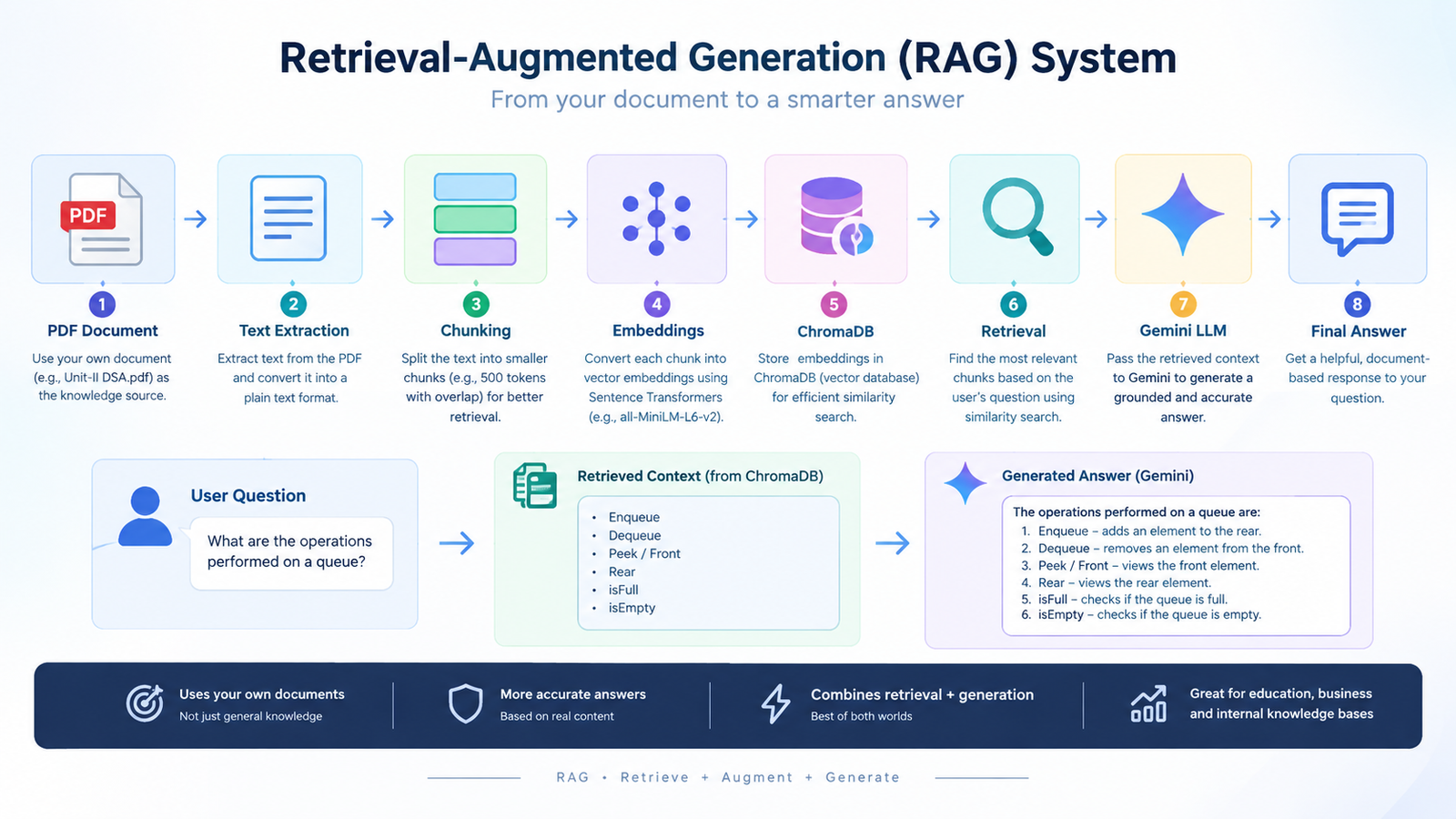
A typical RAG workflow can be represented as:
Document → Chunking → Embeddings → Vector Database → Retrieval → Context → LLM → Answer
The main advantage of this approach is that the model can use information from a specific document or knowledge base while generating its response.
This makes RAG particularly useful for applications such as document assistants, enterprise knowledge systems, customer support, research assistants, and internal information retrieval.
Introducing DataSync AI:
DataSync AI is the RAG-based Document Intelligence System I developed as part of my internship task.
The system uses a policy handbook as its knowledge source. Users can ask questions about the handbook, and the application retrieves the relevant information before generating an answer.
For example, a user can ask:
“How many days can employees work remotely?”
Instead of generating an answer based only on general knowledge, DataSync AI retrieves the relevant section from the handbook and uses that information to generate the response.
The interface also indicates that the answer is based on retrieved handbook content, making the response grounded in the source document.
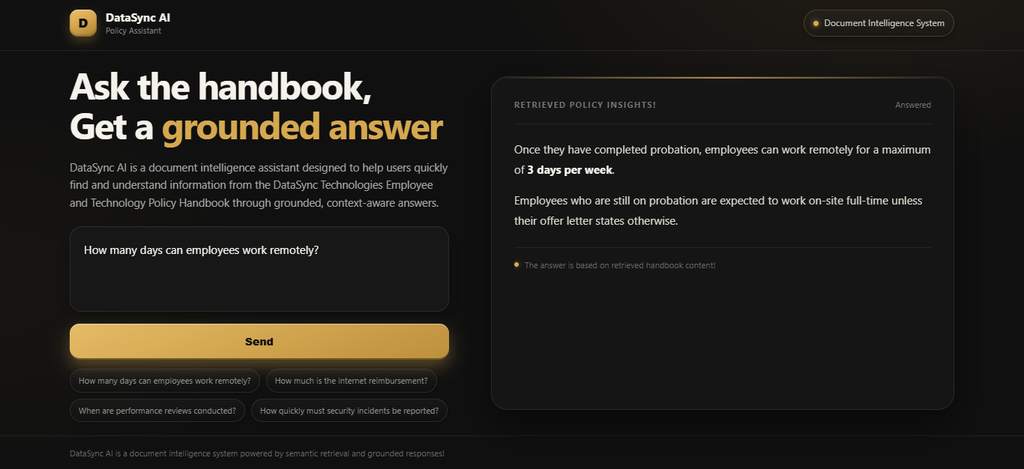
DataSync AI answering a user query using retrieved handbook content.
How the DataSync AI RAG Pipeline Works:

1. Document Ingestion:
The process begins with a policy handbook that acts as the knowledge source.
The document is loaded into the system so that its content can be processed and prepared for retrieval.
2. Text Chunking:
Large documents are not directly passed to the language model as one complete block.
Instead, the document is divided into smaller text chunks. This makes it easier for the retrieval system to identify the specific information relevant to a user’s question.
The chunks are created with appropriate size and overlap so that important information is not unnecessarily separated.
3. Creating Embeddings:
After chunking, the text is converted into embeddings.
An embedding is a numerical representation of text that captures its semantic meaning. This allows the system to compare the meaning of a user’s question with the meaning of the stored document content.
For DataSync AI, embeddings are used to support semantic retrieval rather than relying only on exact keyword matching.
4. Storing Information in ChromaDB:
The generated embeddings, along with their corresponding text chunks, are stored in ChromaDB, a vector database.
ChromaDB allows the application to perform similarity searches and identify the document chunks that are most relevant to a user’s question.
5. Processing the User Query:
When a user submits a question, the query is also converted into an embedding.
The system then compares the query representation with the stored document embeddings to determine which sections of the handbook are most relevant.
6. Retrieving Relevant Context:
The most relevant chunks are retrieved from the vector database.
These retrieved sections provide the context required by the language model to answer the user’s question.
This retrieval step is one of the most important parts of a RAG system because the quality and relevance of the retrieved information directly influence the generated response.
7. Generating a Grounded Response:
The retrieved context is combined with the user’s question and provided to the Google Gemini language model.
Gemini then generates the final response using the retrieved information as context.
The objective is to produce an answer that is grounded in the actual content of the document rather than relying solely on the model’s general knowledge.
Technologies Used:
The DataSync AI project provided hands-on experience with several important technologies and concepts used in modern Generative AI applications:
- Python – Application development and processing
- Google Gemini – Large Language Model and generation
- ChromaDB – Vector database for storing and retrieving embeddings
- Embeddings – Semantic representation of document and query text
- Vector Search – Finding relevant information based on semantic similarity
- Document Processing – Preparing source documents for retrieval
- Prompt Engineering – Structuring instructions and context for the LLM
These components work together to create the complete RAG pipeline, from document ingestion to the final generated response.
Key Learning from the Project:
Building DataSync AI helped me understand that developing a Generative AI application involves much more than simply connecting an application to an LLM API.
I gained practical understanding of how documents can be prepared for AI applications, why chunking is important, how embeddings represent semantic meaning, and how vector databases enable efficient information retrieval.
I also learned the importance of grounding an LLM response with relevant context. Even when a language model is capable of generating fluent responses, providing the right source information is essential when building applications that need to work with specific knowledge.
Most importantly, this project helped me connect individual concepts such as embeddings, vector databases, retrieval, prompting, and LLMs into one complete working workflow.
Real-World Applications of RAG:
RAG can be applied to many real-world scenarios where users need to interact with a specific knowledge base.
Some examples include:
- Enterprise knowledge assistants for internal company information
- Policy and document assistants for quickly finding information
- Customer support systems using product documentation
- Research assistants working with collections of documents
- Educational assistants based on course materials
- Technical support systems using manuals and documentation
The ability to connect an LLM with an organization’s own knowledge makes RAG a valuable architecture for building practical Generative AI applications.
Conclusion:
The DataSync AI project was an important milestone in my Generative AI learning journey. It gave me practical experience in building a complete Retrieval-Augmented Generation workflow and helped me understand how document processing, embeddings, vector search, retrieval, prompting, and LLM generation work together.
Rather than relying only on the model’s existing knowledge, DataSync AI retrieves relevant information from a specific document and uses that context to generate a grounded response.
Through this project, I gained a stronger foundation in RAG architecture and a better understanding of how Generative AI can be used to build practical, knowledge-driven applications.
This experience has motivated me to continue exploring advanced Generative AI concepts and building practical AI solutions that address real-world problems!

Leave a Reply
You must be logged in to post a comment.