
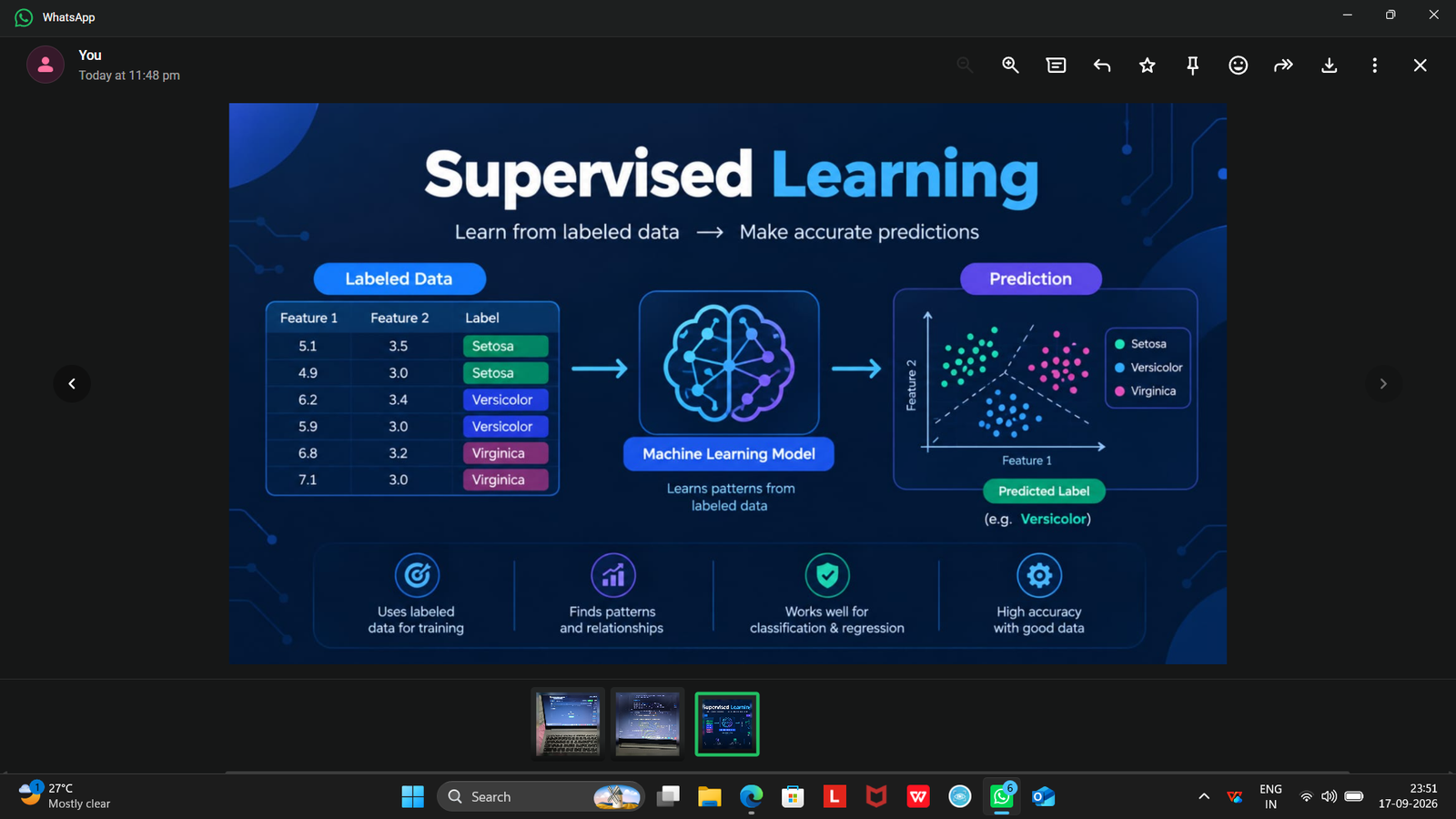

Machine learning is one of the most important areas of modern artificial intelligence (AI). It allows computers to learn patterns from data and make predictions or decisions without being explicitly programmed for every possible situation. One of the most widely used approaches in machine learning is supervised learning.
Supervised learning is a technique where a machine learning model learns from a dataset containing both input data and the correct output (label). The model studies the relationship between the inputs and outputs and then uses what it has learned to make predictions on new, unseen data.
For example, imagine a dataset containing information about houses, such as their location, size, number of bedrooms, and age. If the selling price of each house is also provided, a supervised learning algorithm can learn the relationship between these features and the price. After training, the model can predict the price of a new house.
How Does Supervised Learning Work?
The supervised learning process generally involves several steps.
Testing and Evaluation
After training, the model should be evaluated using data that it has not seen during training. This helps determine whether the model can generalize to new examples.
Common evaluation metrics include accuracy, precision, recall, F1-score, and mean squared error, depending on the type of problem.
Types of Supervised Learning
Supervised learning is mainly divided into two categories: classification and regression.
Classification
Classification is used when the output belongs to a category or class.
For example:
Detecting spam or legitimate emails
Predicting whether a customer will leave a service
Identifying whether an image contains a particular object
Classifying a transaction as potentially fraudulent or legitimate
The model learns from examples with known categories and predicts the appropriate category for new data.
Regression
Regression is used when the output is a numerical value.
Examples include:
Predicting house prices
Estimating sales revenue
Predicting temperature
Forecasting product demand
For instance, a regression model can learn from historical house data and estimate the expected price of a house based on its features.
Real-World Applications
Supervised learning is used across many industries. In healthcare, machine learning models can assist with analyzing medical data and identifying patterns. In finance, supervised learning can be used for fraud detection and credit-risk analysis. In e-commerce, companies can use predictive models to understand customer behavior and improve recommendations.
Supervised learning is also widely used in natural language processing, image recognition, marketing, cybersecurity, and business ana…
Collecting Data
The first step is collecting a suitable dataset. The dataset should contain useful input features and their corresponding correct outputs.
For example, to predict whether an email is spam, the dataset might contain emails as inputs and labels such as “Spam” or “Not Spam” as outputs.
Preparing the Data
Raw data often needs to be cleaned and prepared before it can be used. This may include handling missing values, removing duplicate records, converting text or categories into numerical values, and scaling numerical features when necessary.
Good-quality data is important because the performance of a machine learning model depends heavily on the quality and relevance of its training data.
Training the Model
The prepared dataset is given to a machine learning algorithm. During training, the algorithm identifies patterns and relationships between the input features and known outputs.
Common supervised learning algorithms include:
Linear Regression
Logistic Regression
Decision Trees
Random Forest
Support Vector Machines (SVM)
K-Nearest Neighbors (KNN)
Neural Networks



Leave a Reply
You must be logged in to post a comment.