

Introduction
Artificial Intelligence is becoming increasingly useful for searching, understanding, and working with large amounts of information. However, traditional AI chatbots may sometimes provide incorrect or generalized answers because they do not have direct access to a user’s specific documents. To solve this problem, I worked on a Retrieval-Augmented Generation (RAG)-Powered AI App, which combines document retrieval with a Large Language Model (LLM) to provide answers based on the information contained in uploaded documents.
This project represents an important milestone in my learning journey because it helped me understand how modern AI applications can connect language models with external knowledge sources.
What is RAG?
RAG stands for Retrieval-Augmented Generation. Instead of asking an AI model to answer a question only from its previously learned knowledge, a RAG system first searches a collection of relevant documents and retrieves useful information. That information is then provided to the language model as context for generating the final response.
A simple RAG workflow can be represented as:
Documents → Processing → Embeddings/Knowledge Base → Retrieval → LLM → Answer
This approach makes an AI application more useful for domain-specific information because the model can refer to the provided documents while answering questions.
Building the RAG-Powered AI App
The main goal of my application was to create a system that could work with documents and answer questions about their contents. The project included several important stages.
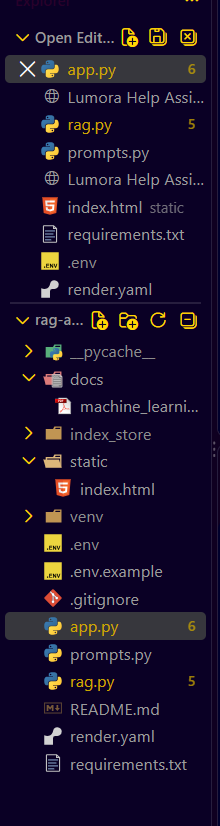
First, documents were collected and placed into the application’s document directory. These documents then needed to be processed so that their information could be used by the retrieval system.
The next step was document ingestion. During ingestion, the application processes the documents and prepares their content for retrieval. This creates the foundation for searching relevant information when a user asks a question.
After that, the application can receive a user’s question and identify information that is relevant to the query. The retrieved context is then passed to the language model, which generates a natural-language answer.
One of the most useful parts of the project was testing the system with questions based on the available documents. For example, I tested the application with a question such as “What is the secret code word?” and verified that the system could use the available context to generate an answer.
Technologies and Tools
The project introduced me to several technologies and concepts used in modern AI applications. These include:
- Python for application development
- Large Language Models (LLMs)
- Retrieval-Augmented Generation (RAG)
- Document processing and ingestion
- Vector-based information retrieval
- Ollama for running a local language model
- VS Code for development and testing
- Virtual environments for managing Python dependencies
Working with these technologies helped me understand that an AI application is not only about the language model itself. The surrounding pipeline—including document processing, retrieval, prompting, and application logic—is equally important.
Challenges I Faced
Developing the RAG application also involved several challenges. Setting up the development environment and installing the required tools was one of the initial difficulties. I also had to understand how documents are processed before they can be searched effectively.
Another challenge was understanding how retrieval and generation work together. A language model may produce an answer, but the quality of that answer depends heavily on the context supplied to it. This made testing and debugging an important part of the project.
Setting up Ollama and verifying that the local model was working was another important step. Once the environment was configured correctly, I was able to test questions through the application and observe the generated responses.
What I Learned
This project gave me practical experience with the architecture behind AI-powered question-answering systems. I learned how documents can be transformed into useful knowledge for an AI application and how retrieval can provide additional context to a language model.
I also learned the importance of testing an AI system with different questions rather than assuming that a successful installation means the application is complete. Testing helps identify problems in document ingestion, retrieval, prompts, and generated responses.
Most importantly, this milestone helped me move from simply using AI tools to understanding how an AI application can actually be designed and developed.
Future Improvements
There are several improvements that can be made to the application in the future. The system could support more document formats, provide a web-based interface, improve document search, and display the sources used to generate an answer.
Other possible improvements include adding conversation history, authentication, better error handling, document management, and a more advanced vector database. These features could make the application more practical for students, researchers, and organizations that need to interact with large collections of documents.
Conclusion
The RAG-Powered AI App is an important milestone in my exploration of Artificial Intelligence and Large Language Models. The project helped me understand how retrieval, documents, local models, and generation can work together to create a more useful AI system.
Rather than treating an AI model as an isolated chatbot, this project demonstrated how an application can provide the model with relevant external knowledge and use that information to answer user questions.
This experience has strengthened my understanding of AI application development and given me a foundation for exploring more advanced projects involving RAG, LLMs, intelligent assistants, and domain-specific AI systems.
screenshots from my actual project,

Leave a Reply
You must be logged in to post a comment.