
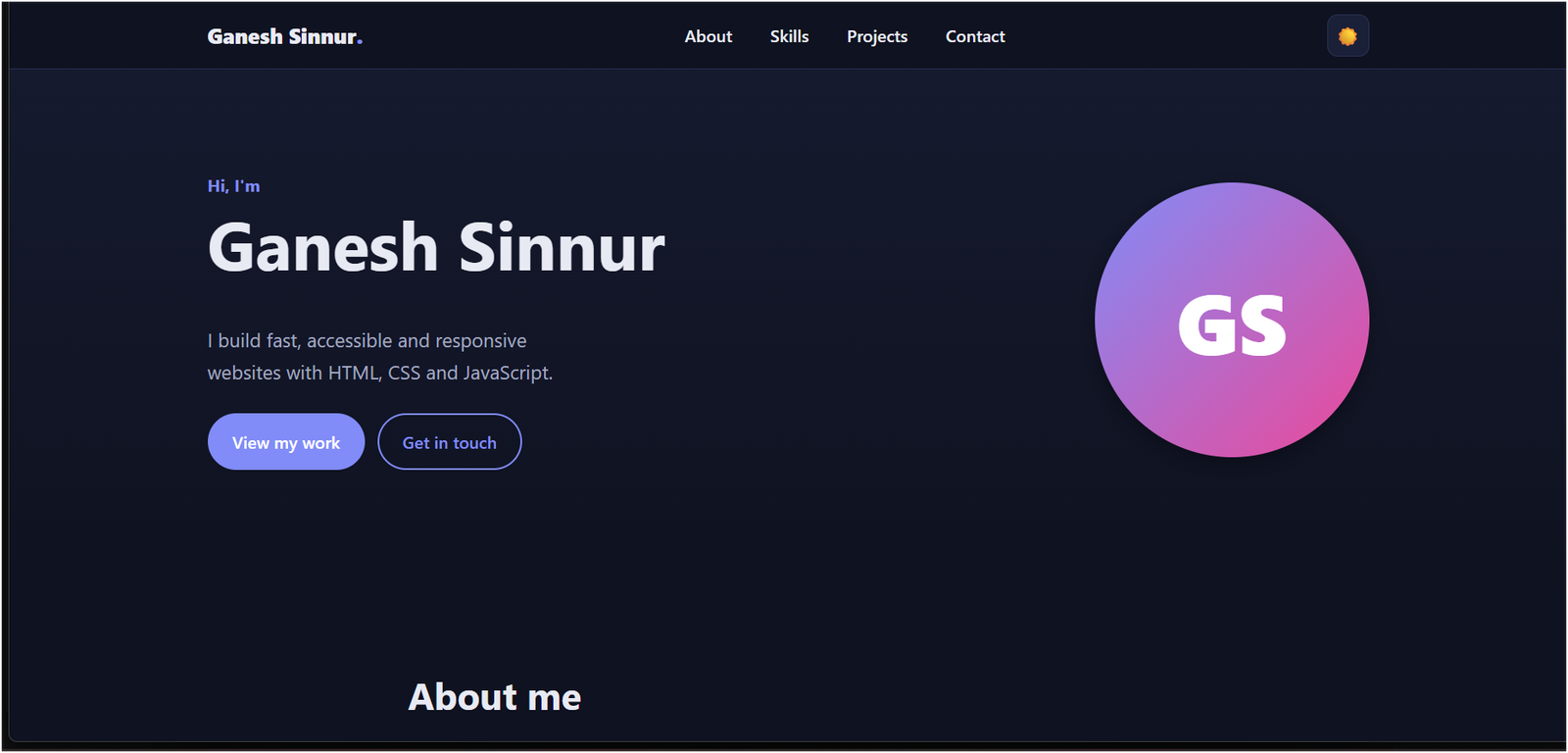

A portfolio website is one of the most important tools for a developer who wants to showcase skills, projects, experience, and achievements in a professional way. As part of my current task, I worked on creating a Portfolio Website that presents my technical skills and projects in a clean, modern, and user-friendly format.
The main goal of this project was to build a personal website that can act as a digital representation of my professional profile. Instead of depending only on a resume, the portfolio provides visitors with a visual way to understand my technical background, projects, skills, and development journey.
Project Objective
The primary objective of the Portfolio Website was to create a professional online presence that can be shared with recruiters, companies, clients, and other developers. A good portfolio should quickly communicate who the developer is, what technologies they work with, and what type of projects they have completed.
The website was designed with simplicity and usability in mind. Important information is organized into separate sections so visitors can easily navigate through the portfolio and find the information they need.
Key Sections
The portfolio includes important sections such as an introduction, about section, technical skills, projects, and contact information. The introduction gives visitors a quick overview of the developer, while the About section provides more information about the background and interests.
The Skills section highlights technologies and programming languages that are part of my development journey. These include technologies such as Java, Python, JavaScript, HTML, CSS, React, Node.js, MongoDB, MySQL, and Spring Boot.
The Projects section is especially important because it demonstrates practical development experience. Instead of simply listing technologies, projects show how those technologies can be used to solve real-world problems.
Project Showcase
One of the main purposes of the website is to showcase projects in an understandable format. Each project can contain information about its purpose, technologies used, important features, and implementation.
Projects such as web applications, resume analysis applications, attendance systems, and other software development work can be presented through this section. This gives recruiters a better understanding of practical programming and development experience.
A portfolio is also useful because it provides an opportunity to demonstrate work beyond what can normally fit into a traditional resume. Screenshots, project links, GitHub repositories, and descriptions can help provide additional context.
Design and User Experience
While developing the portfolio, attention was given to creating a clean and professional interface. The website should not overwhelm visitors with unnecessary information. Instead, the most important information should be easy to identify.
Navigation is another important part of the design. Users should be able to move between sections without confusion. Responsive design is also important because recruiters and visitors may access the portfolio from laptops, tablets, or mobile phones.
The visual design, spacing, typography, buttons, cards, and section structure were arranged to provide a consistent experience throughout the website.
Technologies and Development
The project provided practical experience with frontend development concepts such as component-based design, responsive layouts, navigation, styling, and organizing reusable sections.
Depending on the implementation, modern technologies such as React and JavaScript can be used to create interactive components, while HTML and CSS provide the structure and visual presentation. The project also provides an opportunity to understand how frontend applications can communicate with backend services when dynamic data or contact functionality is required.
Working on the portfolio helped reinforce an important development principle: a project should not only work correctly but should also be easy for users to understand and use.
What I Learned
One of the biggest lessons from this project was the importance of presenting technical work professionally. Building a project and explaining a project are two different skills. A portfolio connects these two areas by allowing developers to demonstrate both their technical ability and their communication skills.
I also gained experience in organizing project information, improving user interface presentation, thinking about responsive design, and creating a consistent visual identity.
Another important lesson was that a portfolio should continuously evolve. As new projects and technologies are learned, the website can be updated to reflect the latest skills and achievements.
Conclusion
The Portfolio Website is more than just a personal webpage. It acts as a central place where my technical journey, projects, skills, and development experience can be presented to others.
Creating this project gave me an opportunity to combine programming, design, and professional presentation skills. It also helped me understand how an online portfolio can support career development by giving recruiters and potential employers a direct view of practical work.
Going forward, I plan to continue improving the website by adding new projects, refining the user interface, improving responsiveness, and keeping the content updated as I learn new technologies.
Overall, this project was a valuable step in building a professional online presence and showcasing my growth as a software developer.

Leave a Reply
You must be logged in to post a comment.